
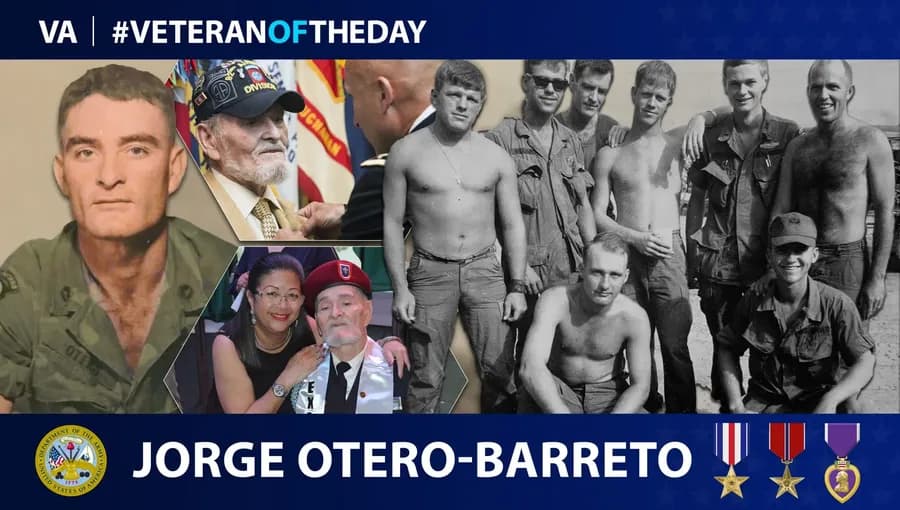
Honor Them While There Is Still Time
How Sergeant First Class Jorge Otero-Barreto’s Legacy Can Strengthen America’s Military Recognition Process
Last updated 03:39 AM EDT • Read time: 6m
Join the Conversation
0America should not have to race against time when an aging, seriously ill, or deceased veteran has a credible case for reconsideration of military recognition. The cases of Major James Capers Jr. and Sergeant First Class Jorge Otero-Barreto illuminate a larger challenge: when recognition requires decades of advocacy—or arrives after the warrior is gone—the system has waited too long.
In national security, we routinely talk about modernization, readiness, lethality, efficiency and the warrior ethos. Those principles matter because strong institutions must translate policy into outcomes. That standard should apply not only to how America prepares for its next war, but also to how it fulfills its obligations to those who fought its last ones.
Our advocacy involving Capers and Otero-Barreto raised a larger question: Why should America have to race against a veteran’s declining health—or death—to determine whether extraordinary battlefield valor was appropriately recognized decades earlier?
Otero-Barreto Should Have Had the Opportunity to See This Day
Otero-Barreto completed five combat tours in Vietnam, survived five combat wounds and accumulated 38 military decorations. On May 1, 1968, according to the historical case assembled on his behalf, enemy fire pinned down his platoon near Huế. Otero-Barreto crossed exposed terrain, assaulted an enemy machine-gun bunker and rallied his men to destroy additional fortified positions. He received his second Silver Star for the action.
Otero-Barreto died in October 2024. Whatever determination the government ultimately reaches concerning his Medal of Honor case, he will never stand at the White House with his family and fellow veterans to hear that decision himself. His family may. The Army may. The nation may. But the soldier cannot.
Working with the Otero-Barreto family, we helped build a broader effort to move his case through public, governmental and legislative channels. That effort contributed to H.R. 9595, legislation providing a vehicle to address the statutory time limitation affecting consideration of his case. The campaign has also assembled support from veterans organizations, retired military leaders and other advocates.
H.R. 9595 is an opportunity to move Otero-Barreto’s case forward on its merits. It can also become a catalyst for strengthening the process itself.
Capers Demonstrated the Cost of Waiting
We learned the same lesson through our advocacy for Major James Capers Jr. As that effort progressed, Capers’ health gave the campaign urgency.
Time is not an abstraction for aging veterans.
For an institution, another year can mean another review cycle. For an aging combat veteran, another year can mean the difference between personally receiving recognition and having it presented posthumously to a family.
The Capers effort demonstrated what sustained advocacy and congressional engagement can accomplish. It also raised an important policy question: Why should extraordinary cases depend upon extraordinary advocacy?
Congress will always retain an essential oversight role, and individual legislation may be necessary when statutory limitations or unusual historical circumstances require it. But individual legislation alone is not the most efficient long-term solution to a recurring institutional challenge.
From Individual Recognition to Lasting Reform
The standards for the Medal of Honor must remain extraordinarily high. The goal is not to lower the standard. It is to improve the process by which credible cases reach that standard.
H.R. 9595 demonstrates the importance of congressional authority in extraordinary cases. Rather than viewing individual legislation and process reform as competing approaches, Congress can use cases such as Otero-Barreto’s to identify where existing processes can become more responsive and efficient while preserving congressional oversight and the independence of the military awards process.
A proposed Special Military Honors Review Board offers one framework worthy of discussion. A standing mechanism could allow requests from Congress, military department leadership, veterans or next of kin, eligible veterans organizations and other authorized parties. It could review military records, witness testimony and historical evidence, while prioritizing elderly, terminally ill and deceased veterans and cases pending for years.
Such a system would not predetermine outcomes. It would establish responsibility, priorities, timelines and accountability.
Measure the System
A modern military-recognition process should also be measurable. Congress and defense leaders should be able to determine how many historical valor cases are awaiting review, how long they have been pending, where they stall and how many involve elderly or seriously ill veterans.
Modern technology can also reduce the time required to locate award recommendations, personnel records, unit histories, witness statements and operational documentation. Reporting on unresolved cases, process deficiencies and recommended improvements would create something particularly valuable: institutional learning.
Individual cases could then help improve the system for everyone who follows.
Recognition Is a National Security Issue
What do military decorations awarded decades after combat have to do with today’s national security? The answer is people.
America can purchase aircraft, ships, missiles, artificial intelligence, satellites and advanced weapons. It cannot purchase the warrior ethos. That must be built and maintained.
Today’s service members and tomorrow’s recruits pay attention to how the nation treats those who served before them. When extraordinary courage receives accurate, rigorous and timely consideration, the system reinforces service, sacrifice and institutional trust. When veterans and families spend decades reconstructing battlefield records and navigating complex processes, there are lessons to be learned about making those systems more responsive.
That matters for morale, military families, recruitment and retention. Recognition is part of the human infrastructure of national defense.
Let Otero-Barreto Be the Catalyst
H.R. 9595 is under review by the House Armed Services Committee and gives Congress an opportunity to accomplish something larger than considering one extraordinary soldier’s record.
First, allow Otero-Barreto’s case to be evaluated on its merits. Protect the extraordinarily high standards required for the Medal of Honor. Follow the evidence and preserve the integrity of the award.
Then learn from the journey that brought his case here.
Capers demonstrated why urgency matters. Otero-Barreto demonstrates what happens when time runs out before the warrior can witness the final outcome. Their experiences should not be viewed as an indictment of the institutions responsible for military recognition, but as an opportunity to strengthen them.
H.R. 9595 can be an important next step. Otero-Barreto’s legacy can also become a catalyst for a system that identifies credible cases earlier, preserves records, uses modern technology, establishes measurable timelines, prioritizes aging and seriously ill veterans, provides greater transparency to families and continuously learns.
The goal is not more medals.
The goal is the right recognition, for the right service member, through the right process, while there is still time.
That is responsible reform. That is stewardship of taxpayer resources. That strengthens institutional trust, the warrior ethos and national security.
Jeffrey Rosales is a Marine Corps combat veteran, veterans advocate and CEO of XODUS, LLC, a consulting firm focused on strategy, industry, integrity and impact.
Arnaldo Claudio is a retired U.S. Army Colonel and senior security and Veterans Affairs consultant. During a 30-year military career, his assignments included service as Chief of Staff/Chief of Police for Joint Force Headquarters–National Capital Region, XVIII Airborne Corps and Multinational Coalition Forces Provost Marshal in Iraq. He later served as Federal Police Monitor overseeing court-ordered reforms of the Puerto Rico Police Department.
The views expressed are those of the authors and do not represent those of the U.S. Army, the Department of War, or any other part of the U.S. government.

The Services Do Not Need a Four-Star Autonomous Warfare Command
By Steven Wills • RealClearDefense
Honor Them While There Is Still Time
By Jeffrey Rosales • RealClearDefense
From Siberia to Fairford: How Operation Spider’s Web Has Changed the Rules of Airpower
By Frank A. Rose • RealClearDefense
Faster Simulations, Better Defense Decisions
By Rut Lineswala • RealClearDefense
Will HASC Have an Oversight Subcommittee in the Next Congress?
By Christopher J. Bright • RealClearDefense
Hegseth Barred Trans Troops. Military Boards Are Rejecting Those Orders.
By NYT
Closing the Sea: Lessons from Ancient Mediterranean Blockades
By DeCasien, CIMSECFrom Siberia to Fairford: How Operation Spider’s Web Has Changed the Rules of Airpower
By Frank A. Rose • RealClearDefenseFaster Simulations, Better Defense Decisions
By Rut Lineswala • RealClearDefense
Bombers Could Have a Major Air-to-Air Combat Role
By Joseph Trevithick, The WarZone