
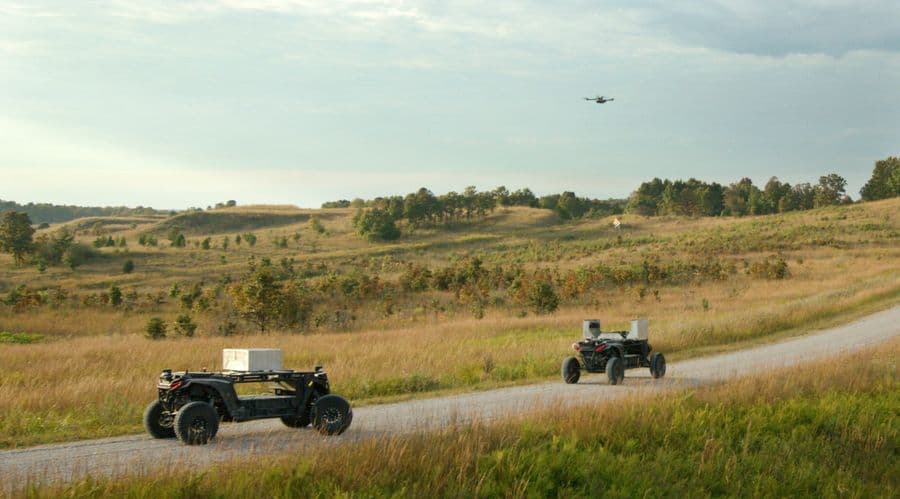
The Services Do Not Need a Four-Star Autonomous Warfare Command
Last updated 03:48 AM EDT • Read time: 5m
Retired Marine Corps Reserve General Arnold Punaro recently advocated creating a four-star autonomous warfare command, drawing parallels to the establishment of U.S. Special Operations Command after the failed 1980 Iranian hostage rescue mission, Operation Eagle Claw, and to the Goldwater-Nichols Act of 1986. Those analogies are unpersuasive.
A joint command responsible for developing—and potentially employing—unmanned weapons would centralize functions best left to the services. Joint command at the operational level of war, a creation in part of the Goldwater Nichols legislation, is regarded as a major enabling factor of U.S. military combat success in t since 1990. Yet advocates of the law, including Punaro’s former colleague Jim Locher, have concluded that some of its joint administrative structures have not worked nearly as well.
The interwar development of combat aviation offers a more relevant precedent: allowing the Army and Navy to pursue distinct operational requirements, and produce capabilities suited to each service. A centralized approach risks a one-size-fits-all, lowest-bid solution that would ill serve the nation in war.
Several historical examples point to the likely problems of establishing a four-star command for autonomous systems.
U.S. Special Operations Command arose from documented failures in the command and control of service special operations forces—including Navy SEALs and Army Green Berets—that contributed to the failure of Operation Eagle Claw on April 24–25, 1980. The mission combined special operations and conventional forces in an attempt to rescue Americans held at the U.S. Embassy in Tehran. The official investigation, led by former Chief of Naval Operations Admiral James Holloway, specifically recommended a joint command structure for special operations forces:
“A Counterterrorist Joint Task Force (CTJTF) be established as a field agency of the Joint Chiefs of Staff with permanently assigned staff personnel and certain assigned forces.
The Joint Chiefs of Staff give careful consideration to the establishment of a Special Operations Advisory Panel, comprised of a group of carefully selected high-ranking officers (active and/or retired) who have career backgrounds in special operations or who have served at the CINC or JCS levels and who have maintained a current interest in special operations or defense policy matters.”
No comparable operational failure involving unmanned systems has created a compelling need for an entirely new joint command. Moreover, unmanned and autonomous forces are more closely integrated with conventional operations than special operations forces historically were. Predator and Reaper aircraft during the war on terrorism were often employed in small detachments or alongside manned special operations forces, but current plans envision unmanned systems as a far larger share of the conventional force.
The Navy, for example, expects unmanned aircraft eventually to comprise as much as 60 percent of a carrier air wing. The service that will organize, train, equip, and employ those forces in combat should retain primary responsibility for their development and procurement.
The development of military aviation provides a more instructive precedent for autonomous systems.
In the early twentieth century, advocates such as Brigadier General William “Billy” Mitchell sought an independent air service that would develop aviation separately from the Army and Navy. Successive presidents and Congresses instead allowed the services to integrate aircraft according to their own operational needs. Britain chose the opposite course, placing all military aviation—including aircraft assigned to the Royal Navy’s emerging carrier fleet—under the new Royal Air Force. That decision severely constrained British naval aviation, while the RAF emphasized strategic bombing at the expense of fighter, light-attack, and carrier aircraft. Control of the Fleet Air Arm returned to the Royal Navy only shortly before the outbreak of war in 1939, too late to erase the effects of two decades of divided authority.
The American service-led approach encouraged experimentation and allowed each service to determine how aviation best fit its force. The Navy developed carrier aviation into the fleet’s principal offensive capability, displacing the battleship early in World War II. The Army advanced heavy bombardment while also developing pursuit—later fighter—and ground-attack aircraft. A centralized aviation organization shaped by Mitchell’s emphasis on independent strategic bombing might have neglected carrier aviation, tactical air support, and fighter forces. The diversity of American airpower emerged not from uniformity, but from competing service requirements and experimentation.
Today’s debate over unmanned systems resembles the interwar debate over combat aviation more than it resembles the circumstances that produced SOCOM. The autonomous forces now contemplated are larger, more numerous, and more diverse in mission than the specialized forces under SOCOM.
A single command charged with integrating systems across every service and domain would face a task approaching that of the Joint Chiefs of Staff itself. The U.S. has already dismissed some of this argument when it removed the Joint Requirements Oversight Council (JROC) from the process that validates service system requirements. A four star joint autonomous command would just replicate that function. Such a command would also be vulnerable to service bias: a commander’s background could shape priorities, requirements, and funding at the expense of capabilities needed by other services.
A Navy commander, for example, might favor maritime and aviation systems over Army ground-based platforms. The result would likely be another bureaucratic layer rather than faster or more effective innovation. The services should therefore retain responsibility for developing the unmanned forces they will command in combat, while the joint force concentrates on what it has done best since 1986: integrating service capabilities in the operational environment.
Steven Wills, Ph.D., currently serves as a Navalist for the Center for Maritime Strategy at the Navy League of the United States. He is an expert in U.S. Navy strategy and policy and U.S. Navy surface warfare programs and platforms.
The Services Do Not Need a Four-Star Autonomous Warfare Command
By Steven Wills • RealClearDefense
Honor Them While There Is Still Time
By Jeffrey Rosales • RealClearDefense
From Siberia to Fairford: How Operation Spider’s Web Has Changed the Rules of Airpower
By Frank A. Rose • RealClearDefense
Faster Simulations, Better Defense Decisions
By Rut Lineswala • RealClearDefense
Will HASC Have an Oversight Subcommittee in the Next Congress?
By Christopher J. Bright • RealClearDefense
Hegseth Barred Trans Troops. Military Boards Are Rejecting Those Orders.
By NYT
Closing the Sea: Lessons from Ancient Mediterranean Blockades
By DeCasien, CIMSECFrom Siberia to Fairford: How Operation Spider’s Web Has Changed the Rules of Airpower
By Frank A. Rose • RealClearDefenseFaster Simulations, Better Defense Decisions
By Rut Lineswala • RealClearDefense
Bombers Could Have a Major Air-to-Air Combat Role
By Joseph Trevithick, The WarZone