
2026 Looks Awfully Like 1914
Last updated 06:40 AM EDT • Read time: 5m
Many analysts may say the world is in a new Cold War, but it isn’t, writes Odd Arne Westad in his new book, The Coming Storm: Power, Conflict and Warnings from History.
Westad, a renowned historian of the Cold War at Yale University, argues that the period leading up to World War I is a much more accurate and troubling parallel. The Cold War was an ideological contest between two camps led by the U.S. and the Soviet Union, whereas today we live in a more multipolar world like that of the late 19th century and without sharp ideological divides.
The Cold War did pass through some dangerous periods. But, overall, it was a far more stable and predictable time than the world of today. Moreover, the Cold War was brought to an end essentially by negotiation. Today, there seems to be little appetite for compromise in the rivalrous relationships involving the U.S., China, Russia and Iran.
Westad sees many similarities between the late 19th century and the world of today. Whereas China is now challenging U.S. global dominance, the late 19th century saw the unification and rise of Germany, which contested the dominance of Britain.
World War I followed a period of intensifying economic globalisation. However, in Britain, hitherto the dominant world power, there was a sense that the system was not delivering towards the end of the 19th century, much as in the U.S. today.
After being the leading proponent of free trade in the 19th century, Britain began withdrawing from the international system it had created and resorted to tariffs and protectionism – again, like the U.S. today. British statesman Joseph Chamberlain, though he never became prime minister, was the driving force for breaking away from the free trade system – and played a similar role to Donald Trump today.
Britain had its Edwardian gilded elite, which drove inequality, in a similar vein to America’s own gilded elite today. The early 20th century was also characterised by rapid technological change, which improved the lot of humankind, but new technologies would also be turned to very destructive purposes: poison gas, aerial bombardment and stronger warships.
The early 20th century followed a 19th century that had suffered little from great power conflict, certainly much less than earlier centuries had. But politics then saw a shift towards both the extreme left and right, and a cult of violence. The assassination of Archduke Franz Ferdinand, heir to the Austro-Hungarian throne, is a well-known event. But Westad argues that more heads of state were assassinated through terrorist action between 1900 and 1914 than at any other time in human history.
These factors did not push the world to war. But they did make it more difficult to step back as tensions rose following the assassination of Archduke Franz Ferdinand.
Westad does recognise that there are differences between the current period and before World War I. Today, we know how events ended in 1914, which should be enough to inoculate us from future war. In contrast to 1914, we have the United Nations and other international organisations, which are well placed to help manage political differences in a multipolar world, although the current U.S. administration has little interest in multilateral organisations. Also, today we have weapons of mass destruction, which should act as deterrents to conflict, although recent threats to use them are a worrying sign.
Westad has a very simple but challenging message: the need for great power compromise around issues that are of real significance. And while he examines a number of hotspots, he recognises that Taiwan is the most likely site for war between the U.S. and China, which could easily turn into an absolute disaster. These tensions will likely be there for a very long time and must be well managed – something which is not happening now.
At the same time, Westad argues that U.S. and Chinese administrations thinking rationally about Taiwan is imaginable. This could entail the U.S. declaring that under no circumstances would it support Taiwanese independence, and China declaring it would not use force against the island, unless it did declare its independence. Westad’s hope for peace is inspired by the bold thinking that led President Richard Nixon to visit Chairman Mao Zedong and thereby defrost U.S.–China relations.
In sum, Westad’s book offers a chilling warning of how things can go awry when international systems start to accelerate towards conflict – and the immense costs of war whose consequences can shape the world for generations.
John West is the author of Asian Century … on a Knife-edge and executive director of the Asian Century Institute. His career has included major stints at the Australian Treasury, the OECD, the Asian Development Bank Institute and Tokyo’s Sophia University.
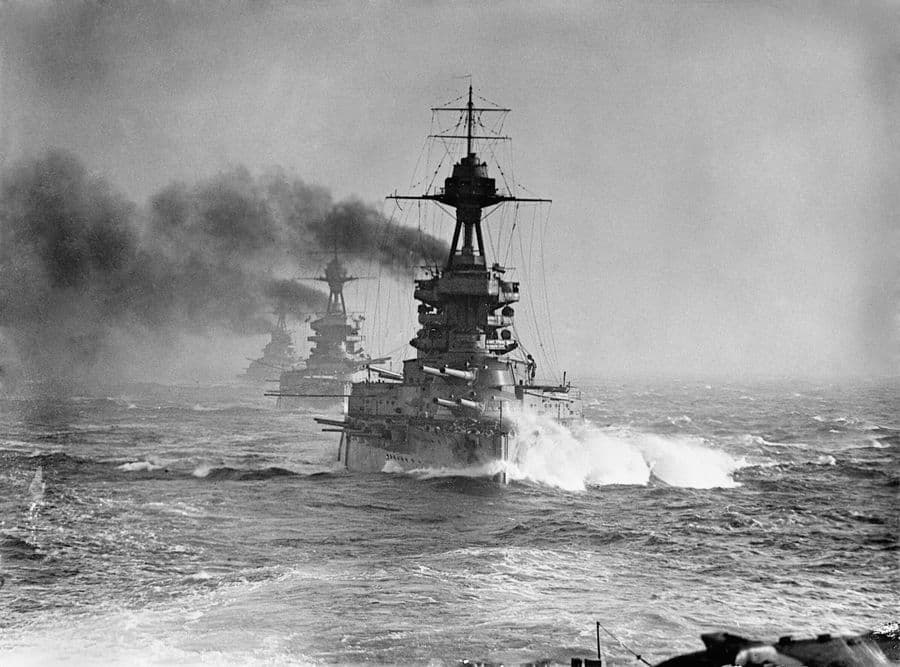
Image of HMS Benbow leading other dreadnoughts of the Iron Duke class in World War I: Imperial War Museum via Wikipedia.
AI contributed no ideas to this article – John West.
This article appeared originally at The Strategist (ASPI).

In Pursuit of Nuclear Abolition
By Peter Huessy • RealClearDefense
Innovation Alone Won’t Prepare the U.S. for the Future Battlefield
By Joshua Segal • RealClearDefense
The sUAS Tactical Trifecta
By Bryan T. Woody • RealClearDefense
The Revolutionary War: When Strategic Options Share the Same Weakness
By Henry Yep • RealClearDefense
The Houthis Are Testing the Limits of Collective Defense
By Saima Afzal • RealClearDefense

Who Shoots Down the Drone Over the Shipyard?
By John Ferrari & Dillon Prochnicki • RealClearDefense
Northrop Grumman Breaks Out the Big Guns at AUSA
By Daniel Terrill, Defense News
Army Pursuing Diverse Array of New Anti-Air Interceptors
By Trevithick, The WarZoneWho Shoots Down the Drone Over the Shipyard?
By John Ferrari & Dillon Prochnicki, RCD
F-35C Lands for the First Time on a Ford-Class Aircraft Carrier
By The Aviationist