
2031, The Middle Kingdom Strikes Back
Last updated 08:30 PM EDT • Read time: 5m
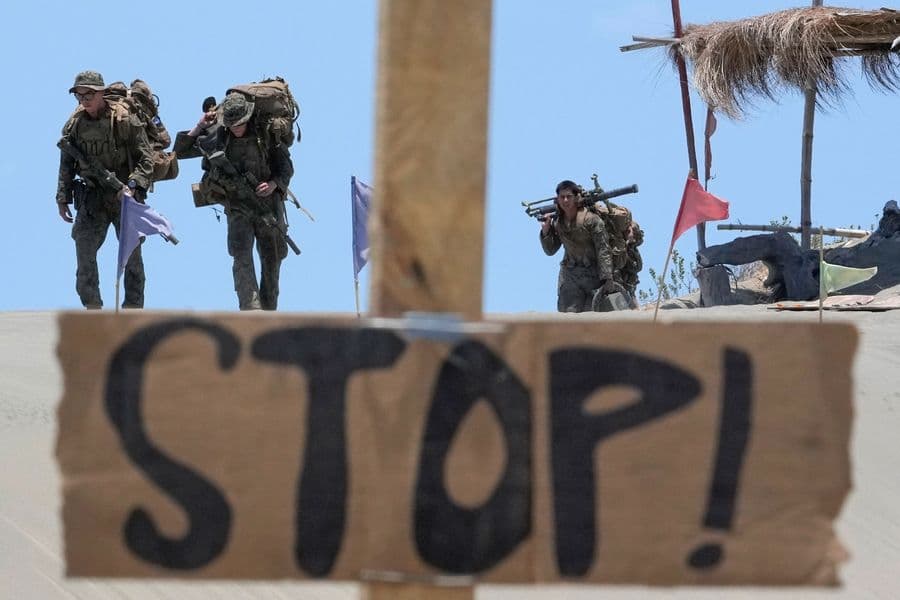
U.S. troopers in battle gear walk under the scorching sun during a joint military exercise on Wednesday, May 8, 2024, in Laoag, Ilocos Norte, northern Philippines. American, Australian and Filipino forces launched a barrage of high-precision rockets, artillery fire and airstrikes to sink a ship Wednesday as part of largescale war drills in waters facing the disputed South China Sea that has antagonized Beijing. (AP Photo/Aaron Favila)
Editor's Note: The following article is a fictional account that portrays the Chinese response to the Marine Corps' Force Design.
As Chinese Admiral Peng viewed the results of the thermobaric strike on Scarborough Shoal, His Aide Lieutenant Liu asked, "Sir how many of their marines survived the bombing?"
"Six" answered the admiral, "but one died on the way to the hospital ship".
"What were they trying to achieve? asked Liu.
"That is a good question, Liu" the admiral answered. "Back in 2019, their marine corps commandant developed a concept that he called expeditionary advance base operations (EABO), and planned to put small groups of troops called Stand-In Forces on tiny islets in the first island chain armed with anti-ship missiles to deter or block our Navy from breaking out of the South China Sea."
"But we never intended to do that," said Liu incredulously.
The admiral shook his head. "That is what makes it so bizarre. The most likely war scenario was us invading Taiwan. Their concept would not contribute to that fight in any substantial way. Going on Napoleon's advice to let an enemy alone if he is doing something stupid, we ignored the whole concept except to tell the countries in the region not to participate by letting their disputed islets and shoals be used. Only the Philippines signed on to the concept. That lowered the American choice of options for bases. They hoped to play a shell game by moving small platoons of marines armed with anti-ship missiles from islet to islet and shoal to shoal. Our use of coercive diplomacy greatly limited their choices to territory claimed by Manila. The Americans would have been better advised to pre- position one of their combined arms Marine Expeditionary Brigades on Taiwan as they once did in Norway, which would have been a real deterrent. Instead, they defanged their conventional combat capabilities to buy the missiles for the new concept. When we flooded the Taiwan Strait with a combination of amphibious decoys and actual amphibious ships, the attack submarines that the Americans and their allies tried to use to stop us ran out of torpedoes and the marine subsonic anti-ship missiles were either out of range or dealt with by our anti-missile defenses. As Stalin said, 'quantity has a quality of its own'. We took heavy casualties, but the prize of Taiwan was worth it. Now it’s a matter of cleaning up the South China Sea."
"Why then, did we finally decide to take the Stan-In Forces out?" asked Liu.
"Two reasons", the admiral replied. "First, they represent a hazard to navigation. One of their missiles might sink a ship in innocent passage. At least, that will be what we tell the UN. Second, by showing the Americans how easily we can eliminate this one, we essentially hold the rest of their Stan-in Forces hostage. Ironically, it is a variation on the island hopping strategy that the Americans developed in World War II. They can either negotiate for abandoning the remaining Expeditionary Advance Force Bases or letting them wage suicidal Last ditch stands. Either way. we win."
"Could they not see the fatal flaw in their strategic logic?" asked Liu.
"Again, there are two answers. The first is that the Americans are slow strategic learners. They do not hold incompetent flag officers accountable for their performance. Look at Afghanistan. None of the generals who led them on a twenty-year program of building security forces that could not sustain themselves after they left the country was held accountable. Nor were the senior military leaders who mismanaged their disastrous final withdrawal. If I were in charge, I would bring the marine corps commandants who came up with their ridiculous Stand-in Forces concept and the navy officers who enabled them back on active duty and court martial them for negligence.
"What is the second reason sir?" Asked Liu.
"Their politicians became focused on our threat in the last two decades; and any scheme, no matter how absurd, that concentrated on China became what the Americans call 'the flavor of the month'. Both of the American parties latched on to any scheme that was anti-China. So, they allowed their navy and marine corps maritime prepositioning and amphibious capabilities to atrophy. Those were two problems that we did not have to concern ourselves with in the present conflict.”
"None-the-less sir, our victory was brilliant," observed Liu.
"It was not brilliant. It was basic strategy and operational art; we followed Sun Tzu and took advantage of our enemy's mistakes and hubris. Their actor John Wayne was right when he observed that 'life is tough, but it is tougher when you are stupid'".
Gary Anderson is a retired Marine Corps Colonel who lectures on war gaming and Red Teaming at the George Washington University's Elliott School of International Affairs. He was a Special Advisor to the Deputy Secretary of Defense from 2003-2005.

Iranian Cyber Operations
By Michael Groen • RealClearDefense
Reflecting on an Epic Horse Campaign in the Mountains of Afghanistan
By Brian Glyn Williams • RealClearDefense
The Godfather of American Foreign Policy Realism Speaks to Today’s World
By Francis P. Sempa • RealClearDefense
In Pursuit of Nuclear Abolition
By Peter Huessy • RealClearDefense
Innovation Alone Won’t Prepare the U.S. for the Future Battlefield
By Joshua Segal • RealClearDefense
26th MEU – U.S. Needs Crisis Response MAGTF
By Marine Corps Compass Points
The Influence of History on a Sea Power
By CDR Salamander
Navy Civilianizes Six Former Flag Billets, Reduces Six to Captains
By Mongilio, USNI N.
Raytheon's $8B Contract for Strategic Comms Terminal Modernization
By M+A El
America’s Maritime Moment Will Not Wait
By CDR Salamander