
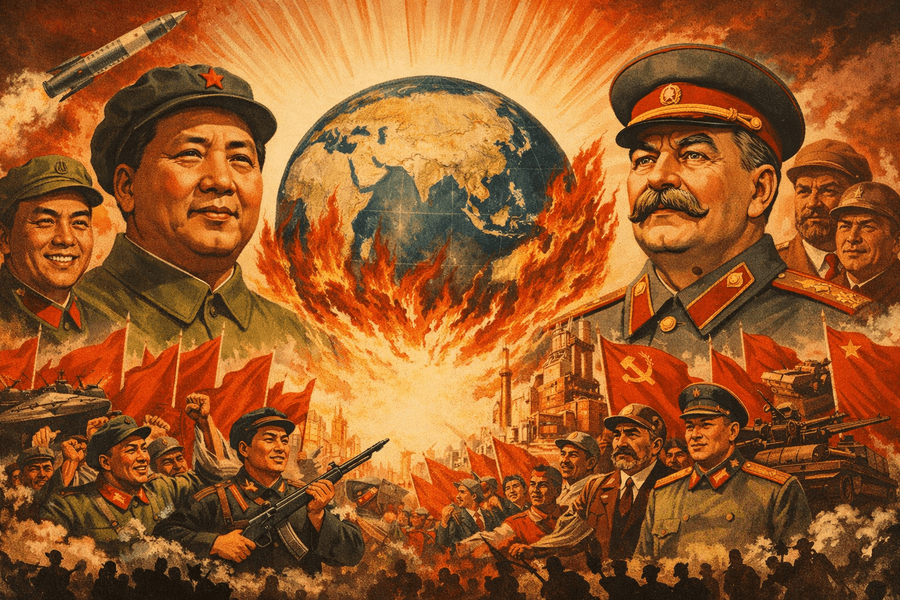
Adaptation and Collapse: Strategic Pragmatism and Systemic Rigidity in the Soviet and Chinese Revolutions
Last updated 06:11 AM EST • Read time: 12m
Introduction
Revolutionary states have long sought to transform themselves into stable modernizers but rarely succeed. Why did China succeed and the Soviet Union fail? The key to answering this question is found in the capacity of each state's leadership to strategically adapt to changing conditions at home and abroad. The Chinese government demonstrated a capacity for ideological flexibility, for pragmatic domestic policy adjustment, and for international realignment, exemplified by the rapprochement with the United States during the early 1970s, which enabled sustainable modernization and globalization. In contrast, the Soviet Union maintained a rigid structure that constrained reform, and in many ways, contributed to its eventual collapse. A comparative case analysis using an integrated theoretical framework demonstrates how strategic adaptation and systemic rigidity reshaped the post-Cold War international order and continue to impact today's China-Russia relationships.
Two of the most ambitious revolutions of the twentieth century were undertaken by the Soviet Union and the People's Republic of China (PRC), both of which sought to establish new forms of socialist modernity based on centralized authority, ideological mobilization, and rapid industrialization. Yet, by the end of the Cold War, the two revolutions had ended in starkly different ways. The Soviet Union collapsed due to internal stagnation and external pressure, while China successfully emerged as a major player in the global economy despite facing numerous challenges throughout its early years.
This paper posits that the primary reason for this difference is the varying degrees to which each state was capable of adapting to systemic pressures in terms of strategic adaptation. China's leadership was able to alter ideology, adjust domestic institutions, and shift its foreign policy in response to both domestic and international pressures. The Soviet Union, on the other hand, continued to maintain rigid economic and political structures that severely restricted its ability to undertake meaningful reform.
Adaptation, Rigidity, and Revolutionary Statecraft
No single theoretical framework can adequately explain the vastly different outcomes of the Chinese and Soviet revolutions. Therefore, this paper utilizes an integrated theoretical framework that combines three main approaches: political economy, state capacity, and strategic pragmatism.
From a political economic standpoint, revolutionary states are confronted with a basic problem after their initial periods of ideologically driven mobilization pass: how do they maintain legitimacy and promote sustained economic development? States that allow some degree of experimentation and partial market mechanisms will be more capable of adapting to changes in the global economy. From a state capacity perspective, the ability of a state to undergo reform is heavily dependent on the extent to which its bureaucracy is flexible and whether there is elite consensus regarding the need for reform. From a strategic pragmatism viewpoint, revolutionary governments modify their foreign policies not because they have abandoned their ideologies, but rather because they recognize that doing so is necessary if they wish to survive in a rapidly changing international environment.
China's course of action serves as a model of how adaptation can enable a revolutionary regime to preserve itself while developing its economy. On the other hand, the Soviet Union's inability to reform indicates that rigidity, although potentially effective in the short run, can create long-term systemic weakness.
Different Revolutionary Trajectories: Ideological and Structural Constraints
Both China and the Soviet Union developed centrally planned economies that focused on heavy industry and ideological discipline in the immediate aftermath of their revolutions. Nonetheless, their paths quickly began to diverge.
Initially, Chinese leaders envisioned participating in a global socialist economy, but ideological disagreements with Moscow including those related to the concept of "peaceful coexistence" highlighted the limitations imposed by the Soviet Union. The Sino-Soviet Split forced Beijing to address the issue of strategic isolation, and while this presented a number of challenges, it also gave Chinese policymakers the opportunity to reassess their own policy alternatives. Even though Chinese policymakers employed extreme language in regard to their revolutionary goals and were involved in intense internal conflict, they consistently maintained an underlying desire to pursue opportunities for international engagement and to develop modernization strategies.
The Soviet Union pursued an entirely opposite path. Although the Soviet Union's early industrialization efforts were productive, by the 1960s the planning system had become rigid and unable to accommodate reform. Rather than modifying the incentives of the system, or decentralizing decision-making, the Soviet Union's leadership chose to rely on resource extraction, military buildup, and ideological conformity. This rigidity eventually constrained the system's ability to react to stagnant economic performance and to changes in the international environment.
Strategic Realignment: Sino-American Rapprochement as a Model of Adaptive Statecraft
The Sino-American rapprochement of the early 1970s is perhaps one of the most significant examples of strategic adaptation in Cold War history. Unlike previous attempts at realignment, however, this one occurred as a result of converging interests rather than ideological agreement.
For China, the latter half of the 1960s were characterized by extreme internal turmoil and escalating external threats, especially from the Soviet Union. The border conflicts that took place in 1969 made clear the urgent need for China to reassess its strategic position. For China's pragmatic leaders, the decision to engage the United States was primarily a tactical decision designed to protect the country's sovereignty and prevent encirclement, rather than a rejection of the fundamental tenets of revolution.
For the United States, engaging China represented a means to gain leverage within the broader triangular balance of power and to potentially break the diplomatic impasse in Asia. As a result of the diplomatic breakthroughs that took place, the United States and China established a foundation for future economic interactions and long-term strategic cooperation.
Domestic Change and Economic Engagement
Although diplomatic realignment was a prerequisite to creating economic linkages, it was not enough to bring about a full-fledged exchange of goods and services. Only when China implemented domestic reforms that synchronized the objectives of strategic interaction with the capabilities of the institutions involved, did trade expand.
During the final years of the Cultural Revolution, China engaged in experimentation with foreign trade that indicated a reevaluation of its stance of isolation. After Mao's death, reformist leaders established economic openness through Special Economic Zones and controlled economic integration into global markets. These reforms preserved the authority of the Communist Party, while creating the mechanisms that would accelerate China's modernization.
In the United States, the process of deindustrialization and the quest for cheap sources of manufactured goods created a growing demand for China as a supplier of such products. Shifts in U.S. public opinion away from traditional protectionism and toward consumer capitalism furthered political support for expanding U.S.-China trade. The coincidence of these developments created one of the largest economic realignments of the late 20th Century.
Structural Rigidity and the Collapse of the Soviet System
As China adapted, the Soviet system continued to exhibit structural rigidity. By the 1970s, declining productivity, technological stagnation, and unsustainable military expenditures undermined the Soviet Union's economic performance. Efforts at limited reform were met with bureaucratic resistance and ideological constraints.
Unlike China, the Soviet Union continued to utilize Western capital to support consumption and defer crisis, which hid its dysfunction while increasing its vulnerabilities. Once the availability of Western credit was reduced in the early 1980s, the lack of adaptive mechanisms led directly to the collapse of the Soviet system.
As the Cold War evolved into a contest of economic performance and standard of living, China responded to the challenge by implementing selective market incentives. The Soviet Union failed to implement meaningful reform until it was too late to reverse its loss of legitimacy.
The Paradox of Revolutionary Governance
The comparison of the Chinese and Soviet experiences reveals a paradoxical aspect of revolutionary governance: ideological rigidity, which is intended to preserve revolutionary purity, can ultimately jeopardize the survival of the revolutionary regime. China's willingness to experiment, to reinterpret its ideology, and to incorporate selectively into the global capitalist system permitted the Communist Party to retain its authority while significantly altering the country's economic foundations. The Soviet Union's refusal to adapt to its circumstances resulted in the collapse of the very regime that rigidity was intended to preserve.
The results of the divergent trajectories of China and the Soviet Union reshaped the post-Cold War international order and continue to affect the nature of China-Russia relations, which are characterized by significant differences in economic strength and strategic autonomy.
This paper has demonstrated that the divergent outcomes of the Chinese and Soviet revolutionary projects are primarily the result of the differential levels of strategic adaptation exhibited by each regime. While both regimes were founded on Leninist ideology, the Chinese government demonstrated a higher level of flexibility in terms of ideological interpretation, domestic institution-building, and international realignment in response to various combinations of domestic and international pressures. The Soviet Union, in contrast, remained mired in rigid economic and political structures that precluded substantial reform until legitimacy and capacity had been lost.
China's experience illustrates that revolutionary regimes can endure, and in fact prosper, when their leaders view ideology as a flexible tool of statecraft, rather than as an unyielding constraint. China's selective incorporation into the global economy, controlled experimentation, and pragmatic diplomacy permitted the Communist Party to maintain its authority while simultaneously transforming China's economic foundations. The Soviet collapse, conversely, illustrates the converse lesson: rigidity intended to maintain revolutionary purity ultimately accelerates systemic disintegration.
Implications for Studies of Revolutionary Regimes and Comparative Political Economy
The conclusions reached in this paper have several implications for studies of revolutionary regimes and comparative political economy:
First, they challenge determination of socialist collapse. The collapse of the Soviet Union was not an inevitable outcome of socialism per se, but rather the result of an institutional and ideological unwillingness to adapt to changing circumstances. The Chinese example demonstrates that alternative routes to sustainable modernization existed within socialist systems, as long as leaders were willing to allow for some degree of experimentation and partial marketization.
Second, the analysis highlights the critical role of elite consensus and bureaucratic flexibility in facilitating reform. China's fragmented and often chaotic political environment paradoxically allowed for the creation of space for innovative policymaking, while the highly institutionalized bureaucracy of the Soviet Union effectively entrenched vested interests opposed to change. This implies that excessive institutional rigidity can pose as much of a threat to regime survival as political instability.
Third, the study underscores the significance of international alignment in promoting domestic transformation. China's rapprochement with the United States was not solely a diplomatic breakthrough, but a strategic pivot that fundamentally altered China's developmental trajectory. As a result, revolutionary regimes that operate in hostile international environments may find that their very survival depends on their willingness to engage selectively in the international community, rather than remaining isolated.
Implications for Contemporary China-Russia Relations
The divergent trajectories analyzed in this paper continue to influence contemporary China-Russia relations. While both countries are often depicted as ideologically allied in opposition to Western hegemony, their asymmetric relationship is a direct result of the long-term effects of strategic adaptation versus rigidity. China enjoys significantly greater economic strength, technological capability, and global economic integration than Russia, whose economy remains largely resource-based and dependent on military spending.
This asymmetry has created a relationship of strategic utility between China and Russia, rather than a relationship of equal partners. Increasingly, Russia has come to rely on China as a source of markets, technology, and diplomatic support, while China benefits from preferential access to Russian energy resources at lower-than-market prices and a diminished competitor for regional leadership.
Historical Legacy of the Soviet Experience and Implications for Global Order and Great Power Politics
More broadly, the study provides insight into the dynamics of contemporary great power politics. The final stages of the Cold War demonstrated that economic performance and adaptability can be more important than pure military power. China incorporated this lesson into its definition of modernization as the basis of national power, while the Soviet Union prioritized maintaining military parity with the West at the expense of economic sustainability.
In the present international system, states that fail to adapt to technological change, global markets, and shifts in norms will likely suffer from long-term decline regardless of their short-term coercive capabilities. China's emergence as a rising power demonstrates that strategic pragmatism, rather than ideological rigidity, may be the defining characteristic of successful great powers in the twenty-first century.
Implications for Theories of International Relations
Finally, the research contributes to ongoing theoretical debates in international relations. Realist theories focus on power balances and security concerns, yet the study demonstrates that a state's ability to adapt domestically to external pressures plays a critical role in determining its ability to respond to external pressures. Liberal theories of political economy highlight the importance of market integration, but the Chinese case demonstrates that such integration is possible without liberal democratic institutions. Constructivist theories of ideology are still important, since the re-interpretation of doctrine played a critical role in China's ability to adapt.
Together, the Chinese and Soviet experiences demonstrate that no single theoretical framework is sufficient to explain long-term outcomes of revolutionary states. Rather, a synthetic approach that incorporates multiple factors including domestic institutions, elite politics, ideology, and international structure is required.
Conclusion
The emergence of China and the collapse of the Soviet Union represent one of the greatest divergences of the modern era. Their divergent courses illustrate that a state's ability to survive in a changing international environment is not necessarily determined by ideological purity, but by its ability to strategically adapt to changing domestic and international environments. Revolutionary regimes that treat ideology as unchanging are more likely to suffer systemic collapse, while those that re-interpret doctrine to ensure their national survival may radically alter the international order.
As contemporary states grapple with disruptions to their economies, technological changes, and emerging rivalries in geopolitics, the lessons of adaptation vs. rigidity remain highly relevant. The histories of China and the Soviet Union serve as reminders to scholars and policymakers that flexibility, rather than dogma, is often the true wellspring of a nation's strength.
Chick Edmond is a Political Scientist and Graduate Researcher in the International Studies program at Old Dominion University. His research focuses on Nuclear Deterrence Strategies, Geopolitics in Europe/Africa and the balance of power between NATO and Russia.

Innovation Alone Won’t Prepare the U.S. for the Future Battlefield
By Joshua Segal • RealClearDefenseThe sUAS Tactical Trifecta
By Bryan T. Woody • RealClearDefense
The Revolutionary War: When Strategic Options Share the Same Weakness
By Henry Yep • RealClearDefense
The Houthis Are Testing the Limits of Collective Defense
By Saima Afzal • RealClearDefense
Radio Frequencies in the Intelligence Ecosystem
By Craig Brower • RealClearDefense

Who Shoots Down the Drone Over the Shipyard?
By John Ferrari & Dillon Prochnicki • RealClearDefense
Northrop Grumman Breaks Out the Big Guns at AUSA
By Daniel Terrill, Defense News
Army Pursuing Diverse Array of New Anti-Air Interceptors
By Trevithick, The WarZoneWho Shoots Down the Drone Over the Shipyard?
By John Ferrari & Dillon Prochnicki, RCD
F-35C Lands for the First Time on a Ford-Class Aircraft Carrier
By The Aviationist