
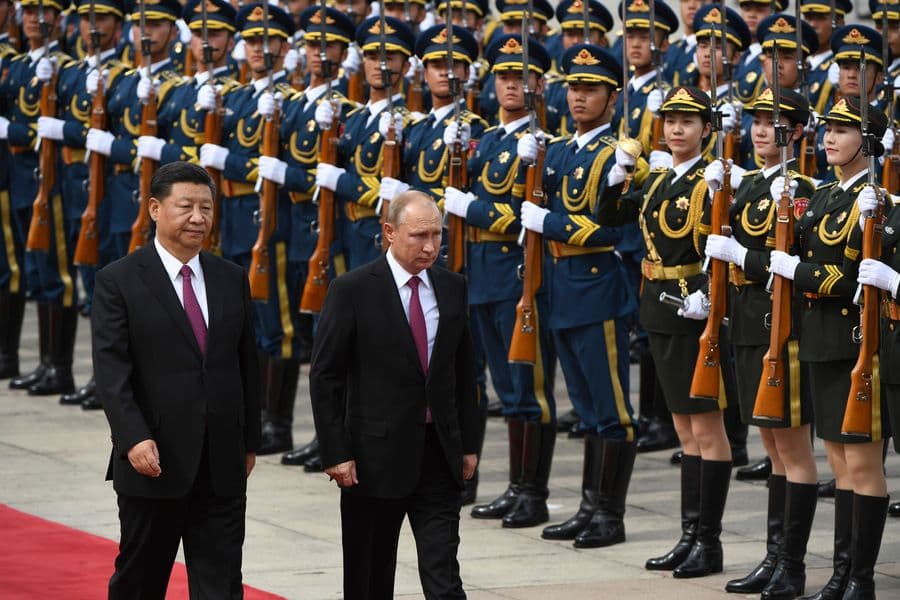
China and Russia Seek To Deepen Defence and Security Cooperation
Last updated 01:24 PM EST • Read time: 4m
The deepening strategic partnership between China and Russia will affect the Indo-Pacific and Europe more than anywhere else. International tension and conflict will increase as countries in these regions reluctantly respond to this partnership.
We should not cling to hopes that either China or Russia will moderate the other.
The latest indication of the partnership’s deepening was a 20 November meeting between General Zhang Youxia, the first-ranked vice-chairman of China’s Central Military Commission, and his Russian counterpart, Andrei Belousov, in Moscow. The goal of their meeting was to strengthen security and defence cooperation between the two countries. A short statement by China’s defence ministry said the two sides had held ‘an in-depth exchange of views’ on China–Russia ties, including between the two militaries, leading to a ‘consensus on strengthening high-level exchanges and deepening practical cooperation.’
This came on the heels of other meetings, including consultations on ‘missile defence and missile aspects of strategic stability’, according to a statement from the Russian defence ministry. In that instance, the Chinese side was led by Li Chijiang, the deputy director-general of the Department of Arms Control and Disarmament of China’s Ministry of Foreign Affairs, and the Russian delegation was led by Andrey Malyugin, the Russian foreign minister’s special representative for strategic stability. Additionally, on the political side, Chinese Premier Li Qiang met Russian President Vladimir Putin, following a meeting between the Russian Prime Minister Mikhail Mishutin and Chinese President Xi Jinping.
This flurry of meetings does not bode well for European and Asian hopes that the partners may moderate each other’s behaviour. European powers had hoped, as German Chancellor Friedrich Merz has reiterated, that China might play a helpful role in the Ukraine war by putting pressure on Russia to restrain itself. Similarly, India has harboured hopes that Russia might help moderate Chinese aggression towards India.
China and Russia are particularly worried about two recent US security initiatives: the Golden Dome missile defence system and the AUKUS partnership between Australia, the UK and the United States. Indeed, a Russian and Chinese joint statement on global strategic stability issued in May characterised the Golden Dome plan and AUKUS as ‘deeply destabilising’, arguing they weakened strategic stability and would incite an arms race.
China and Russia see the Golden Dome as weakening their nuclear deterrence. It also provides a convenient excuse for China’s nuclear expansion. AUKUS is more specifically a Chinese concern as it deals with the Indo-Pacific, but Russia is willing to sign on to China’s complaint in the interest of the partnership and as a way of undermining US interests generally.
Of course, what China and Russia are missing is that it is their unbridled military build-up, including nuclear modernisation, and their belligerent behaviour, including Russia’s invasion of a sovereign country, that have caused many anxieties in the Indo-Pacific and beyond. As countries in the affected regions pursue their own countermeasures, the net result will be further insecurity, arms races and military build-ups.
The threat of the resumption of nuclear testing illustrates this dynamic well. US President Donald Trump’s October statements about the resumption of nuclear testing, after a gap of 30 years, concerned Beijing and Moscow. But it was clearly provoked by Russia’s successful test of a nuclear powered and armed long-range cruise missile, the Burevestnik, earlier that month. The test took place just four months before the expiry of the only continuing US-Russia arms control agreement, the New START Treaty.
Similarly, China illustrated its continuing nuclear modernisation efforts in a display of its nuclear triad at its September military parade, including its first air-launched ballistic nuclear missile, the JL-1; its submarine-launched ballistic missile, the JL-3; and its land-based intercontinental ballistic missiles, the DF-5C and DF-61. Add to this the almost frantic pace of China’s nuclear expansion—almost 200 new warheads per year—and it is not surprising that the US feels the need to respond.
Russia and China have never been short on rhetoric, and their joint statements have often called on the US to abandon Cold War mentalities, such as spheres of influence and bloc confrontation. However, it is military and security cooperation between Russia and China that is looking increasingly like a military bloc. This is evident in the number of joint military exercises that the two have conducted over the past two decades and the high level of their military-technical cooperation.
China and Russia need to demonstrate that they are responsible stakeholders in regional and global affairs. It is their behaviour to which the US, as well as others in Europe and the Indo-Pacific, are responding with their own countermeasures.
Raji Rajagopalan is a resident senior fellow at ASPI.
This article appeared originally at The Strategist (ASPI).

In Pursuit of Nuclear Abolition
By Peter Huessy • RealClearDefense
Innovation Alone Won’t Prepare the U.S. for the Future Battlefield
By Joshua Segal • RealClearDefense
The sUAS Tactical Trifecta
By Bryan T. Woody • RealClearDefense
The Revolutionary War: When Strategic Options Share the Same Weakness
By Henry Yep • RealClearDefense
The Houthis Are Testing the Limits of Collective Defense
By Saima Afzal • RealClearDefense

Who Shoots Down the Drone Over the Shipyard?
By John Ferrari & Dillon Prochnicki • RealClearDefense
Northrop Grumman Breaks Out the Big Guns at AUSA
By Daniel Terrill, Defense News
Army Pursuing Diverse Array of New Anti-Air Interceptors
By Trevithick, The WarZoneWho Shoots Down the Drone Over the Shipyard?
By John Ferrari & Dillon Prochnicki, RCD
F-35C Lands for the First Time on a Ford-Class Aircraft Carrier
By The Aviationist