
The New National Security Strategy's Dangerous Language on Taiwan
Last updated 07:33 AM EST • Read time: 4m
The Trump administration has released its new National Security Strategy (NSS) and many in the U.S. foreign policy elite have declared it soft on China, downgrading the Asia-Pacific region in order to focus more on the Western Hemisphere.
A former senior U.S. diplomat complained in the Wall Street Journal: “To pretend the Chinese threat in Asia… can be ignored… feels like 1930s-era foolishness.” A leading academic expert on strategy offered: “Unlike Trump’s first security strategy, China is not identified by name as a country that poses a military threat, which may be the loudest omission in the entire document.”
Yet an early Chinese assessment of the NSS took a very different interpretation. Though it did note an overall “weakening of U.S. hegemony,” it said of the document’s position on Taiwan, “The strength of this wording far exceeds that of the past.” The analyst added that policies in the new NSS “may increase the risk of military conflict in the Asia-Pacific region.”
Why might the Chinese read the NSS so differently than American critics? While the NSS does declare that the “United States rejects… global domination,” and “The outsized influence of larger, richer, and stronger nations is a timeless truth of international relations,” it does not apply that logic to the long-simmering Taiwan issue.
The Chinese analyst is right that the document’s position on Taiwan is more hardline than usual.
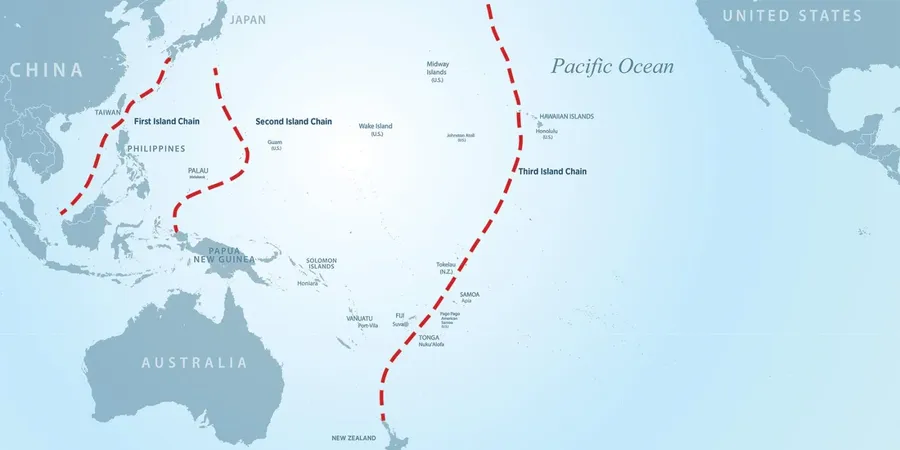
The NSS states that the U.S. aims to deter conflict in the Taiwan Strait, “ideally by preserving military overmatch.” It floats two novel rationales for U.S. strategic interest in the island: “because of Taiwan’s dominance of semiconductor production, but mostly because Taiwan provides direct access to the Second Island Chain...”
These ideas are new to U.S. strategy documents and they are erroneous. In fact, the consensus is growing that it is China that possesses “military overmatch” in the Taiwan Strait, suggesting the document could rest on wishful thinking. Most of Taiwan’s microchips, moreover, go into phones and laptops, products that would suffer delays in the event of a cross-strait conflict but hardly justifying unique U.S. strategic interest in such a powder keg.
Yet it's the final point about Taiwan providing “direct access to the Second Island Chain” that is the most disturbing. It suggests that U.S. leaders view Taiwan as a cork in the bottle to contain the alleged Chinese threat.
The NSS’s Taiwan phrasing amounts to flagrant threat inflation for several reasons: first, Chinese forces already operate regularly beyond the first island chain, suggesting the cork is not effective; second, the argument is ahistorical and ignorant of culture, since Taiwan’s status is altogether different from other islands and island archipelagoes in the Pacific; third, it significantly overstates the danger to both Japan and the Philippines, which have defense in depth that Taiwan completely lacks; and last but not least, it fails to note that China has not resorted to the large-scale use of force in almost half a century.
These distortions, moreover, are evident in other parts of the Asia-Pacific analysis in the new NSS. The document repeatedly warns that some “hostile power” (obviously China) intends to block the sea lanes in the South China Sea with “a toll system,” but there is zero evidence to suggest such a “toll system” is in the cards. Another bizarre twist is that the document does not even mention North Korea.
The NSS’s lengthy section on Latin America takes as a main theme the need for “pushback” against “Non-Hemispheric competitors [who] have made major inroads” in the region—a clear reference to China. This is plainly a “spheres of influence” approach that seeks to minimize external influence in America’s backyard. Yet the NSS never recognizes that China, a rival superpower, might expect the same in its own region.
The NSS has various good points, such as pushing for Asian allies to take on a greater role in balancing China and rejecting, at least in Asia, a crusading mentality that leads to needless conflict and war. However, this document, especially when it comes to Taiwan, represents a missed opportunity to set out a new and less dangerous trajectory on U.S. China policy. After all, a conflict with China could prove far more costly than any hardship yet experienced over the last three decades of futile bloodshed.
Lyle Goldstein is Director of the Asia Program at Defense Priorities.

In Pursuit of Nuclear Abolition
By Peter Huessy • RealClearDefense
Innovation Alone Won’t Prepare the U.S. for the Future Battlefield
By Joshua Segal • RealClearDefense
The sUAS Tactical Trifecta
By Bryan T. Woody • RealClearDefense
The Revolutionary War: When Strategic Options Share the Same Weakness
By Henry Yep • RealClearDefense
The Houthis Are Testing the Limits of Collective Defense
By Saima Afzal • RealClearDefense

Who Shoots Down the Drone Over the Shipyard?
By John Ferrari & Dillon Prochnicki • RealClearDefense
Northrop Grumman Breaks Out the Big Guns at AUSA
By Daniel Terrill, Defense News
Army Pursuing Diverse Array of New Anti-Air Interceptors
By Trevithick, The WarZoneWho Shoots Down the Drone Over the Shipyard?
By John Ferrari & Dillon Prochnicki, RCD
F-35C Lands for the First Time on a Ford-Class Aircraft Carrier
By The Aviationist