
History Supports Senator's Plan to Revive the Nuclear Arsenal
Last updated 10:04 PM EDT • Read time: 6m
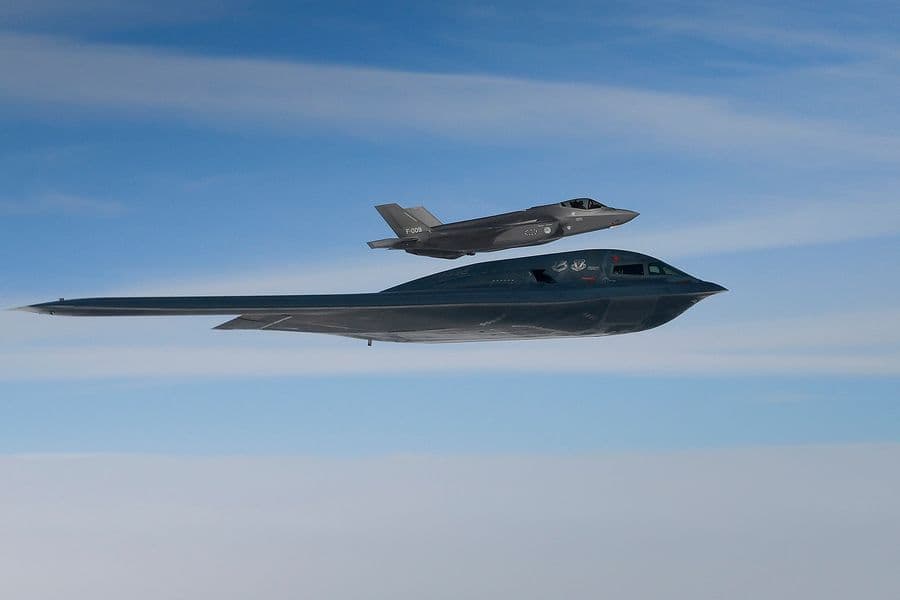
Photo: A U.S. Air Force B-2A Spirit assigned to the 509th Bomb Wing at Whiteman Air Force Base, Mo., and a Royal Netherlands Air Force F-35A Lightning II conduct aerial operations in support of Bomber Task Force Europe 20-2 over the North Sea, March 18, 2020. Bomber missions provide opportunities to train and work with NATO allies and theater partners in combined and joint operations and exercises. (U.S. Air Force photo by MSgt Matthew Plew) - Editor's Note: The Royal Netherlands Air Force has become the first nation to declare their F-35A's as responsible for nuclear strike.
“America’s national defense strategy and military budget are inadequate for the dangerous world in which we find ourselves.” This stark warning opens Sen. Roger Wicker’s (R-MS) recently released plan to grow military spending to 5 percent of Gross Domestic Product and prepare the country for long-term competition.
Due to skepticism about defense spending in segments of both parties, however, Sen. Wicker’s plan will face a rocky road in Congress. But the lessons of America’s first cold war with the Soviet Union support his conviction that a sea change in the threat environment requires a generational investment to better compete in the emerging second cold war. Harkening back to President Reagan’s famous exhortation to revive U.S. military power, the senator’s plan is aptly dubbed “21st Century Peace Through Strength.”
In a panoramic assessment of the strategic landscape, Sen. Wicker rattles off the unprecedented threats that the United States and its far-flung partners face. China’s rapid nuclear missile buildup menaces America’s friends in the western Pacific. Meanwhile, Russia is ravaging Ukraine and almost daily threatens the United States and its transatlantic allies with nuclear attack. Iran, a latent nuclear power, is engaged in a deadly shadow war against Israel, a vital U.S. partner in a critical region. And North Korea continues to defy the international community, conducting flight tests of missiles capable of striking the United States and its allies.
What’s more, these Eurasian autocracies are now coordinating with each other to dissolve America’s global alliance system. The United States, as Sen. Wicker rightly concludes, “has not faced such a dangerous threat environment since the years before World War II.” The era of unipolar U.S. military dominance is unquestionably over.
Indeed, for the first time in the nuclear age, the United States will soon face two-peer nuclear adversaries in Russia and China. During the Cold War, when it confronted just a single peer in the Soviet Union, the United States routinely devoted between 5 percent and 10 percent of GDP to national defense. Yet today, the defense budget stands at just 2.9 percent of GDP, and the Biden administration’s woeful fiscal year 2025 budget request of $849.8 billion signals a cut in real value. Just like in the 1970s, when Soviet military power was rising and U.S. defense spending plunged to 4.5 percent of GDP, a desire to lessen global commitments has contributed to America’s military decline relative to its primary competitor, China.
Alas, despite President Biden’s repeated insistence that “America is back,” U.S. allies are increasingly anxious about the credibility of the U.S. nuclear umbrella. From central Europe to the western Pacific, America’s friends see a stretched U.S. defense posture and a belligerent Eurasian axis. Analogous to the Soviet theater-range missile buildup in Europe during the 1970s, which caused NATO allies to question America’s credibility, U.S. partners in Europe and the Asia-Pacific are raising doubts today, given China’s and Russia’s massive medium-range missile arsenals. On this point, it is essential to recall that until the Reagan administration deployed theater-range missiles to reassure Western Europe, NATO was mired in a crisis over America’s credibility, jeopardizing the alliance’s future.
As in the Cold War, extending the U.S. nuclear umbrella to far-flung allies today is a no less demanding yet critical challenge. To thwart nuclear proliferation around the world, the United States must assure its partners that the U.S. nuclear arsenal is coupled to their defense, so they don’t acquire independent capabilities. Moreover, projecting U.S. power in Asia, Europe, and the Middle East—whether conventional or nuclear—is essential to maintaining both political and military access in vital regions. Without allies, the United States loses a tremendous asymmetric advantage against China and Russia.
The fundamental mechanics of extended deterrence are no different today than in Reagan’s time—it requires assuring allies of U.S. credibility. For instance, in 2023, South Korea was so uneasy that the Biden administration established the Nuclear Consultative Group to exchange information and reassure Seoul. However, even with this mechanism in place, and even after a port call from a U.S. ballistic missile submarine, many South Korean officials remain apprehensive. None other than the South Korean president, Yoon Suk Yeol, has broached the idea of returning U.S. nuclear weapons to the peninsula after a thirty-two-year absence.
Japan, too, has expressed concern about the U.S. extended deterrent. Tokyo has long objected to the Obama administration’s decision to retire the nuclear-armed sea-launched cruise missile, believing its enduring forward presence provided the only credible extended deterrent. Unfortunately, the United States has not filled this long-standing gap. Since the retirement of the sea-launched cruise missile, the United States has lacked an enduring regional nuclear option to reassure Japan and South Korea.
Thus, as Sen. Wicker’s plan advocates, a generational investment in America’s global posture—like Reagan’s defense buildup—is required to reassure far-flung allies. Adding $55 billion to Biden’s fiscal year 2025 request, he proposes a defense budget that devotes significant resources to developing a new nuclear-armed sea-launched cruise missile (contra Biden); ensuring delivery of two Virginia-class attack submarines per year (the platform which would carry the cruise missile); expanding production of Columbia-class ballistic missile submarines from 12 to 14; and uploading more nuclear warheads on currently deployed Minuteman III intercontinental ballistic missiles.
Additionally, the plan calls for exploratory talks with Asian allies like Japan and South Korea to assess their interest in a nuclear-sharing arrangement, where the United States would maintain custody of warheads in peacetime and allied pilots would fly nuclear-armed aircraft in crises or wartime.
On the senator’s sense of urgency, Cold War history is thus instructive. If not for the deployment of credible regional nuclear options by the Reagan administration, the United States risked the collapse of NATO. Fortunately, a growing chorus of voices in Congress today recognizes the enduring relevance of Reagan’s call for peace through strength. The Biden administration or its prospective successor would be wise to rebuild the defense program and reassure anxious allies.
Kyle Balzer is a Jeane Kirkpatrick Fellow at the American Enterprise Institute

The First Test of Peace Lies in Ukraine's Borderlands
By Dennis T. Cosgrove • RealClearDefense
The VFW’s Gambling Addiction Victimizes Veterans
By Jack Yoest • RealClearDefense
Superintelligence Exposes a Gap in the Law of Delegated Authority
By Sue Ghosh Stricklett • RealClearDefense
When the Network Goes Dark, Who Controls the Battlefield?
By Jonathan K. Corrado • RealClearDefense
We Cannot Build Tomorrow's Weapons With Yesterday's Alloys
By Joseph F. Krause • RealClearDefense
When the Network Goes Dark, Who Controls the Battlefield?
By Jonathan K. Corrado • RealClearDefense
Air Force Should Buy 250 Blended-Wing Tankers, as 2027 Demo Looms
By A&SF Mag.
Long Deployments to Be Navy Standard For Next Couple Years
By Mongilio, USNI NewsWhen the Network Goes Dark, Who Controls the Battlefield?
By Jonathan Corrado, RCD
Marines Deploy Neros Archer Drone in Live Fire Exercise for First Time
By USNI News