
Combine and Conquer: China and Russia Synchronize for Eurasian Hegemony
Last updated 04:02 PM EDT • Read time: 10m
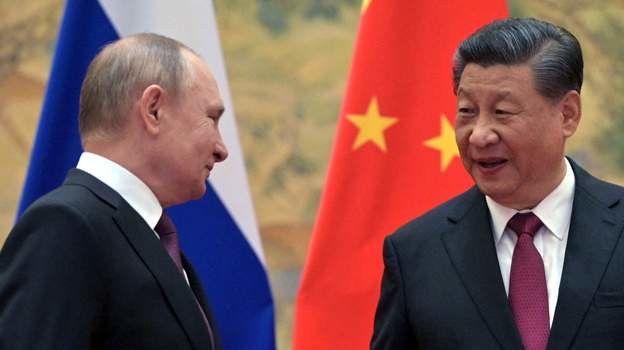
The “no limits” partnership established between Russia and China this February had been decades in the making. It was not an abrupt strategic shift for either country. Both have long envisioned cooperation with their Asian neighbors as a means of constructing an anti-American bloc in Eurasia. To accomplish this goal, Russia has become rhetorically, militarily, and geopolitically synchronized with China.
Beijing’s Defense Ministry justified the recent military drills around Taiwan by calling them a “solemn deterrent against collusion and provocation between the U.S. and Taiwan.” During the 10th Moscow Conference on International Security held last month, Russian President Vladimir Putin labeled Nancy Pelosi’s trip to the island as “part of the purpose-oriented and deliberate US strategy designed to… sow chaos in the region and the world.”
Putin did not stop there, however. His criticism encompassed three continents and one ocean as he accused Washington of igniting conflicts in Asia, Africa, and Latin America while destabilizing the Indo-Pacific. The Kremlin concluded that this was another example of “thoroughly planned provocation.” The phrase echoed not only the Chinese Defense Ministry, but also a March 2022 People’s Daily article which argues that Washington is constantly “provoking ideological conflicts” across the globe.
Russian and Chinese declarations evoke the idea that the West, particularly the United States, is bent on fomenting conflict and animosity with rising powers— not the other way around. This allows them to frame their military and energy-based cooperation as defensive initiatives. Chinese troops recently joined their Russian counterparts in a series of drills to underscore the solidarity of their February pact, which opposes “the United States' Indo-Pacific strategy on peace and stability in the region.” The first pipeline capable of sending gas directly from Siberia to Shanghai will soon reach its completion.
While Russia and China may currently have their eyes locked on regional struggles, this will not distract them from their long-term shift toward the Indo-Pacific.
China’s persistent border disputes with India since the 1950s, its claim to the Senkaku Islands in 1970 following the discovery of oil in the region, its occupation of the Paracel Islands from South Vietnam in 1974, and several crises in the Taiwan Strait represent decades of expanding influence in the Indo-Pacific. Consequently, Moscow has had to pay greater attention to the region despite the war on its hands to align its policies with its ally.
Russia’s pivot predates the “no limits” partnership between CCP leader Xi Jinping and Putin by more than a decade. In 2010, Lavrov penned a piece for International Affairs arguing that the world is entering the “Asia Age” and that Russia would “benefit from developing mutually advantageous cooperation with ASEAN.” Two years later, to reinforce this grand strategy in advance of the 2012 elections, Putin wrote, “We see before our eyes not only the rise of China and India, but the growing weight of the entire Asia-Pacific [r]egion.” At the 2013 St. Petersburg International Economic Forum, Putin anticipated today’s Sino-Russian energy rapprochement by acknowledging pipeline infrastructure and railway projects connecting the Far East to China.
Shortly thereafter, Russian policy followed through with Lavrov’s advice. 2014 marked an unprecedented shift in the number of bilateral meetings between the Kremlin and Asian countries within ASEAN, many of which enjoy access to Russia’s diverse array of natural resources and comparatively stronger economy. Friendly relations come naturally either thanks to bilateral relationships established during the Cold War or because both sides have compatible objectives. A joint statement issued last year by Vietnam and Russia, for example, outlined a plan for military, educational, political, technological, and trade-based cooperation moving forward. Unsurprisingly, Vietnam has failed to condemn Russia’s war on Ukraine.
Indeed, Moscow’s turn to the Indo-Pacific cannot be viewed separately from its westward invasion. To guarantee support for his military incursions abroad, Putin has woven a web with all strings attached to the Kremlin. Cambodia, Laos, and Myanmar have joined Vietnam in keeping quiet about Ukraine. China and North Korea did not have to think twice before siding with one of their closest allies. Thailand and the Philippines, despite their strong relationship with the United States, have gone no further than occasionally expressing dismay at the humanitarian element of the crisis. Ties between Russian and Thai royal families stretching back to the late 19th century dissuade Bangkok from erring from Moscow’s playbook. For all these countries, important parts of their economy are sufficiently dependent on Russia or China so that the costs of condemning the Kremlin far outweigh the benefits.
Russia’s strategy of rounding up Asian countries goes far beyond the ongoing conflict in Ukraine. It is also about energy. Russia is preparing for a world where its trading partners and oil and gas importers in Europe are replaced by Asian customers. During an August 2022 meeting on developing the shipbuilding industry, Putin spoke with executives from a variety of companies and governmental departments to consider their perspective in his modernization plans.
Russia’s Minister of Industry and Trade Denis Manturov explained that the Zvezda shipyard in the Far East “has already completed the first Aframax-class tankers and is building LNG [liquified natural gas] tankers and product carrier ships for the Northern Sea Route,” a path that runs entirely through Arctic waters. Dominating the Arctic is yet another way Russia intends to pivot to the Indo-Pacific. Novatek, Russia's second-largest natural gas producer, is spearheading the Arctic LNG 2 project to gain “access to the Atlantic Basin and Asia-Pacific markets,” according to their website. During the same shipbuilding meeting, the Chairman of Novatek’s Management Board emphasized that 80 percent of the LNG produced from the Arctic project will be directed toward the Indo-Pacific while only 20 percent will go to the West. “The fewer tankers we have, the more LNG will go to the West. This is wrong and creates additional risks,” he added. Following China’s footsteps by undertaking a coordinated shift toward the Indo-Pacific aligns with Putin’s plan to abandon integration with the West.
As Russia builds a coalition of Asian countries, it is simultaneously challenging the American alliances that oppose Moscow's ambitions. The Quad is the most flagrant example. Moscow has exploited India’s presence in the forum to slow its progress. As it does with many ASEAN countries, Russia has built on its long-standing cooperation with India to secure a crucial ally. The Soviet Union supported India with defense technology to counterbalance China starting in the 1960s. Putin has framed his recent 10-year defense cooperation pact with Indian Prime Minister Narendra Modi as a continuation of both countries’ historic amity.
As Russia aligns with China to oppose the United States, though, India is being pulled in two different directions. Sino-Indian border conflicts have persisted for nearly six decades and New Delhi is well aware that Beijing has no intention of accommodating its rise on the continent. A fundamental misunderstanding that has systematically been repeated since the start of Russia’s invasion of Ukraine is that India is logically turning a blind eye to the conflict in Eastern Europe because China is a more imminent threat. If Russia is pooling so many resources into its invasion, it must be more preoccupied with European rather than Asian affairs, this line of thinking goes.
This is not necessarily so. Moscow began rerouting its exports toward Asia to disconnect from the West even before the war in Ukraine. Although the Kremlin has manipulated certain statistics about Russian imports and exports after February 24, the numbers leading up to that date are more reliable. For instance, according to an article from Russia Briefing, 42.2% of Russian exports were sold to Asian countries in 2020, catching up to the 49.3% sent to Europe. The article concludes that “Russian businesses should be studying these trends and conducting analysis on where and how they can generate market penetration into Asia – as the demand begins to eclipse that in Europe.”
Moscow’s pivot to the Indo-Pacific will have to encompass industries beyond gas and oil because these will require an arduous transition. The infrastructure that has traditionally sent gas to Europe cannot be abandoned overnight, and it will be difficult to connect it to the nascent Power of Siberia project. Novatek’s battle for the Arctic described above has seen its fair share of setbacks. After attempting to construct its LNG pipelines with Russian technology, “extensive technical troubles” caused the Kremlin to revert to Western parts. Moreover, Russia’s turn to Asia comes at a time of pressing industrial shortage. “With a favorable exchange rate, we are now trying to close the need for equipment and components as soon as possible where Russian production, simply due to a shortage of capacities, is not able to promptly meet domestic demand,” Manturov said during an August 2022 interview with Interfax.
As a result, other industries have had to step in to provide short-term relief to Russia’s economy and keep the focus on Asian markets. This year, Russia has become Vietnam’s main meat supplier, with the value of meat exports surpassing $100 million. The Kremlin is also seeking to boost agricultural trade to a variety of Asian countries, including Myanmar, Singapore, and Vietnam. Finally, Moscow is sending its surplus gold reserves to China, raking in $108.8 million in July 2022 which can more easily be spent on war operations.
The Asian and European theater are becoming increasingly inextricable from one another. As the United States contemplates a potential crisis in the Taiwan Strait, it must not diminish its aid to Ukraine: the more Russia squanders its resources in Eastern Europe, the less it will be able to shift to the Indo-Pacific. Moreover, if Washington impedes Russia’s penetration of Asian markets, it can foil the Kremlin’s long-term goal of building a robust anti-American bloc on the continent.
A tug of war is taking place with neutral Asian countries. The U.S. and China are at the front of each side, and Russia is throwing its weight behind the latter. Europe’s ability to back Washington is limited at the moment as it faces a devastating energy crisis. To prevail in this struggle, the U.S. needs to focus on the countries that can conceivably swing to its side. India, Thailand, and the Philippines are three examples. They have all participated in military exercises with American troops, harbor skepticism about China’s long-term ambitions, and benefit from partnerships with Washington.
South Korea and Japan are also increasingly threatened by Beijing’s rise and have demonstrated a strong willingness to join forces militarily and economically with the U.S. Trying to please dictators as President Donald Trump did when he visited North Korea’s Kim Jong Un is an unfruitful strategy. Kim’s newfound belligerence is a testament to the short-lived nature of rapprochement with authoritarian leaders. The U.S. must avoid spreading itself too thin, focusing instead on countries of strategic importance that have expressed disillusionment with either Russia or China’s regime. Washington’s goal should be to include more countries in economic or security initiatives like President Biden’s Indo-Pacific Economic Framework for Prosperity, incentivize trade with the West, and encourage more military cooperation with Asian countries.
The U.S. can and should drive a wedge between its principal adversaries and enlist more Asian allies in its fight against authoritarian hegemony over Eurasia.
Axel de Vernou is a sophomore at Yale University studying Global Affairs.

Counterterrorism and the Growing Convergence in Homeland Security and Homeland Defense
By Austin Doctor • RealClearDefense
The Future of Space Power Depends on Integration
By Damian DiPippa • RealClearDefense
America Should Unleash Cyber Privateers
By Jacob Schelp • RealClearDefense
America Invented the Battery, but China Controls the Factory
By William Crane • RealClearDefense
A Defense Win for Americans and Israelis in Arkansas
By Bradley Bowman • RealClearDefense

Key Space Force Satellites Can’t Talk to Each Other
By T. Hitchens, Breaking Defense
Blue Angels Pilot Scott Laux Removed for Failing To Uphold Standards
By Johnson, PNJ
The Future of the Ground Reconnaissance Enterprise
By Joe Albano, The Connecting File
The Future of the ARG/MEU
By William Yale, Proceedings
Big Surface Combatants are so Hot Right Now
By CDR Salamander