
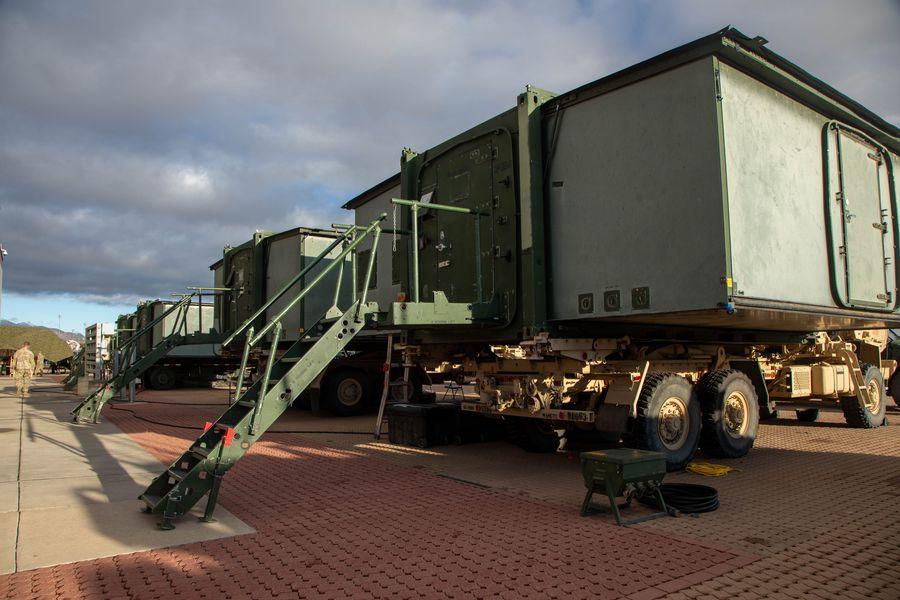
A nodal construct is positioned outside the Mission Training Center during Ivy Sting 7 at Fort Carson, Colorado, Oct. 26, 2026. The system supports Next Generation Command and Control (NGC2) operations by connecting communication networks and enabling information sharing across the battlefield.
The Future of Space Power Depends on Integration
Last updated 05:59 AM EST • Read time: 4m
Join the Conversation
0For decades, military planners viewed space primarily as an enabler. Satellites provided communications, navigation, intelligence, and missile warning while the decisive fight happened elsewhere.
That paradigm no longer exists.
Ongoing operations in the Middle East have reinforced what defense leaders have long recognized: military advantage increasingly depends on an integrated space enterprise that connects sensors, decisionmakers, and warfighters across every domain. Victory is no longer defined by the performance of a single platform or constellation. It depends on how effectively disparate systems work together to deliver resilient communications, secure data, and synchronized command and control under real operational pressure.
The conflicts we are witnessing today underscore that reality. Long-range precision strike, integrated air and missile defense, and coalition operations all rely on a digital backbone that stretches from orbit to the tactical edge. Space-based sensors detect emerging threats. Communications networks move mission data across the battlespace. Ground systems fuse information from multiple sources, enabling commanders to make informed decisions at the speed modern operations demand. Remove any one of those links—or prevent them from communicating effectively—and the entire operational advantage begins to erode.
This shift should fundamentally change how we think about defense modernization.
For years, acquisition strategies have been understandably focused on delivering individual capabilities: another satellite, another radar, another communications terminal. Those investments remain essential, but they are no longer sufficient on their own. Increasingly, the advantage belongs to organizations that can connect existing capabilities into resilient operational ecosystems that evolve as quickly as the mission itself.
That challenge is coming into an even sharper focus as the Pentagon advances concepts such as the Golden Dome. Whether the final architecture ultimately matches today’s vision is less important than the objective itself: integrating space-based sensing, missile warning, missile tracking, command and control, and defensive capabilities into a single operational enterprise.
Success will not hinge on one revolutionary technology. It will depend on bringing together hundreds of governments and commercial capabilities—many already in existence—into an architecture that enables operators to understand the battlespace, coordinate responses, and act faster than an adversary.
From an industry perspective, the conversation needs to evolve. Interoperability can no longer be treated as a requirement checked late in a program. Integration has to become a design principle from the very beginning.
That means embracing open architectures, software-defined capabilities, cloud-enabled mission systems, and secure data transport that can adapt as missions change. Just as importantly, it means giving operators the flexibility to incorporate emerging technologies without rebuilding an entire enterprise every few years.
The United States has an extraordinary advantage in this regard. Across both the defense industrial base and the commercial space sector, innovation is occurring at remarkable speed. New satellite constellations, artificial intelligence applications, digital engineering tools, and resilient communications capabilities are entering the market faster than ever before.
Our greatest challenge is not generating innovation but integrating it into operational missions quickly enough to maintain our competitive advantage.
Tomorrow's operational environment will only become more complex. Government systems will operate alongside commercial constellations. Legacy infrastructure will coexist with cloud-native mission applications. Artificial intelligence will accelerate data analysis while military leaders retain responsibility for operational decisions. Every layer of that ecosystem must function together, even when facing cyberattacks, electronic warfare, or degraded communications.
The military forces that can rapidly integrate new capabilities into resilient operational architectures will consistently outpace adversaries relying on rigid, proprietary systems. Their advantage will not simply come from possessing better technology. It will come from connecting technology more effectively, adapting it more rapidly, and delivering relevant information to operators when every second matters.
That should influence how government and industry approach modernization in the years ahead. We should prioritize adaptable architectures over closed ecosystems, reward integration alongside innovation, and recognize that software, systems engineering, and mission orchestration are every bit as important as the platforms themselves.
The United States already possesses extraordinary space capabilities. Preserving our advantage now depends on connecting those capabilities into a resilient enterprise that can evolve as quickly as the threats it is designed to counter. From orbit to the tactical edge, integrated command, control, and communications are becoming the foundation of modern military operations.
If we get that right, we will not simply build better systems; we will build a force that can see faster, make quicker decisions, and respond to threats faster than any adversary. That is the strategic advantage the next generation of space power demands.
Damian DiPippa is CEO of Auria, which delivers highly secure technology solutions for next-generation space, satellite, and mission systems. He has more than two decades of experience leading organizations across the defense and intelligence communities to help solve complex national security and technology challenges.

Counterterrorism and the Growing Convergence in Homeland Security and Homeland Defense
By Austin Doctor • RealClearDefense
The Future of Space Power Depends on Integration
By Damian DiPippa • RealClearDefense
America Should Unleash Cyber Privateers
By Jacob Schelp • RealClearDefense
America Invented the Battery, but China Controls the Factory
By William Crane • RealClearDefense
A Defense Win for Americans and Israelis in Arkansas
By Bradley Bowman • RealClearDefense

Key Space Force Satellites Can’t Talk to Each Other
By T. Hitchens, Breaking Defense
Blue Angels Pilot Scott Laux Removed for Failing To Uphold Standards
By Johnson, PNJ
The Future of the Ground Reconnaissance Enterprise
By Joe Albano, The Connecting File
The Future of the ARG/MEU
By William Yale, Proceedings
Big Surface Combatants are so Hot Right Now
By CDR Salamander