
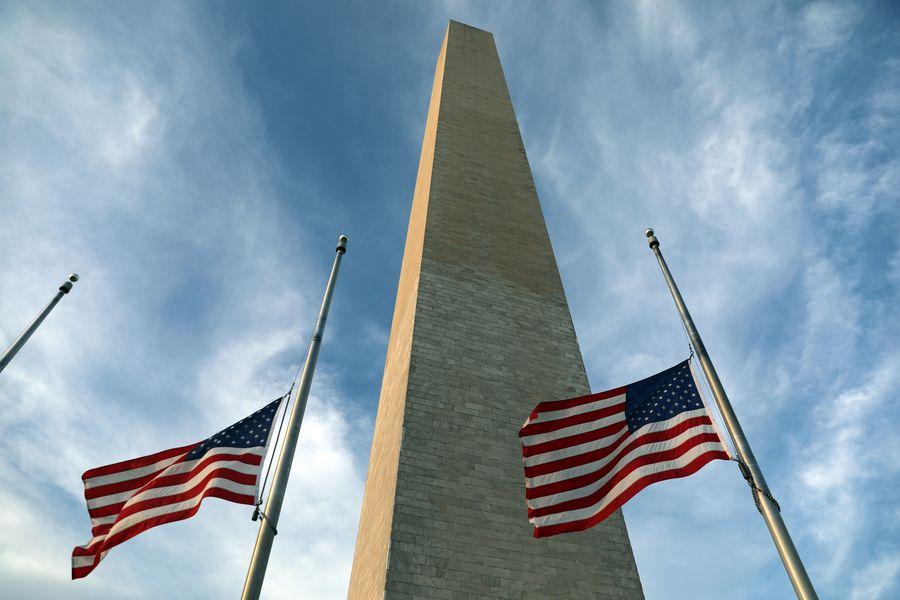
American flags fly at half-staff at the Washington Monument, to mark the anniversary of the Sept. 11, 2001, terror attacks on America, Friday, Sept. 11, 2026, in Washington. (AP Photo/Rahmat Gul)
Counterterrorism and the Growing Convergence in Homeland Security and Homeland Defense
Last updated 05:55 AM EST • Read time: 13m
Join the Conversation
0U.S. homeland security and homeland defense activities are converging. Perhaps nowhere more so than in counterterrorism.
America rebuilt its national security architecture after 9/11. Since then, it has institutionalized interagency collaboration, and it has developed proficient techniques that disrupt terrorist plots and attacks further upstream. More recently, the country has rebalanced counterterrorism budgets toward other security priorities. This comes as the shifting threat environment – including the terrorist designation of cartels and transnational criminal organizations – is imposing new strains on a lean legacy architecture.
These structural changes bring closer together two mission communities that have, historically, been less conversant. The homeland defense mission, in which the military focuses on protecting against external threats and ensuring U.S. sovereignty, now encompasses threats that originate abroad but move across regional networks and extend into American communities. Conversely, the homeland security mission – in which law enforcement oversees border management and domestic threat prevention - now faces a diverse range of violent criminal actors with transnational linkages who enjoy a level of technological access that was not so long ago a unique privilege of state adversaries.
The formal line between the two missions still demarcates material differences in authorities, equities, and areas of operational specialization. But the adversary gets a vote. And consequential adversaries are operating across that line and along the seams of our mission structures.
An effective and proactive approach will require institutions on both sides of the homeland security and defense line to share information, coordinate frameworks, and invest in evidence-based tools fit for purpose.
The missions are converging because today’s threats cross traditional boundaries.
As a description, the distinction between international and domestic threat streams is less useful than in the past. For much of the post-9/11 period, that distinction naturally supported case allocation and workflows under clear authorities. That sorting mechanism is breaking down. Shamsud-Din Jabbar was a U.S. Army veteran from Texas who self-mobilized on Islamic State content and acted alone on American soil to target U.S. citizens in New Orleans. The attack killed fourteen victims, plus the perpetrator, with at least fifty-seven others injured, including two police officers who were shot. Pro-ISIS HVEs have also recently targeted military bases and personnel in the United States. In May 2025, the FBI arrested a former Michigan Army National Guard member for allegedly planning an ISIS-inspired attack on the Army’s TACOM facility in Warren, Michigan. The jihadist threat is seen in both its homegrown variants and the persistent risk of external terrorist operations. The Intelligence Community assesses that al-Qaeda and Islamic State affiliates are among the most likely to support external plotting, and terrorist facilitators can exploit the same smuggling infrastructure that criminal networks use. In June 2024, reportedly, more than 400 individuals entered the United States through an ISIS-affiliated human smuggling network. Even more so, the Mexican drug cartels now designated as Foreign Terrorist Organizations operate daily across the U.S. Southern Border, commit acts of violence in both Mexico and the United States, and recruit in American communities. The result is a threat environment in which the domestic-international classification is increasingly blurred obligates greater levels of military and law enforcement coordination.
A related asymmetric threat is state-sponsored terrorism and increased points of contact at U.S. borders and in the homeland. In 2026, a man was sentenced to ten years in prison for serving as a hired gun to stalk, surveil, and ultimately assassinate Masih Alinejad—a United States citizen—on behalf of the IRGC.” In January 2025, U.S. Border Patrol arrested a former member of the Russian proxy Wagner Group in Texas as he waded across the Rio Grande. He was carrying two passports (one Russian and one Kazakh), $4,000 USD, 60,000 pesos, and a drone. The Wagner Group has been designated a transnational criminal organization by the U.S. Treasury Department. In a June 2026 media interview, DHS Secretary Markwayne Mullin stated that arrests of Iranian nationals attempting to enter across the northern border were rising daily and that the “vast majority” had ties to the IRGC. The fight to secure American safety and sovereignty is increasingly being fought on every edge of the U.S. homeland.
At the same time, a blitzkrieg of new commercial technologies is narrowing the capability gap between states and nonstate actors. Violent militants aspire to use commercial drones to conduct surveillance or deliver explosives. They use open-source AI tools to enhance their capabilities, including target identification, operational planning, and weapons employment. Additive manufacturing is increasingly being used to reduce dependencies on traditional supply chains and conceal planning and preparation activities.
The U.S. homeland and Western Hemisphere are contested spaces where asymmetric threats increasingly converge. To be clear: evolutions in terrorist network linkages are only a part of the issue. It’s also that the risks stemming from these evolutions place new pressures on targets and spaces that are in overlapping domains of both homeland defense and homeland security practitioners. It means that distinct statutory authorities and related workflows are in closer proximity and on a daily basis. That includes U.S. borders, military bases and assets in civilian-dense environments, large-scale public events, and defense critical infrastructure. These threats do not fit neatly into the mission categories that have guided policy and practice for decades.
Homeland security and homeland defense are converging in key domains, revealing actionable blueprints and exposing new pain points.
The 2025 White House National Security Strategy reestablishes preeminence in the Western Hemisphere as a core condition of U.S. security. Following suit, the 2026 National Defense Strategy directs the Department of War to restore American military dominance in the Western Hemisphere. The same strategy directs the Department to degrade “narco-terrorist organizations across the Americas” and to maintain “a resource-sustainable approach to countering Islamic terrorists, focused on networks that possess the capability and intent to strike the U.S. Homeland.” Some of this work is being executed under Defense Support of Civil Authorities. This comes as the Department of Homeland Security is prioritizing border security and disruption of transnational violent criminal activities in the U.S.
As may be expected, the convergence of homeland defense and homeland security activities is producing an initial mix of friction and success in responding to the new generation of terrorism-related threats. This is especially evident in three core operating environments: U.S. airspace, U.S. land borders, and the U.S. maritime domain.
First, the two missions most visibly converge in the air domain through ongoing efforts to counter threat actors’ use of unmanned aerial systems (UAS). In his 2026 posture statement to Congress, USNORTHCOM commander Gen. Guillot reported that U.S. military forces have used counter-UAS authorities and equipment to mitigate more than one hundred small drones that routinely track and monitor their patrols. The same commercial airframes that are active over military installations are those appearing at the mass gatherings that DHS rates as National Special Security Events and near critical infrastructure. Formally implemented in July 2026, the SAFER SKIES Act extended counter-UAS authority to state and local law enforcement. The FBI launched the National Counter-UAS Training Center (NCUTC) to serve as the sole hub for certifying those personnel to a common operating standard. In February 2026, JIATF-401, which coordinates DOW counter-UAS initiatives, deepened its collaboration with the FBI and NCUTC. This focused on expanding joint training and accelerating the development of counter-UAS capabilities in coordination with federal interagency partners. Officials said the goal is to strengthen homeland defense against small drone threats through more integrated interagency planning and operational alignment.
These are meaningful steps. But reorganization alone will not solve the underlying challenge. Common threat characterization frameworks, shared analytic tools, and joint training pipelines do not yet exist at the scale the new architecture requires. In February 2026, CBP deployed a counter-UAS directed energy tool on loan from DOW near Fort Bliss without completing FAA coordination, prompting the agency to close the saturated airspace over El Paso. The intercepted target was revealed to be a party balloon. CBP used a Pentagon-developed counter-drone laser near Fort Bliss without coordinating with the FAA, prompting the FAA to close the airspace over El Paso; the closure was announced for ten days and lifted within hours. The target was reportedly a party balloon. Two weeks later, a military laser downed a Customs and Border Protection drone, and the FAA closed additional airspace nearby. These are the still-loose seams of nascent coordination across federal agencies around evolving homeland threats.
Second, the convergence is observed in the land domain under strengthened border security initiatives. Of course, military forces have been active on U.S. borders for decades. The designation of cartel-related terrorism did not itself confer military authority — that rests on separate statutory and constitutional authorities — but it reframed cartels as a core security challenge, and military authorities followed. Under 10 U.S.C. § 284, military forces provide detection and monitoring, aerial reconnaissance, and infrastructure support, backfilling a capability gap CBP does not hold organically. This has included a growing role of National Guard personnel. Pursuant to Executive Order 14167, USNORTHCOM established Joint Task Force – Southern Border and took operational control of National Defense Areas in multiple U.S. border states, including Arizona, New Mexico, and Texas. According to title authorities, under Operation Ardent Vanguard, military personnel do not participate directly in civilian law enforcement activities, but they are authorized to control access to the NDAs and temporarily detain trespassers until they can be transferred to law enforcement. Similarly, the Department of War established the Joint Interagency Task Force – Counter Cartel (JIATF-CC) under USNORTHCOM in January 2026, integrating more than twenty interagency partners and coordinating directly with the Homeland Security Task Force National Coordination Center and the National Counterterrorism Center's Intelligence Fusion Cell. JIATF-CC reportedly provided information to Mexican authorities ahead of the 2026 Jalisco operation that led to the death of CJNG leader "El Mencho."
The seams in this domain surfaced quickly. In court, federal magistrate judges in New Mexico dismissed military trespass charges in at least 120 cases, finding little evidence that those charged knew about the zone. The consequence extends beyond migration enforcement as terrorist facilitators and criminal organizations can leverage similar routes, brokers, and financial channels. Moreover, once a foreign-origin lead develops a domestic nexus, DOW's retention and dissemination limits constrain what the force can do with it – the handoff to law enforcement can be constrained.
Third, ongoing investment in securing the U.S. maritime domain is another, less discussed point of mission convergence. The Navy and Department of War are actively engaged in the protection of ports, military bases, and other coastal assets. A component of DHS, the Coast Guard is an armed service branch that carries organic authority to board, seize, and arrest, which makes it a natural hinge between the two missions. Other DHS components, including Homeland Security Investigations, Border Patrol, and Customs and Border Protection (CBP) Air and Marine Operations (AMO) also lead maritime interdiction activities – often with support from military units. Together, many of these units are working in similar or adjacent waters.
The growing intersection of missions is perhaps most visible in the interdiction of small boats operated by cartel associates into American waters. Earlier this year, the U.S. Coast Guard and Department of Homeland Security partner agencies, supported by the U.S. Navy, interdicted five suspected maritime smuggling vessels and apprehended 62 aliens during coordinated operations south of San Clemente Island. Maritime smugglers using pangas – small fiberglass vessels common among fishermen in Mexico – has become a persistent and adaptive tactic among Sinaloa Cartel associates along the California coast. Their tactics have evolved to evade detection and deliver goods further up the California coast. This has involved expanding their range into international waters off the U.S. coastline.
The points of friction across these domains emerge not just from differing authorities but from unique workforce incentive structures and timelines inherent to intelligence, law enforcement, and defense. Practitioners prioritizing interdiction, seizure and arrest, network disruption, individual case building and prosecution, or asset development naturally sequence their activities differently. And they will accordingly lean on interagency or local partners on the selective basis of the desired outcome. The persistent task is coming to a collective understanding of when these inherent barriers obfuscate the higher-level need for security and public safety.
The government has thus far shored up gaps between homeland security and homeland defense by creating new coordinating bodies and permanent operational formations. These changes improve command relationships and bring the right organizations into the same room. But institutional reorganization is not the same as solving the underlying problem. A task force does not automatically produce a common threat model, compatible data, coordinated authorities, shared training standards, or an evidence-based method for choosing disruption options or deliberating related tradeoffs.
We can build new mechanisms at the crux of homeland security and homeland defense.
The convergence of a shared threat across homeland security and homeland defense presents opportunity for enabling a more integrated mission while maintaining strict respect for relevant protections and boundaries.
Congress is asking for stronger partnerships, enhanced capabilities, and institutionalized integration with the private sector. Interagency and multi-sector collaboration, information sharing, and joint planning have to be more than buzzwords. In a September 2026 report, the House Homeland Security Committee, underscores that the new terrorist designations “forces agencies to operate across legal and operational seams that did not exist twenty-five years ago.” The recent Falcon Peak 26.2 event led by USNORTHCOM and JIATF-401 is a good example. As partners to the mission community, American universities and applied scientists with established relationships across the security and defense enterprise are well positioned to serve as a credible intermediary. There is value in an interagency broker who can facilitate stronger collaboration without its own need to protect historical turf and equities.
Answering the hard questions at the seams of homeland security and homeland defense requires rigorous methods and an evidence base built upon over time. Practitioners under daily operational pressure cannot always stop to ask structural questions: Why do certain networks prove resilient to disruption? How do mobilization dynamics shift as communication platforms evolve? What does the empirical record on terrorist group longevity tell us about how to approach newly designated FTOs? As a first order priority, applied academics maintain a deep bench of expertise to these kinds of questions. Evidence-based answers are essential for translating operational problems into rigorous tools that work in the field.
Twenty-five years after September 11, the counterterrorism enterprise does not need to discard the architecture it built. It needs to adapt that architecture to threats that no longer manifest cleanly within institutional boundaries. New task forces bridging the homeland security and homeland defense responsibilities are part of that response. But a holistic solution requires new ways of understanding the problem. In this next era of counterterrorism, the test is whether homeland security and homeland defense can close the seams between them faster than adversaries can exploit them.
Austin Doctor, Ph.D., is the director of strategic initiatives at the National Counterterrorism Innovation, Technology, and Education Center (NCITE), the Department of Homeland Security’s Center of Excellence for counterterrorism research. He is an associate professor of criminology and criminal justice at the University of Nebraska at Omaha.
Counterterrorism and the Growing Convergence in Homeland Security and Homeland Defense
By Austin Doctor • RealClearDefense
The Future of Space Power Depends on Integration
By Damian DiPippa • RealClearDefense
America Should Unleash Cyber Privateers
By Jacob Schelp • RealClearDefense
America Invented the Battery, but China Controls the Factory
By William Crane • RealClearDefense
A Defense Win for Americans and Israelis in Arkansas
By Bradley Bowman • RealClearDefense

Key Space Force Satellites Can’t Talk to Each Other
By T. Hitchens, Breaking Defense
Blue Angels Pilot Scott Laux Removed for Failing To Uphold Standards
By Johnson, PNJ
The Future of the Ground Reconnaissance Enterprise
By Joe Albano, The Connecting File
The Future of the ARG/MEU
By William Yale, Proceedings
Big Surface Combatants are so Hot Right Now
By CDR Salamander