
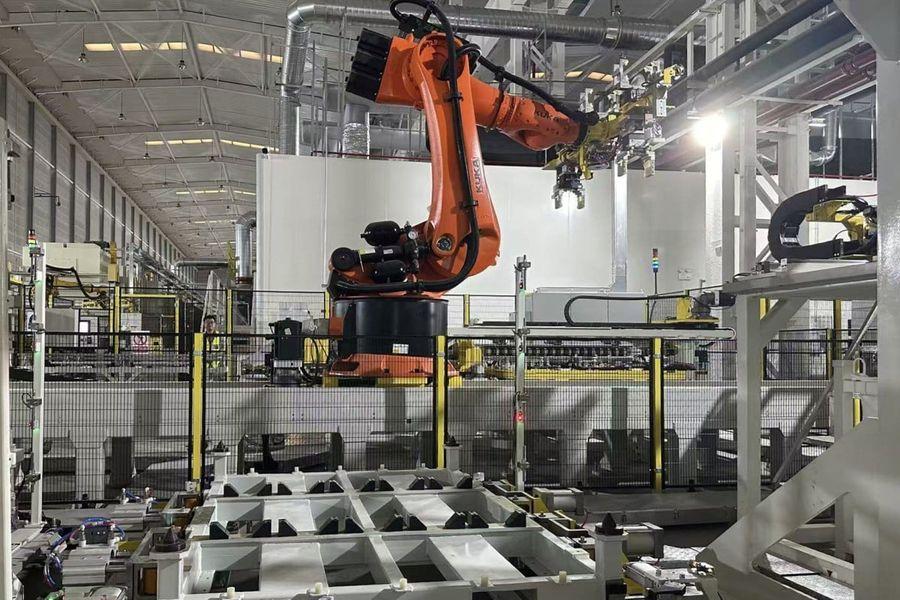
EnerVenue’s nickel-hydrogen battery facility in Changzhou. Photo: Daniel Ren
America Invented the Battery, but China Controls the Factory
Last updated 05:57 AM EST • Read time: 5m
Join the Conversation
0America invented a revolutionary battery. American taxpayers helped fund the research. A Kentucky community was promised hundreds of manufacturing jobs. Instead, the factory opened in China.
EnerVenue, a California battery company, is bringing to market nickel-hydrogen technology developed at Stanford University with research funded by American tax dollars. Its batteries require neither lithium nor cobalt, two materials whose supply chains China heavily controls. The company says its batteries can last 30 years and withstand 30,000 charging cycles.
These are batteries that could help keep America's electric grid running, power AI data centers and provide backup electricity to military installations. This is exactly the kind of technology America should be building.
In 2023, EnerVenue announced plans for a $264 million factory in Shelbyville, Kentucky, promising 450 jobs. Those plans were abandoned. This September, production began at the company's first commercial factory in Changzhou, China.
White House trade adviser Peter Navarro recently questioned whether this arrangement violates the Bayh-Dole Act, which sets domestic manufacturing requirements for certain federally funded inventions. The Department of Energy should investigate whether those requirements apply and were followed.
But there is a bigger problem here. Why could an American company develop this technology using American research and still find China a better place to manufacture it?
For decades, America has been happy to invent things and let other countries build them. We told ourselves that moving manufacturing overseas would make our economy more competitive. Instead, we lost the factories, suppliers, and skilled workers needed to bring new technologies to market.
China took the opposite approach. It built entire communities around manufacturing, bringing together machine builders, engineers, suppliers and workers. EnerVenue's leadership has acknowledged that China's manufacturing capabilities influenced its decision.
We have seen what happens when America gives up a critical part of its supply chain.
Beijing can restrict exports of refined critical minerals, drive up prices, and leave American manufacturers scrambling. We can have the factories and the raw materials, but without the ability to process them, we are still dependent on China.
Consider lead-acid starter batteries. American companies manufacture these batteries in North America and recycle approximately 99% of them domestically. They provide starting and backup power for everything from family cars to military equipment. Yet China controls much of the refining capacity for antimony, a mineral essential to many of these batteries.
EnerVenue shows the other side of this problem. Even when American scientists develop a technology that avoids certain Chinese-controlled minerals, we can end up relying on China to manufacture it.
For those of us who spent our careers defending this country, that is a serious national security concern.
During COVID-19, America struggled to produce protective equipment. We lacked not only enough finished products but also the machinery needed to manufacture them quickly. Today, our defense industrial base faces similar obstacles in expanding weapons production.
If a conflict erupted in the Taiwan Strait or South China Sea, we could not simply order factories to start producing more missiles, ships and military equipment. We would need the machine tools, components, engineers and trained workers to make them.
Economic independence has been a national security concern since our founding. In Federalist No. 11, Alexander Hamilton warned against America being confined to “passive commerce,” with foreign powers controlling its trade and shipping. More than two centuries later, the 2025 National Security Strategy acknowledges that misguided bets on globalization and free trade hollowed out America's industrial base.
America needs to start rebuilding that capacity now. Batteries are key to that capacity.
First, we must do a better job turning discoveries into American-made products. Our universities and national laboratories conduct world-class research, but too often the next step, building and testing a manufacturing process at scale, happens overseas. If it’s invented here, especially with taxpayer funds, then it needs to be manufactured here.
Second, we need to make American manufacturing competitive again. Consider Changzhou. It isn't Shenzhen or China's largest industrial center, but it has the battery manufacturers, equipment suppliers and skilled engineers that EnerVenue needed. America should be able to build similar manufacturing centers here.
That means making it easier to finance, build and operate factories in the U.S. Companies need predictable demand, reliable suppliers and confidence that government policy won't change every few years. Federal purchasing commitments, price floors and targeted financing can help private industry make investments that take decades to pay off.
We also need to cut the time and expense of building factories. The Bipartisan American Affordability and Jobs Act would help streamline permitting and bring greater certainty to projects while maintaining America’s leading environmental protections.
Secretary of State Marco Rubio recently called for America “to take back control of our critical supply chains, to reindustrialize our economy, to rebuild our defense.”
That ambition reflects a lesson our founders understood 250 years ago: national strength requires more than commerce with the rest of the world. It requires the capacity to produce what our nation needs.
Rebuilding American industry means more than protecting patents or announcing new investments. It means reindustrialization. It means having the workers, equipment, and factories to turn American discoveries into American products.
America cannot afford to invent the future while relying on China to manufacture it for us.
MG William “Bill” Crane (U.S. Army National Guard, ret.) is a former adjutant general of the West Virginia National Guard. RADM Peter Brown of the (U.S. Coast Guard, ret.) is a former homeland security and counterterrorism adviser to President Trump. They serve as chair and vice chair, respectively, of the Responsible Battery Coalition’s Critical Minerals Leadership Roundtable.

Counterterrorism and the Growing Convergence in Homeland Security and Homeland Defense
By Austin Doctor • RealClearDefense
The Future of Space Power Depends on Integration
By Damian DiPippa • RealClearDefense
America Should Unleash Cyber Privateers
By Jacob Schelp • RealClearDefense
America Invented the Battery, but China Controls the Factory
By William Crane • RealClearDefense
A Defense Win for Americans and Israelis in Arkansas
By Bradley Bowman • RealClearDefense

Key Space Force Satellites Can’t Talk to Each Other
By T. Hitchens, Breaking Defense
Blue Angels Pilot Scott Laux Removed for Failing To Uphold Standards
By Johnson, PNJ
The Future of the Ground Reconnaissance Enterprise
By Joe Albano, The Connecting File
The Future of the ARG/MEU
By William Yale, Proceedings
Big Surface Combatants are so Hot Right Now
By CDR Salamander