
Deterrence on Best Efforts: When Taiwan's Arms Come Without a Guaranteed Delivery Date
Last updated 07:26 AM EDT • Read time: 7m
Taiwan’s arms contracts treat delivery dates as estimates, and Congress should require Washington to account for the major slips.
At a defense forum in Taipei in September, Anduril founder Palmer Luckey said that the hold on a $14 billion Taiwan arms package is “definitely affecting the business,” and that “as long as that’s stuck, you don’t have continued forward progress in other areas.” He had raised it, he said, with the President. That is a hold before any sale. A different problem starts after Taiwan signs a sale agreement and waits for delivery. The standard terms in those agreements do not, as a rule, guarantee a delivery date, and if a date slips, any dispute over it goes to consultation between the two governments.
The Foreign Military Sales cases for Taiwan that have been notified to Congress and not yet fully delivered come to roughly $29.7 billion in total value, according to the Taiwan Security Monitor at George Mason University. Those cases sit at different stages, and some have no signed agreement yet. For those that do, the standard terms treat projected delivery dates as estimates rather than promises, unless a case specifies otherwise.
What the contract says
A Foreign Military Sale runs through a Letter of Offer and Acceptance, a government-to-government document with a fixed set of standard terms, three of which decide this question.
Section 1.4 promises that the United States “will use its best efforts to provide the items for the dollar amount and within the availability cited.” Best efforts obliges Washington to work toward the projected date without turning the projection into a deadline.
Section 4.1 states that “the cost of items to be procured, availability determination, payment schedule, and delivery projections quoted are estimates based on the best available data.” The same section says the United States “will use its best efforts to advise” the buyer of “delays which might significantly affect estimated delivery dates,” and adds that failing to advise “will not change the Purchaser’s obligation” to pay, so even the warning is best efforts.
Section 7.2 provides that any disagreement about the agreement will be resolved “by consultations between the USG and the Purchaser,” with neither side referring it “to any international tribunal or third party for settlement.”
What the terms do and do not excuse
The terms reflect a real constraint. The Pentagon contracts for interceptors rather than building them and cannot promise a foreign buyer a date it cannot promise its own services, so the agreement treats delivery as a projection, for Taiwan as for every other buyer. The terms also commit the United States to best efforts in warning of significant delays, and that is as far as the duty to explain goes. Nothing requires an account of why a date moved, what is being done to recover the time, or when the buyer will hear next, and the terms leave that fuller account to the seller’s discretion. For Taiwan, that gap is a strategic one.
Why it does not work for Taiwan
Taiwan carries a cost the contract does not measure. An interceptor that arrives two years late is a capability Taiwan has had to plan without while facing a live threat, and to the contract the missed date is a change to an estimate. Two features of Taiwan’s position explain why.
The first is that Taiwan has no treaty behind the deliveries. Japan has a mutual defense treaty and U.S. bases on its soil, and Poland has Article 5 and American brigades rotating through. For those buyers, an arms delivery is one signal among many about American intent. Taiwan has the Taiwan Relations Act, which is domestic law, the Six Assurances, which are policy, and the weapons. Delivery is one of the few places where the American commitment becomes physical, so a slipped date can carry more political weight in Taipei than it would in Warsaw.
The second is that Beijing can follow publicly reported deliveries and delays. After the December arms announcement, China’s foreign ministry sanctioned twenty American defense firms and ten executives, Luckey among them. A government that answers an approval that way has reason to watch what follows it, and a reported slip with no stated cause leaves room for an explanation of Beijing’s choosing. Nothing here shows that Beijing has caused a delay, and the claim is narrower, that a contract drafted as a logistics document carries part of the weight of deterrence in Taiwan’s case, so an unexplained slip costs more there than it would elsewhere.
What it explains
Seen that way, two puzzles make more sense. The first is why doubt about American reliability in Taiwan never runs out of evidence. The delays are real, the contract lets the estimates move, and nothing in its terms tells Taipei whether a slip was unavoidable or badly handled, so every delay can be cited and none settled. The second is why American reassurance so often lands flat. When an official says the commitment is unchanged, that may well be true as a statement of policy, and it still leaves Taipei without an answer to why an estimate slipped or what is being done to recover the time, so the practical doubt stays where it was.
What Washington owes, and what Congress can require
Congress need not rewrite the standard terms. It can turn the account the terms now leave to discretion into an obligation. Whenever a major delivery projection for Taiwan slips, the administration should give Taipei and the relevant committees a case-specific account covering the reason, the revised estimate, the steps to recover time and the date of the next update. Sensitive detail can go to the committees privately. Some causes will sit on the buyer’s side, as section 4.3 acknowledges when it warns that late payment “may result in delays in contract performance by DoD contractors.” The account should name those with the same candor, and a report that admits the buyer’s part where it applies is fairer to require and harder to dismiss.
The executive branch has already signed on to measuring FMS performance. Executive Order 14383, signed in February, directs the State, War and Commerce Departments to publish “aggregate quarterly performance metrics on FMS case development and execution.” Congress can build on that by requiring case-by-case reporting on Taiwan, showing for each notified sale whether it is contracted, in production, partly delivered or delayed, with a public summary and the sensitive detail given privately to the committees and, where appropriate, to Taipei. A delay listed with its stage and cause is harder for Beijing to narrate.
Taiwan accepted a system without guaranteed delivery dates because the weapons in it matter to its defense. Accepting that did not hand Taipei the job of explaining Washington’s delays. Even where the United States cannot say exactly when a weapon will arrive, it can say why the date moved, what it is doing about it, and when Taiwan will hear next.
Hong-Yu Harper Chen, J.S.D., is a U.S.-licensed attorney admitted in New York and Washington, D.C., and an adjunct assistant professor at the Institute of China and Asia-Pacific Studies, National Sun Yat-sen University in Taiwan, where she teaches international law.
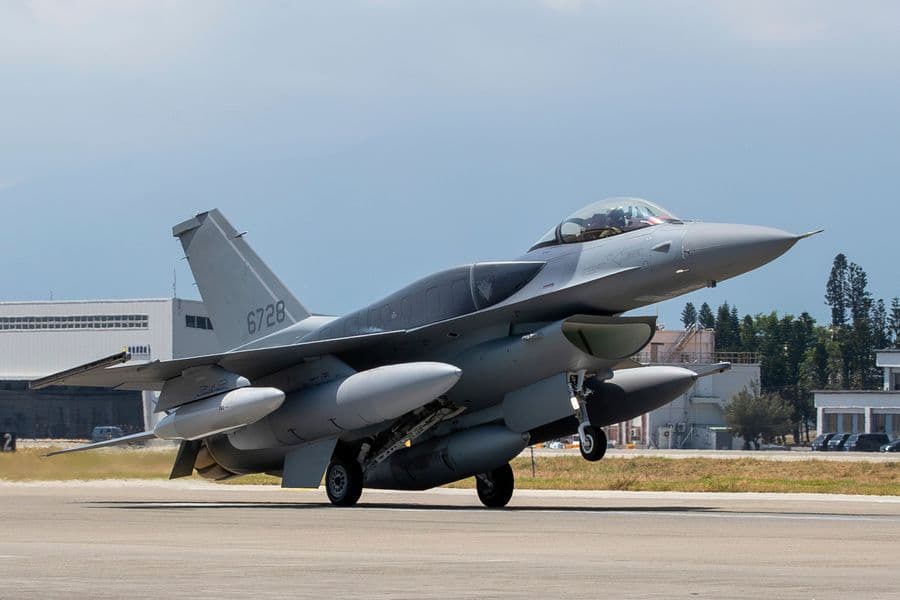
image: In this photo released by the Taiwan Ministry of National Defense, a F-16V Block 70 fighter jet, one of two delivered to Taiwan from a purchase of 66 from the U.S., arrives at the Zhi-Hang airbase in Taitung in southeastern Taiwan, Friday, Oct. 2, 2026. (Taiwan Ministry of National Defense via AP)