
Preventing the Next World War
Last updated 06:27 AM EDT • Read time: 6m
To Prevent the Next World War, the United Stats Must Secure and Defend America’s Interests in the Pacific from Chinese Aggression
It’s clear from the increasingly bellicose actions of the People’s Republic of China that the PRC seeks to return to its self-appointed role as the “Middle Kingdom” at the center of the world. To do this it must supplant the United States, both economically and militarily, by becoming the preeminent power on the world stage—at which point it will be able to rewrite the rules of the existing world order established by America after World War II.
The first step to overturning that order (and replacing it with a world order dominated by Beijing) is for China to become the world’s largest economy. The second and most threatening step is for China to make itself the dominant military power in the Western Pacific and expel American forces from the region while ending the long-standing system of alliances that the United States has maintained in the Indo-Pacific for the past several decades. The most decisive way for the PRC could do this would be to defeat U.S. forces in a large-scale military conflict.
China today is a threat in a way that the Soviet Union, even at the height of its power, never was. At its strongest, the Soviet Union’s economy was only one-half that of the United States and was handicapped by not having a population large enough to fully support the necessary economic growth of a world power. Today, the PRC economy is slightly more than two-thirds as large as the U.S. economy. China has the world’s largest navy and largest concentration of missiles, is building the largest fleet of fifth-generation aircraft, and is the world’s most rapidly growing military power.
Admittedly, the United States maintains military technological superiority over China, but quantity has a quality all its own, and China’s military expansion is impressive. The PRC regularly threatens its neighbors with economic punitive action, uses its military to carry out hostile actions against them, and even questions the legitimacy of elected governments. And it does all this while exporting its population around the world under the guise of economic support to smaller countries but actually to create economic dependence and situations for coercion.
For these and other reasons, the United States—across both Republican and Democrat administrations—has prioritized China as its primary foreign military adversary. The United States Department of War has embarked upon a massive modernization effort to field a force that can credibly deter and, if necessary, decisively defeat Chinese aggression across the Indo-Pacific theater.
And we do mean massive. This revitalization includes investments in shipyards, missile production lines, next-generation fighters and bombers, more strategic airlift and sealift capabilities, air refueling tankers, the Golden Dome missile defense system, and a strategic deterrent to carry the United States through most of the 21st century.
Given American commitments to and responsibilities in parts of the world beyond the Indo-Pacific—including the Western Hemisphere, Europe, and the Middle East—the United States must and will work with allies and partners to deter aggression from the Beijing-led axis while other U.S. allies and partners that are threatened by Russia and Iran assume a larger share of the burden for their own security.
Everyone will have to step up. Such an axis is designed to overturn the existing U.S.-led world order, which ensures much of the stability so many rely on today. Working with allies and partners to deter aggression from such an axis means identifying which capabilities, provided by which countries, are needed in the world’s theaters to deter aggression and so avoid conflict from a position of strength.
Should deterrence fail, however, the United States and its allies and partners must field the forces and capabilities—and maintain the political will—to defeat decisively any aggressive action from the PRC or its vassal, North Korea. There are positive trends that indicate this strategy would be successful. They include especially the U.S.’s military modernization plans, which include new systems such as the B-21 that will provide a credible deterrent to Chinese military planners, and the seriousness with which American allies and partners like Japan, Australia, the Philippines, and Taiwan are taking the threat from China as exemplified by their expanded defense budgets and security cooperation.
Yet while building U.S. military capability and capacity while working with regional partners and allies as a means to deter adversary aggression is critically important, it should be remembered that the most credible (and therefore the most effective) deterrence posture is the one that can achieve victory on the battlefield. There is essentially no difference between the fielding of capabilities that can best deter aggression and the fielding of those that can decisively defeat an adversary.
To secure peace, deter aggression, and if necessary, decisively defeat the authoritarians in Beijing, the United States should:
- Support a peaceful and free Pacific with the United States as the status quo power against an aggressive PRC that seeks to overturn the regional balance of power and order in its favor.
- Encourage U.S. allies in the Indo-Pacific to adopt the NATO 5 percent spending model.
- Expand U.S. airpower across the region.
- Proliferate air and missile defenses across the theater.
- Forward deploy ground-based long-range precision fires across the theater.
- Create a U.S. anti-access/aerial denial (A2/AD) zone within China’s A2/AD zone before a conflict erupts.
- Finance and sell inexpensive, asymmetric capabilities for Taiwan and the Philippines.
- Forward deploy non-strategic nuclear weapons to Guam and Korea.
- Expand maritime presence within the theater, to include destroyer and submarine operations.
“To be prepared for war is one of the most effectual means of preserving peace,” President George Washington said in his first annual address to Congress. Only by heeding his advice can we prevent China from achieving complete hegemony over the United States.
Robert Peters is Director of the Allison Center for National Security at The Heritage Foundation. Wilson Beaver is a Senior Policy Advisor for defense budgeting at Heritage.
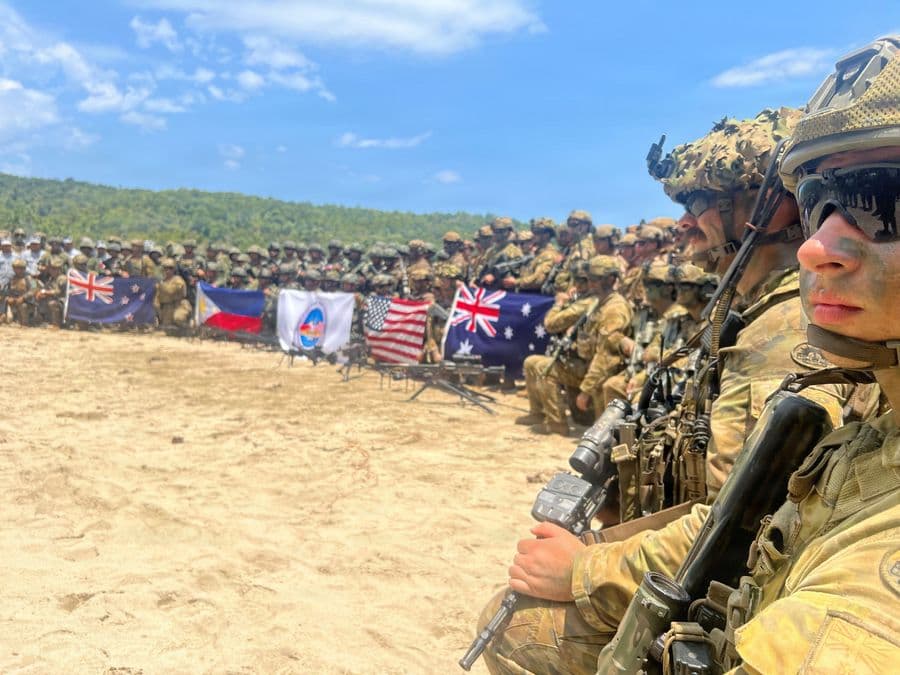
image: Service members from New Zealand Army, Armed Forces of the Philippines, U.S.
Marine Corps and Australian Defence Force pose for a photo following a counter-landing live-fire exercise during Exercise Balikatan 2026 in Palawan, Philippines, April 27, 2026. U.S. Indo-Pacific Command J7 Pacific Multi-domain Training and Experimentation Capability, provided maritime and aerial drone targets to enable troops to rehearse the full spectrum of detection, tracking, and engagement in a dynamic, contested environment. Balikatan is a longstanding annual exercise between the Armed Forces of the Philippines and U.S. military that represents the strength of our alliance, improves our capable combined force, and demonstrates our commitment to regional peace and prosperity. (U.S. Indo-Pacific Command photo by Eleanor Prohaska)