
What Happens After Deterrence Over Taiwan Fails?
Last updated 07:31 AM EDT • Read time: 6m
Hong-Yu Harper Chen is right to warn against turning Taiwan’s military preparedness into an ever-moving test of whether the island deserves American support. Washington has good reasons to press Taipei to spend more, reform its reserves, strengthen civil defense, and invest in capabilities suited to surviving a Chinese attack. But as Chen argues in her recent RealClearDefense essay, “The Taiwan Readiness Trap”, pressure intended to strengthen Taiwan can weaken deterrence if Beijing begins to believe that American support is conditional on Taipei first demonstrating some undefined level of readiness.
There is, however, a second problem lurking behind the readiness debate. It begins where most discussions of deterrence end.
What happens if deterrence fails?
Much of the American debate over Taiwan concentrates on preventing China from using force in the first place. Strategic ambiguity is defended because uncertainty is supposed to complicate Chinese calculations while discouraging unilateral actions by Taipei. Strategic clarity is advocated because an explicit American commitment might convince Beijing that an attack cannot succeed without bringing the United States into the war. Chen approaches the problem from another direction: deterrence can also be weakened if Washington inadvertently signals that its willingness to act depends on Taiwan satisfying an escalating series of demands.
All three arguments concern signals sent before Beijing acts. Yet the value and meaning of a security commitment do not necessarily remain constant once an adversary decides to test it.
A Chinese blockade, seizure of an outlying island, missile attack, or invasion would confront Washington with a different strategic environment from the one in which its Taiwan policy was originally designed. The costs of intervention would be enormous. But the costs of nonintervention could rise at the same time. American credibility with Japan and the Philippines, the military balance along the first island chain, and perceptions of the regional order would suddenly enter a calculation that previously could remain partly hypothetical.
I have called this post-deterrence problem the “Corcyra Dilemma”. The concept draws on the relationship between Athens and Corcyra immediately before the Peloponnesian War. Athens did not initially want an unlimited commitment to Corcyra. It sought something narrower: enough support to prevent Corcyra and its strategically valuable fleet from falling under Corinthian control without needlessly provoking a wider war. The result was a limited defensive arrangement and, initially, the dispatch of only ten Athenian ships under restrictive instructions.
The logic was familiar. Athens wanted deterrence without entrapment and commitment without surrendering its freedom of action. Yet once Corinth tested that commitment at the Battle of Sybota, the calculation changed. Standing aside no longer meant simply preserving the limited policy Athens had chosen beforehand. The confrontation itself changed the strategic and political consequences of nonintervention.
Taiwan could create a much more dangerous version of the same problem.
This does not mean that Taiwan is destined to drag the United States into war, nor that Washington should issue an unconditional guarantee to defend it. The point is almost the opposite. A limited commitment designed to preserve flexibility can lose some of that flexibility when it is challenged. An adversary does not merely discover whether a commitment is credible by testing it. The test can change the commitment itself.
This is where Chen’s readiness argument becomes particularly important. Taiwan’s ability to resist is not simply a prerequisite that Washington should demand before deciding whether the island merits assistance. It affects the strategic choices available to the United States after a crisis begins.
A Taiwan capable of preserving command and control, keeping its government functioning, protecting critical infrastructure, maintaining military resistance, and denying China a quick fait accompli gives Washington something extraordinarily valuable: time. Time creates options. It permits consultation with allies, mobilization of forces, economic measures, signaling, and calibrated military responses. It may also leave room for de-escalation.
A Taiwan whose defenses collapse rapidly produces the opposite effect. Washington could suddenly face a compressed choice between intervening under increasingly unfavorable military conditions and accepting a transformed strategic environment in the Western Pacific. Readiness therefore matters not because Taiwan must pass a loyalty test before receiving American support, but because Taiwanese resilience helps prevent Beijing from dictating the circumstances under which Washington must make its most consequential decision.
This distinction also suggests why American pressure on Taipei should be specific rather than conditional. Washington should demand measurable improvements in munitions, reserves, hardened infrastructure, distributed command systems, energy security, and civil resilience. These are not demonstrations that Taiwan has become “worthy” of defense. They are investments in preserving strategic options for both Taiwan and the United States.
The same principle applies to American preparations. Stockpiles, distributed forces, access to regional bases, survivable logistics, intelligence sharing, and the ability to contest a blockade are not merely instruments for convincing Beijing that aggression will fail. They are also insurance against a situation in which deterrence does fail. The stronger those capabilities are before a crisis, the less likely Washington is to discover afterward that every remaining option is either militarily prohibitive or politically unacceptable.
The readiness debate and the Corcyra Dilemma therefore point toward the same conclusion from opposite directions. Washington should push Taiwan harder without making American commitment appear contingent on an impossible standard of perfection. Taipei, meanwhile, should strengthen its defenses not simply to demonstrate seriousness to Washington, but to ensure that a Chinese challenge does not immediately deprive both governments of room for maneuver.
Deterrence is ultimately more than persuading an adversary not to make the first move. Sound strategy must also prepare for what happens if the adversary makes that move anyway.
That is the danger in allowing debates about Taiwan to stop at the question of whether deterrence will work. Beijing’s first move would not merely test the existing American commitment. It could change the costs surrounding that commitment and narrow the choices available to Washington.
The objective, therefore, should be not only to deter China from forcing the question, but also to make certain that, if China does force it, the answer is not dictated by circumstances Beijing has created.
Adam Kuź, Ph.D. is an assistant professor at Pomeranian University in Poland, specializing in U.S.–China relations, Taiwan security, and Indo-Pacific strategy.
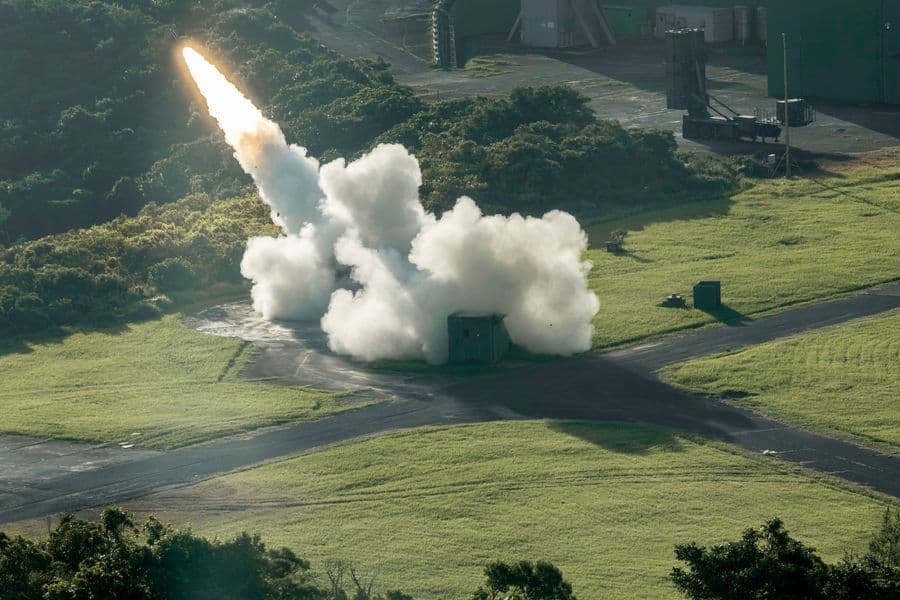
image: In this photo released by the Taiwan Presidential Office, a missile is launched during drills inspected by Taiwan's President William Lai Ching-te at a base in Pingtung county, in southern Taiwan, on Friday, Sep. 18, 2026. (Taiwan Presidential Office via AP)