
China in Our Backyard – A Wakeup Call
Last updated 09:15 PM EST • Read time: 7m
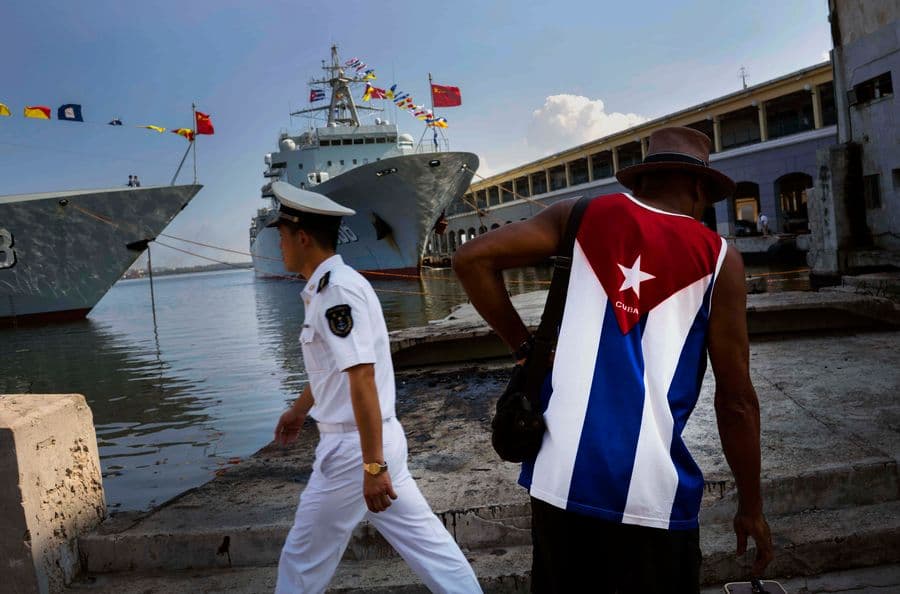
A man wearing a shirt with a Cuban flag looks at the recently arrived Chinese Navy ships while a Chinese sailor walks next him, in the port of Havana, Cuba, Tuesday, Nov. 10, 2015. The People's Liberation Army Navy is the naval warfare branch of the People's Liberation Army, the national armed forces of the People's Republic of China. (AP Photo/Ramon Espinosa)
In her official written testimony before the House Armed Services Committee in March of 2022, USSOUTHCOM Commander General Richardson provided, in illuminating and stark detail, a number of concerns and threats both resident and growing in the Southern Command Area of Responsibility (AOR). The list of vexing challenges included everything from human exploitation and smuggling to the surging problem of narcotics production and trafficking. Additionally, she highlighted the growing role of the People’s Republic of China (PRC) in the Western Hemisphere, stating that:
“Over the past year the PRC and its state-owned enterprises (SOEs) continued to target, recruit, and bribe officials at all levels in the AOR to expand their economic, political, and military influence throughout the region. PRC activities include investments in strategic infrastructure, systematic technology and intellectual property theft, disinformation and propaganda campaigns, and malicious cyber activity – all with the goal of expanding long term access and influence in this hemisphere.”
Of course, it is no secret that China has been working every angle and opportunity to challenge the U.S. and our allies in nearly every corner of the world – from greater Asia, to Europe, to Africa, and even to the Arctic. And, with a combination of interests resident in the Western Hemisphere desirous to China – from more market access, to new trade relationships, to access to energy and raw materials – the fact that the PRC is inserting itself into our hemisphere should be of no surprise.
What is more, they’re using a variety of openings, opportunities, and diplomatic means – and frankly, exploiting certain gaps the U.S. is not addressing – to ingratiate themselves with regional leadership and cement a deeper presence in the region. The PRC has been using this approach in multiple countries for several decades now – particularly in Africa, where the Chinese have accessed what they want by providing African governments with everything from no-strings-attached loans to medical aid and military hardware. And while the world has perhaps taken a more concerned view of China’s global expansion and motives in the wake of the pandemic, it hasn’t completely prevented the PRC from making links and building bridges across continents.
Closer to home, China has not only leveraged humanitarian aid and financial support to pursue its geopolitical agenda throughout South America, but is using the arms trade to secure what it wants and needs. In fact, China is one of the biggest defense exporters operating in Latin America, having “reportedly sold more than $615 million worth of weapons to Venezuela from 2009 to 2019,” according to the Council on Foreign Relations. CFR has also indicated that, “Bolivia and Ecuador have also purchased millions of dollars’ worth of Chinese military aircraft, ground vehicles, air defense radars, and assault rifles,” and that, “Cuba has sought to strengthen military ties with China, hosting the Chinese People’s Liberation Army for several port visits.”
With China clearly setting its sights on our hemisphere, we need to seriously consider how we can effectively and swiftly move to shore up our own interests, access, and influence with our neighbors in our own backyard. It is often said that nature abhors a vacuum – and if the U.S. is not making a more concerted effort to prevent vital relationships in South and Central America from sliding, China can only be expected to fill that gap. In fact, China is already moving in and establishing tight links with some of America’s longest-standing allies, such as Colombia, in the region.
In all of this, it is important to highlight the need for engagement with our most critical partners in the region – as well as the key role that certain forms of security assistance play in keeping those relationships alive and preventing other global actors with malign or problematic intent from getting a deeper foothold so close to home. And in this regard, the importance of counter-narcotics and related security assistances looms very large in the Western Hemisphere.
With the threat of narcotics production and trafficking, wider transnational crime – and the record-level misery it is causing for both the U.S. and our regional neighbors – this is one policy area that merits a revisit and potentially increased action. The drug trade fuels instability and corruption, thwarts development, destroys public trust in institutions, and contributes to an arc of death, suffering and social erosion in countries that produce, transit and consume drugs. And because of the way drugs, corruption, violence and organized crime sully a nation, the combined threat also challenges economic growth, advancement and development in vulnerable countries. And in these nations, drugs and transnational crime are existentially threatening – which is why assistance and support in combatting these problems is a policy area of common and routine priority for South and Central American countries.
At the same time, U.S. efforts to build the counter-drug capacity and capability of these nations shows a degree of commitment and dedication, which in turn can help to dissuade or prevent backsliding toward other powers like China, or Russia seeking to exploit these very same conditions for their own priorities. Working to bolster the capacities of emerging partners throughout the hemisphere, not only helps to prepare allies defensively, but also allows the U.S. to maintain more direct visibility into a wider region and its particular concerns.
On the diplomatic side, the strong body of work performed by the State Dept. Bureau of International Narcotics and Law Enforcement Affairs (INL) in checking the power of global crime, strengthening the rule of law, and giving partner nations hope for the future, serves as an example of what we can do more of to ensure our connectivity to vital partners in the Western Hemisphere remains robust. INL’s forward leaning approach to addressing transnational threats in vulnerable regions is precisely the type of anticipatory approach that is needed now – and one that should probably be enhanced in order to maintain healthy diplomatic, trade, and security cooperation connectivity between the U.S. and our friends in the hemisphere.
The U.S. and our allies have a clear, mutual interest in maintaining rule of law in places buffeted by winds of transnational crime, rising narcotics-related corruption, and other challenges. In many of these locations, the common thread is concern for critical raw materials and energy, expanded markets or increased political and security alliances; in some cases, the common interest is in simply maintaining strong institutions of order and self-determination. That said, not engaging in cooperative efforts will only assure that responses to future problems are reactive, crisis-type responses, rather than preventive outlays to keep unwanted situations from taking root and spreading out.
Broadly, maintaining interagency ties and diplomatic goodwill across the region should be a top priority for U.S. policy makers, and could be facilitated by more concerted efforts at State and in other parts of the U.S. interagency. With transnational organized crime continuing to pose the most fundamental, real-time and impactful threat to U.S. allies in the USSOUTHCOM AOR, there is a real need for the USG to not only approach this problem with a significant degree of attention, but to direct efforts and resources in a way that gives South and Central American partners a better option than one being pitched by other global actors with ulterior designs or more self-centered motives. Responding to partner nation needs – on a case-by-case basis – in alignment with U.S. objectives for each specific nation may be more important once again, not just to tackle the mutual threat of drugs and crime, but to shore up wider strategic interests in our own backyard.
Miguel Alejandro Laborde is a former NCO in the 160th SOAR (A), and a subject matter expert on defense aviation programs, capabilities and platforms, with decades’ worth of experience in the aerospace industry supporting the joint force.
The U.S. is Overpaying for Missiles
By Alex Lee • RealClearDefense
The U.S. Nuclear Deterrent Umbrella
By Peter Huessy • RealClearDefense
The Islamic Republic Can Lose the War and Still Win
By Nima Gholam Ali Pour • RealClearDefense
Talent Ecosystems: Building a Scalable National Security STEM Workforce
By Payuna Uday • RealClearDefense
The Underground Cloud
By Ben Poulin • RealClearDefense
U.S. Navy to Begin Testing for USS Lyndon B Johnson (DDG 1002)
By Naval-Technology
Marine Corps Moves To Expand Maven Smart System Account Access
By DefScoop
Navy F/A-18 Spotted With New AIM-174B And AIM-260 Long-Range Missiles
By TWZ
Pentagon’s 6th Generation Stealth Fighter Will Control Drone Swarms
By Warrior M.
Air Force Needs 1,509 Combat-Ready Jets by 2035
By Michael Marrow, Breaking Defense