
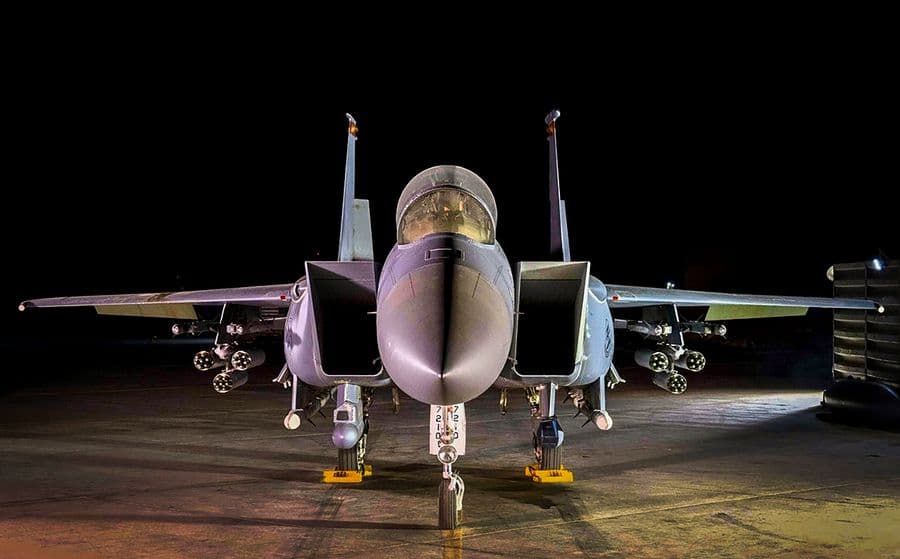
An F-15E Strike Eagle loaded up with AGR-20F Advanced Precision Kill Weapon System II laser-guided rockets waits for its next mission in the area of responsibility. (U.S. Air Force)
The U.S. is Overpaying for Missiles
Last updated 05:34 PM EDT • Read time: 4m
The U.S. cannot sustain high consumption of military systems designed for small-scale manufacturing. As Iran drains the Pentagon’s stockpiles, orders for missiles are outpacing what defense contractors can provide, resulting in backlogs. Unsatisfied with the timelines for current production rates, the U.S. is pushing to expand the defense industrial base.
This will also take time: today’s factories will need 3 years to replace every Patriot missile used in the war, and the promise to triple output won’t materialize until the end of 2030. Fixing this requires changing where the government spends on defense, not just how much. Instead of relying solely on munitions intended to be the best money can buy, the U.S. should embrace those intended to be cheap and good enough.
One example is Anduril’s Barracuda 500M, a $200,000 cruise missile similar to $1-4 million competitors. Even at this price, it functions well enough to earn contracts not only with the U.S., but also Taiwan and Poland, countries that know subpar defense equipment could bring severe consequences.
In part, Anduril achieved this low cost with off-the-shelf parts, reportedly using commercial components for about 70% of the missile. The company also heavily emphasizes designing equipment that can be made with non-specialized tooling, allowing factories outside of the defense sector to build weapons during wartime. Avoiding proprietary parts and machinery makes production both cheaper and easier to expand.
These principles are echoed by Castelion, a startup of former SpaceX engineers. Their upcoming hypersonic strike missile, known as the Blackbeard, is intended to cost a fraction of its alternatives. The Navy and Saronic Technologies, another defense contractor, will integrate the Blackbeard into their launch platforms, signaling confidence in the missiles.
Along with using commercial components to lower manufacturing costs, Castelion saves money during the development process by prioritizing real-world tests over simulated trials. This makes the testing itself more expensive, but it also accelerates timelines and keeps the workforce lean, lowering the cost of the salaries for high-level engineers.
Another approach is repurposing other munitions already made at scale. Boeing used rocket boosters to convert guided bombs into economical air-launched and ground-launched missiles, dubbed the JDAM-LR and GLSDB respectively (Joint Direct Attack Munition, Long Range; Ground Launched Small Diameter Bomb). The Navy is adopting the former, while the latter has been sold to Taiwan and combat-tested in Ukraine.
This concept isn’t limited to strike missiles. An interceptor called the AGR-20 FALCO is made by retrofitting cheap rockets with guidance systems and proximity fuzes. It’s proven effective in conflicts from the Middle East to Ukraine. Further, the U.S. has practiced shooting down drones with Hellfire missiles, which are built in higher numbers than most air defense munitions.
Ukraine further vetted this manufacturing method, and the use of commercial components, with its Flamingo cruise missile. These have warheads made from Soviet-era dumb-bombs, and recycle worn-out jet engines from civilian and military aircraft, which only need to function for a single flight.
The company behind the Flamingo claims they can build 100 per month at 1/6th the price of a Tomahawk. Simultaneously, these missiles showcased their capabilities by successfully striking targets in Russia well over 500 miles from the frontline.
All of these munitions have tradeoffs. The Barracuda’s warhead is somewhat undersized for sinking ships. Castelion's promises to scale up production remain unproven. Boeing’s makeshift missiles could be vulnerable to jamming or interception. The FALCO has relatively short range. Hellfires in counter-drone roles cost more than their targets, despite being less expensive than purpose-built interceptor missiles. Flamingos seem less accurate than Western missiles.
Affordability outweighs these shortfalls. Cheap missiles don’t need to handle every task covered by our current arsenal, only some of them. They’re supplements, not substitutes. The government and the defense contractors both know this: the Pentagon recently bought old variants of Patriots that it stopped ordering decades ago, and Lockheed Martin now offers a more budget-friendly version. Instead of replacing the Patriot’s flagship model, these measures come in addition to it.
The U.S. still needs high-end missiles, but much of this demand can be met with far cheaper munitions. Producing more of both is likely the only way to ease the increasingly serious munitions shortage.
Alex Lee is an Associate at Windham Knox. He has been featured in The Center for Maritime Strategy, The Diplomat, The National Interest, Defense News, and RealClearDefense.
The U.S. is Overpaying for Missiles
By Alex Lee • RealClearDefense
The U.S. Nuclear Deterrent Umbrella
By Peter Huessy • RealClearDefense
The Islamic Republic Can Lose the War and Still Win
By Nima Gholam Ali Pour • RealClearDefense
Talent Ecosystems: Building a Scalable National Security STEM Workforce
By Payuna Uday • RealClearDefense
The Underground Cloud
By Ben Poulin • RealClearDefense
U.S. Navy to Begin Testing for USS Lyndon B Johnson (DDG 1002)
By Naval-Technology
Marine Corps Moves To Expand Maven Smart System Account Access
By DefScoop
Navy F/A-18 Spotted With New AIM-174B And AIM-260 Long-Range Missiles
By TWZ
Pentagon’s 6th Generation Stealth Fighter Will Control Drone Swarms
By Warrior M.
Air Force Needs 1,509 Combat-Ready Jets by 2035
By Michael Marrow, Breaking Defense