
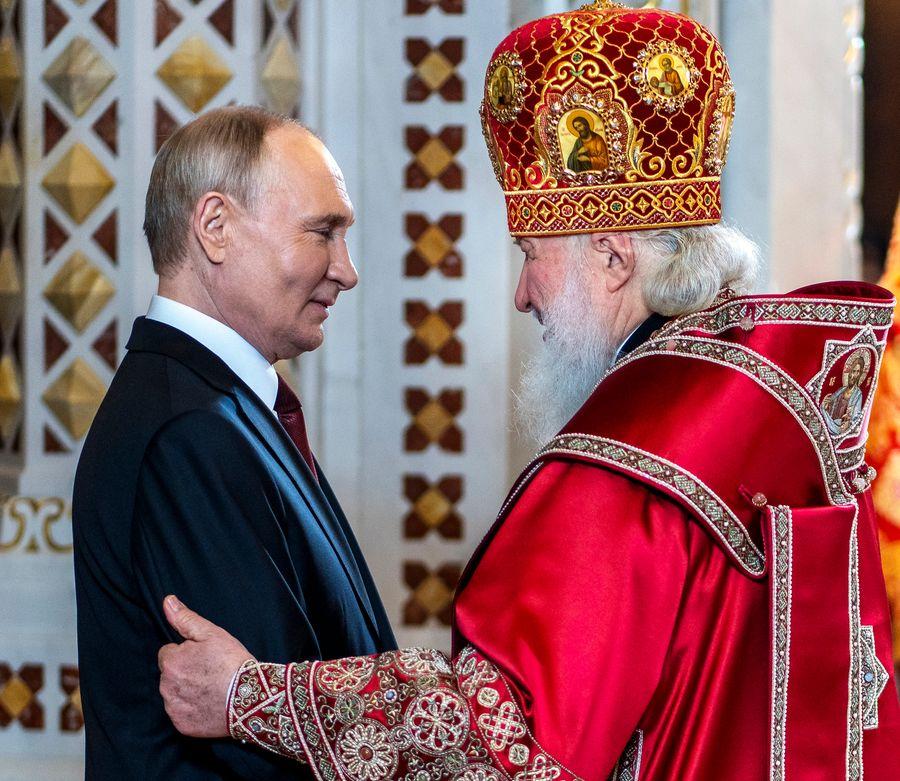
How the Kremlin's Information Warfare Influence U.S. Policymakers
Last updated 07:08 AM EDT • Read time: 6m
To combat Russian disinformation, policymakers in Washington DC must approach this critical threat as a nonpartisan national security issue and take proactive measures to identify and counter the Kremlin's operations. Once manipulated stories enter the mainstream public discourse, it becomes increasingly difficult to distinguish falsehoods from facts. As a result, the damage has already been done. We have witnessed during the months-long debate on the Ukraine-aid package, that allegations of Ukrainian religious freedom violations were able to play a significant role in stalling the agreement in the House for months. The passage of the $61B package does not negate Putin’s disinformation operation’ national security implications.
Recently, Michael McCaul (R. Tx.), head of the House Foreign Affairs Committee, and Mike Turner (R., Oh.), House Intelligence Committee Chair, accurately highlighted the Kremlin's influence on decision-makers in Washington DC. Russia, China and Iran have exponentially increased their targeted deception campaigns since Russia's full-scale invasion of Ukraine to create narratives that promote their agenda. Russia spends $1.5B on influencing foreign audiences annually, while China allocates $7B to the same purpose. The soft power strategies of these authoritarian regimes often overlap, amplifying each other’s messages that are tailor-made for specific regions and countries.
The Kremlin’s main objective is to disrupt Western unity from supporting Ukraine. As uncertainties arose around aiding Kyiv, the Kremlin moved quickly to bring them to the forefront by injecting a disinformation narrative into the US public discourse. One of the central topics that has been weaponized is the false claim that Ukraine restricts religious freedom while Russia protects it.
A typical information warfare attack has several essential elements. According to the Influence Operations Kill Chain, market research is the adversaries’ first step. This crucial component allows foes to find divisions, weaknesses, and hot-button issues in the targeted country or region to exploit it for their own agenda. A 2023 Russian document obtained by a European intelligence service and analyzed by the Washington Post proves this “It’s important to create a mechanism for finding the vulnerable points of their external and internal policies with the aim of developing practical steps to weaken Russia’s opponents.” The Foreign Policy Concepts and National Security Strategies of the Russian Federation since Putin assumed power in 2000 increasingly portray Russia as a quasi-messiah committed to protect Christianity from the declining West. However, the true reality is that Russia has been identified by the U.S. Commission on International Religious Freedom as one of the world's worst violators of religious freedom. The persecution of evangelical Christians is well-documented in the occupied territories. This did not stop Putin’s regime instantly capitalizing on the doubts formed around Kyiv’s efforts limiting the political and spiritual influence of the Russian Orthodox Church in Ukraine. Once again, the truth is different: the full-scale Russian invasion of Ukraine has made it a national security necessity for Kyiv to legally limit the influence of the Kremlin-proxy Russian Orthodox Church, which essentially has been operating as Russia’s local agents during the war. Regardless, the Kremlin’s propaganda machine has found a vulnerable spot.
The second step is to build up audiences and platforms. Ben Walters, a spokesperson for Meta, which owns WhatsApp, Facebook and Instagram said, “The Russian operations targeting Ukraine are aggressive and persistent.” An April 17 report by Microsoft revealed that in the U.S. claimed that “Messaging regarding Ukraine - via traditional media and social media - picked up steam over the last two months with a mix of covert and overt campaigns from at least 70 Russia-affiliated activity sets.” The power of persuasion lies in repetition. Russia floods multiple channels with similar and rapid content instead of relying on just one platform. In this case to conceal its religious persecution, repression, torture of religious personnel in the occupied territories, as well as the large-scale destruction of over 600 spiritual and cultural heritage sites by falsely accusing Kyiv doing the same.
Once these channels are established, the next step is to create alternative narratives, fake news, and deepfakes. Russian propaganda is notoriously masking kernels of truth with falsehoods. The twisted alternative Russian narrative is portraying Ukraine as an “anti-Christian dictatorship” a country where “satanism” flourishes, or as Russian presidential press secretary Peskov said is prosecuting a “war against Russian orthodoxy.” Meanwhile, Russia is presented as the “protector of Christianity.” The (kernel of) truth is the existence of the Ukrainian draft law to limit the Kremlin’s use of church as a soft power in time of war.
The next step is to make it seem as if the stories came from somewhere else. One way to do it is through a so-called Doppelganger operation, which mimics well-known news outlets like The Guardian and political entities like the French Ministry of Defence to spread disinformation. According to the EU Disinfo lab Russia has created at least 17 such media providers to publish fabricated articles, videos, and polls. The aim is to make fake news seem more credible and to spread them faster on social media.
As these fake messages exploit social divisions and fears that appear on seemingly credible sites, they are likely to be picked up by influential voices. For example, Tucker Carlson claimed that President Zelensky “banned a Christian faith in his country and arrested nuns and priests,” which was later echoed by Marjorie Taylor Green (R., Ga.) who said, “The Ukrainian government is attacking Christians; the Ukrainian government is executing priests. Russia is not doing that; they're not attacking Christianity. As a matter of fact, they seem to be protecting it.” Vivek Ramaswamy and Sen. Rand Paul (R., Ky.) also repeated the same message making distorted truths an inseparable part of the mainstream public debate. This is an intentional goal of Russian disinformation campaigns to get influencers to unwittingly repeat lies, known as misinformation.
The last two steps are straightforward: the Kremlin denies involvement and plays the long game.
America’s vulnerability to information operations is critically high. Most especially in an election year, when billions of dollars of foreign aid are at stake. Policymakers in Washington must not be complacent. They must be more aware, fact and source check vigilantly, promote better digital literacy, and call out these tactics for what they are—a cunning attempt to undermine Western values and, yes, religious freedom, too. Failure to do so is a betrayal of fundamental American values.
Michelle C. Watson is an American Business Executive, Visiting Senior Fellow at the Danube Institute in Budapest, Hungary, Co-creator of the Cyber Statecraft and Corporate Statecraft programs at the Institute of World Politics in Washington D.C. and former founder, CEO of Cyber Intelligent Partners in Mclean, Virginia.
Mónika Palotai is a Senior Fellow at the Religious Freedom Institute, Washington DC, Non-Resident Expert at the Warsaw Institute, Warsaw, jurist, PhD candidate at the National University of Public Services, Budapest in International Criminal Law
Kristóf György Veres is a Hungarian Historian, International Director of the Danube Institute, Budapest, Visiting Research Fellow at the Center for National Interest, Washington DC, and Non-Resident Expert at the Warsaw Institute, Warsaw.
Don’t Be Swayed by Tactical Nukes
By Benjamin Giltner • RealClearDefense
How Seoul’s Break With Kyiv Serves Trump’s Russia Turn
By Sang Won Pyo • RealClearDefense
When the Grid Goes Down, the Mission Must Go On. Solar and Storage Can Help.
By John Szoka • RealClearDefense
Data and Communications Technology are the Hidden Keys to Success for Golden Dome
By Eric Velte • RealClearDefense
The Dual Threat: Why Beijing’s Collapse Is Just As Dangerous as Its Rise
By Efraín Vázquez-Vera • RealClearDefense

USS Stout Loses Power During Port Visit Due to ‘Engineering Casualty’
By USNI News
Air Force Lessons Learned From Operation Epic Fury
By Tabitha Reeves, National Defense
Marines Need Nine More Amphibious Warships To Carry Out Its Missions
By TWZ
AFRL, ACC Fly XQ-67A Drone To Test Autonomous Teaming
By Airforce Technology
F-35B Releases Meteor BVRAAM for the First Time
By Parth Satam, The Aviationist