
Volume Manipulation
Last updated 06:58 AM EDT • Read time: 6m
Volume Manipulation has become a Bigger Problem of Influence Operations than Fake News
An Israeli artificial-intelligence firm recently warned that Chinese cyber operators are using AI agents to automate attacks on foreign governments, according to CNN. The case is another reminder that AI is not only changing cyber operations. It is also lowering the cost of cross-border political influence. As Taiwan, the United States, New Zealand, and other democracies move toward elections near the end of 2026, the use of AI to shape foreign information environments deserves more attention; Taiwan's President Lai Ching-te recently has also warned publicly about Chinese election interference.
The usual discussion of AI’s usage on influence operation focuses on fake news or disinformation. That is understandable, but it misses a more difficult problem. AI agents do not need to invent a false story to influence an election. They can instead practice “volume manipulation”: the coordinated inflation or suppression of attention online around selected topics.
Volume manipulation works through scale. A network of coordinated accounts can repeatedly post about a chosen issue, like and share friendly content, or hide and down-rank content on platforms whose algorithms punish posts that many followers mark as unwanted. The goal is not persuasion. It is agenda control. When citizens have limited time and attention, making one topic appear everywhere can push other topics out of public view.
This tactic is not new. A decade ago, researchers at Harvard University studied leaked records from a Chinese local-government online propaganda operation. Their key finding was that state-backed commentators often did not argue with critics or provide counterarguments. During politically sensitive moments, they flooded the internet with patriotic or apolitical content that distracted attention from controversy.
AI makes this old tactic cheaper and more scalable. In February 2026, OpenAI reported that Chinese state-linked actors had tried to flood anti-Chinese Communist Party conversations with pro-CCP or irrelevant content with the aid of ChatGPT. Recent debates over data centers in the United States have also raised concerns that Chinese influence operations may be using AI to intervene in American infrastructure politics.
Taiwan has seen similar patterns. During the Kuomintang's 2025 party-chair election, former KMT vice-presidential candidate Jaw Shaw-kong accused that roughly nine hundred TikTok videos supporting PRC-friendly Cheng Li-wen appeared within a month, while about 150 YouTube videos generated 1.8 million views. Around Taiwan's 2024 presidential election, a rumor about an alleged illegitimate child suddenly received heavy attention before election day, which was amplified by large numbers of suspicious accounts, including accounts using AI-generated audio and coordinated reposting. My own research found that this foreign amplification pushed this issue above policy discussion in voters' online attention right before the election Day, even though the rumor had appeared for months.
The difficulty is that volume manipulation is hard to regulate in democracies. It does not always spread false information. It often amplifies real issues, suppresses other real issues, or shifts attention toward content that is irrelevant but emotionally easy to consume. Democratic politics assumes that citizens can freely debate public issues and that attention will move when a policy window opens. Market economies also tolerate advertising and promotion. A democracy cannot and should not ban every attempt to make a topic more visible.
But foreign state-led volume manipulation is different. It uses the scale of an adversarial state and military to intervene in ordinary citizens’ attention, public opinion, and preference formation in the targeted civil society. The damage is not only that citizens may believe a false claim. The deeper damage is that they may no longer know whether a public concern is organic, whether an online controversy is representative, or whether their fellow citizens are actually saying what the algorithm makes them appear to be saying. That uncertainty weakens trust and makes democratic consensus harder to build, which is the foundation of public sphere.
What should democracies do?
For individuals, the first step is not panic, but awareness. A post with tens of thousands of likes is not necessarily a signal of public opinion. A sudden wave of pages using AI avatars, AI-generated photos, and AI-written content to discuss local politics, health, gender, tourism, or lifestyle issues should be treated with caution. Users can check when an account was created, whether its location is hidden, and whether it suddenly changes narrative before a politically important date. I have documented such narrative switching in Taiwanese information operations before, including cases involving pages that later shifted toward Chinese external propaganda.
Governments and platforms also need a transparency agenda. Laws should not try to police every opinion. They should instead make coordinated reach easier to inspect. Social media pages or groups with thousands of followers could be required to disclose aggregate geographic information about followers. Channels receiving large monthly donations could disclose aggregate donor geography without revealing individual identities. The purpose is not to expose private users, but to help the public know whether an account's apparent audience is local, foreign, or artificially concentrated. This transparency approach has been proved effective: under the European Union's Digital Services Act, large platforms must maintain searchable ad databases, and Forbes used TikTok's new library to show that Chinese state media ads, including Xinjiang propaganda, had reached millions of European users.
Volume manipulation cannot be blocked completely at the border. Like an invisible virus, it crosses platforms and reaches ordinary citizens long before governments can respond. Yet its effect depends on how much antibody a civil society develops. If citizens know that foreign volume manipulation exists, check the source of viral accounts, and refuse to treat algorithmic popularity as proof of democratic legitimacy, the tactic becomes less powerful. In the AI era, defending democracy will require not only fact-checking falsehoods, but also protecting the attention through which citizens decide what matters.
Austin Horng-En Wang is an Associate Professor in the Department of Political Science at the University of Nevada, Las Vegas. He is also an adjunct associate political scientist at RAND. He received his Ph.D. in Political Behavior at Duke University. His research interest includes cognitive warfare, global AI governance, and US-China-Taiwan relations.
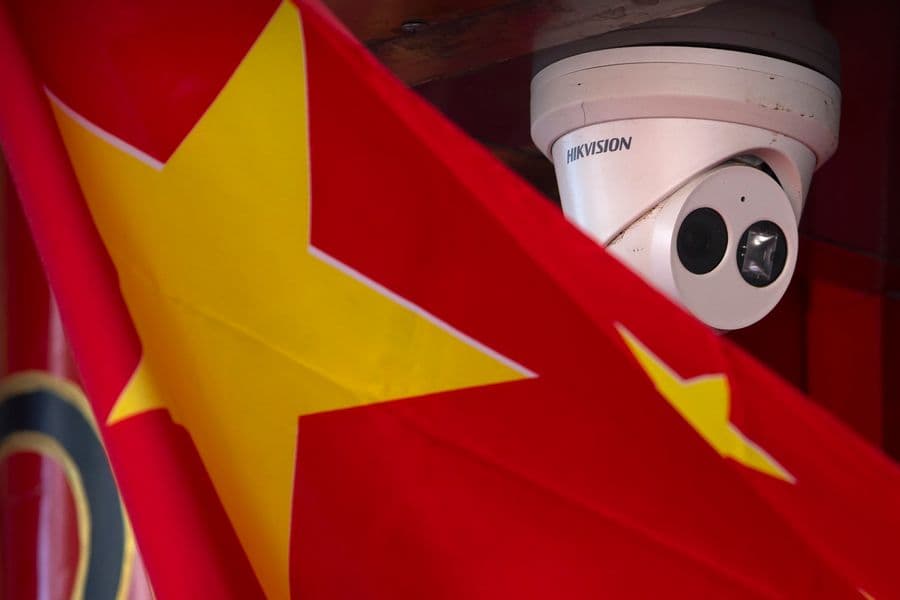
image: A Chinese flag hangs near a security camera outside of a shop in Beijing on Oct. 8, 2019. China has long been seen by the U.S. as a prolific source of anti-American propaganda but less aggressive in its influence operations than Russia, which has used cyberattacks and covert operations to disrupt U.S. elections and denigrate rivals. But many in Washington now think China is increasingly adopting tactics associated with Russia — and there's growing concern the U.S. isn't doing enough to respond. (AP Photo/Mark Schiefelbein, File)

Trump's Disrupt First, Negotiate Second: Greenland in Focus
By Meda Parameswara Reddy • RealClearDefense
In Seeking Peace With Beijing, Taipei Is an Asset, Not a Burden
By Alexandru Filip • RealClearDefense
Strike First: Israel's Inevitable Doctrine for the Iranian Axis
By Lance Gordon • RealClearDefense
It’s Not President Trump but Thomas Friedman Who Should Be Ashamed
By Francis P. Sempa • RealClearDefense
Putin, Plague, and America’s Biodefense Gap
By Ryan Kane • RealClearDefense

U.S. and Japan Begin Naval Exercises Near Taiwan
By Mari Yamaguchi • Associated PressU.S. and Japan Begin Naval Exercises Near Taiwan
By Mari Yamaguchi, AP
U.S. Navy, Gecko Robotics Surge AI Maintenance Contract
By Ceder, Simkins, Navy T.
Ghost Shark XL-AUV Payload Bay Seen For First Time
By Thomas Newdick, The WarZone
Dakota Meyer Tapped As Barracks Task Force Senior Advisor
By C. Stassis, MC Times