
Finish the Job — Close the Wallet
Last updated 06:56 AM EDT • Read time: 12m
Compel the IRGC to Choose: The Deal or Insolvency
Clausewitz wrote that war is the continuation of politics by other means. The political object, not the military result, is the test. The strategist's recurring error is tactical victory that fails to convert into the strategic outcome the campaign was designed to produce. The United States is at exactly that hinge in Iran. With President Trump's May 29 Situation Room meeting ending without his approval of the proposed Memorandum of Understanding (MOU), his subsequent announcement of an open-ended ceasefire extension with continued US blockade, and Iran's senior leadership publicly refusing the highly enriched uranium terms he demands, the question is whether the administration holds the line for the comprehensive deal the campaign earned or accepts the vague compromise that would forfeit it.
The settlement this campaign earns is the Libya 2003 disarmament model: an Iranian state that gives up the threats that justified the war, in exchange for the means to fund the Iranian state through legitimate oil sales under monitored compliance. Iran gives up nuclear weapons capability under permanent prohibition, with the full enriched-uranium stockpile removed and enrichment suspended under enforceable monitoring. It gives up coercive control of the Strait of Hormuz, with mines cleared, fast-boat threat withdrawn, and free passage under international management. It gives up the regional proxy apparatus: Hezbollah, the Houthis, and Iraqi militias as instruments of Iranian policy. It gives up the missile and drone programs as offensive instruments, with hard caps on range and inventory. In exchange, sovereignty is respected, no further strikes, no regime-change campaign; the blockade lifted, oil production permitted to recover under monitored compliance. This is the Libya 2003 model, not the Libya 2011 sequel — the analogy is to the disarmament deal, which delivered, not to events that came nearly a decade later under different conditions.
The military campaign came close. Admiral Brad Cooper, commander of US Central Command, told the Senate on May 14 that Iran is “degraded significantly across all measures of national power.” In less than 40 days, US forces systematically dismantled what Iran spent four decades building. The defense industrial base for drones, missiles, and the navy was degraded by 90 percent, with extensive strikes on weapons-manufacturing sites and naval mine stockpiles. The navy will not reach prior strength for years, and air defenses are “functionally and operationally irrelevant.” The fast-boat threat in the Strait of Hormuz has fallen from 20 to 40 per transit to two or three. Iran's proxies — Hezbollah, the Houthis, Iraqi militias — can no longer be reliably armed. The opening salvo killed the Supreme Leader and most of the senior Islamic Revolutionary Guard Corps (IRGC) and Quds Force leadership. Launch rates collapsed by 85 to 92 percent. Cooper rejected media reports that Iran retains 70 percent of its missile stockpile as “not accurate,” with the Wall Street Journal's reporting putting Iran's inventory at roughly half its prewar level, mostly short-range, command and control “shattered.” The campaign achieved its operational objectives. The strategic objective remains unrealized, and the longer the residual capability sits, the closer the reconstitution. Tactical success without political achievement is the error Clausewitz named.
The financial arithmetic is where the leverage lives. The premise is structural: the IRGC has shown high tolerance for the suffering of the Iranian people, but cannot tolerate the loss of the revenue stream that funds the security apparatus itself — the IRGC, Artesh, Law Enforcement Command, Basij, and Ministry of Intelligence are the institution; their funding mechanism is the institutional survival mechanism. Pre-war, Iran's accessible revenue ran $50-70 billion annually, with oil providing $30-40 billion in hard currency after the Chinese-refiner discount. The US-China Economic and Security Review Commission, reported by the Wall Street Journal, puts China-specific oil revenue at $31 billion in 2025: the largest single source. Obligations ran $75-105 billion annually (security apparatus, civilian functions, debt service, and proxies combined, by component). The security apparatus alone ran $23 billion (the IRGC the largest share), plus $700 million to $1 billion in proxy support, as I argued previously. The pre-war structural gap was $20-35 billion, monetized through central-bank rial printing that already drives 40 percent inflation and a rial down 95 percent since 2018.
The blockade has broken the revenue side. Crude clearing the blockade fell from 1.85 million barrels per day in March to about 567,000 between April 14 and 23 per Kpler — a 70 percent drop. Per the Wall Street Journal, fresh terminal loadings have fallen toward near-zero. Energy Secretary Wright confirmed Iran cut production by approximately 400,000 barrels per day. Iran now monetizes only its floating storage reserve, estimated by Vortexa at 90 million barrels of Iranian oil outside the blockade. China still receives about one million barrels per day from drawn-down storage, with May deliveries 25 percent below April, 38 percent below March. At sustained blockade, annualized oil revenue collapses toward $13-20 billion, and the structural gap widens to $55-90 billion annually — $4.6-7.5 billion every month.
FGE NexantECA's Iman Nasseri, formerly of Iran's Petroleum Ministry research arm, told the Journal that “Economic Fury was supposed to bring them to their knees” but that Iran is suffering the least among regional exporters. That comparison is relative, not absolute. President Masoud Pezeshkian told the Tehran Chamber of Commerce on May 27: “The main war is in the economic field. If you fail, the country fails.” Capital Economics estimates Iran's foreign-currency reserves cover no more than three months of prewar imports. On Nasseri's timing claim, a two-to-three-month transit plus a two-to-three-month payment lag means revenue from pre-blockade oil flows through October — a finite depleting reserve, not ongoing supply.
The dark fleet is the regime's hidden artery. The Journal's May 27 investigation documented how Iran moves crude to China despite the blockade — a network of aging shadow tankers conducting ship-to-ship transfers in the Eastern Outer Port Limits (EOPL), a 500-square-mile gray zone off Malaysia's coast that the Journal calls a “little epicenter of maritime lawlessness.” Iran reaped roughly $31 billion in oil revenue from China last year, accounting for about 45 percent of the government's budget. Treasury has frozen $344 million in Iranian cryptocurrency and named USDZ, the IRGC-linked stablecoin, as a sanctions target. United Against Nuclear Iran recorded 679 such transfers in 2025, up from 280 in 2023. Per the group's Charlie Brown, a former US naval officer: “China cannot get its oil from Iran without going through the EOPL.”
The interdiction ledger is mixed. CENTCOM reports more than 70 Iran-linked tankers intercepted; Lloyd's List documents 26 to 34 that evaded. The blockade is substantially effective but porous, and the Journal's investigation concludes: “to truly rein in the fleet, the United States would likely need to maintain a warlike footing against the ships indefinitely. If it lets up, the oil would likely flow uninterrupted again.”
Runway estimates converge. The CIA, via the Post, assesses three to four months before severe economic hardship. Capital Economics estimates accessible reserves cover no more than three months of prewar imports. The window is real but finite.
Four operations close the wallet.
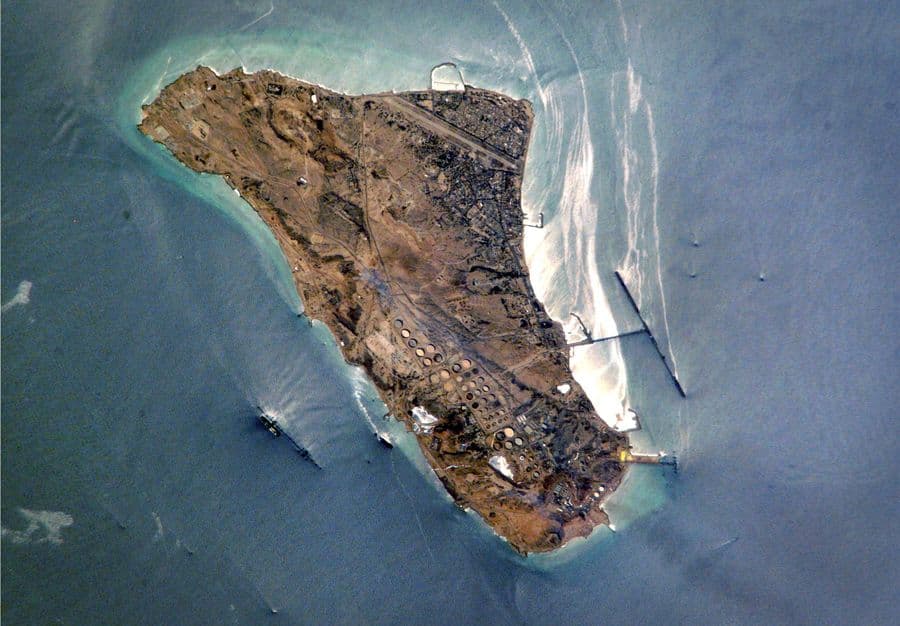
First, strike Kharg infrastructure. A single bounded denial operation against the mechanical export apparatus: single-point moorings, jetty manifolds, loading arms, pumps, control systems. Not the wells. Not the stored crude. Not the population. Subject to Law of Armed Conflict (LOAC) review, Kharg's export infrastructure is a plausible military objective because it finances ongoing hostilities and the narrow target set limits environmental consequences. Kharg handles roughly 90 percent of Iranian crude exports; the strike removes supply at source.
Second, sustain the embargo and squeeze the EOPL. Interdiction under the law of naval warfare applies LOAC principles to vessels reasonably identified as Iranian-flagged or carrying Iranian contraband. Coastal-state jurisdiction in Malaysia's exclusive economic zone is to be worked through with allies, not treated as an obstacle. The recent seizures of the Tifani, Touska, and Hasna proved the Navy can interdict from the Gulf through the Indian Ocean. What remains is absolutizing the enforcement.
Third, block the payment rail. Impose secondary sanctions on the Chinese banks clearing Iranian transactions, the teapot refiners in Shandong and Liaoning purchasing the crude, and the crypto exchanges and stablecoin issuers settling the trade. This stage costs nothing in interceptors or basing.
Fourth, force Iran to reopen the Strait on US terms — unrestricted passage, no tolls, Iran clearing its own mines as a condition of any blockade lift. Per Axios, the negotiators' draft proposed exactly these terms. But Iran's parliamentary leadership now demands “permanent management” of the Strait, and Treasury responded by sanctioning the Persian Gulf Strait Authority — the entity Iran created to extract tolls. The Jefferson principle holds: millions for defense, not one cent for tribute. The remaining work is sustained US-coalition naval presence, the credible option of limited clearance should non-performance threaten shipping, and refusal to accept Iranian management as the price of any agreement. Close the Strait as a coercive lever, and Iran's externalization of pain closes with it.
There are no guarantees in war. Iran might escalate. The materiel constraint is real: per the Washington Post, the United States fired more than 200 Terminal High Altitude Area Defense (THAAD) interceptors and over 100 Standard Missile-3 and Standard Missile-6 interceptors defending Israel, depleting nearly half the Pentagon's high-end inventory against a production line that cannot keep pace. But the Center for Strategic and International Studies has assessed the United States has enough munitions for any plausible scenario in the Iran war; the risk lies in future theaters and future years. The depletion raises opportunity cost; it does not foreclose bounded action. That is precisely why the economic instrument carries the main effort, and the Kharg strike is a single bounded denial operation, not a punishment campaign. The administration's recent selective self-defense strikes — against missile launch sites and against boats laying mines in the Strait — demonstrate this calibrated approach is already being applied. If Iran retaliates, the response remains calibrated: tanker seizures meet immediate kinetic response; proxy mobilization meets strikes on IRGC commercial assets and senior leadership; a nuclear breakout dash meets strikes on hardened nuclear infrastructure. The ladder is finite; each rung is bounded denial, not open-ended punishment.
The IRGC reads the war as proof the institution survived. The successor was installed, the regime held, significant residual capability remains. Hardliners negotiate from a winning posture. But pragmatists see what Pezeshkian saw — the main war is now economic, and the country can fail. The Memorandum of Understanding (MOU) under discussion reflects the hardliner posture, not the pragmatist one. The Foundation for Defense of Democracies, in a May 29 essay by CEO Mark Dubowitz, has urged the same standard: no deal is better than a bad one.
The negotiators' draft MOU, per Axios, is a 60-day ceasefire framework, extendable by mutual consent, built on Trump's “relief for performance” principle. The negotiators reached technical agreement on a Strait reopening with unrestricted passage, no tolls, and Iranian mine clearance, with the blockade lifting in proportion to commercial shipping. But the draft has not been signed because neither principal has approved. On the Strait, Iran's parliamentary leadership now demands “permanent management,” a position Treasury directly rejected by sanctioning Iran's newly created Persian Gulf Strait Authority. The decision belongs to the president, and President Trump's stated position is unambiguous: Iran must agree it will never have a nuclear weapon; the Strait must be reopened immediately with no tolls for unrestricted shipping in both directions; Iran will complete mine clearance; and Iran's highly enriched uranium stockpile, buried in collapsed strike-site infrastructure, will be unearthed in coordination with the International Atomic Energy Agency and destroyed. No funds will be released until further notice. Iran's senior leadership has publicly refused these terms. Ebrahim Azizi, head of Iran's parliamentary National Security Committee, declared Tehran has no intention of transferring its enriched uranium stockpile abroad. Foreign Ministry spokesman Esmaeil Baghaei called Trump's HEU surrender claim a “lie” and “baseless.” David Albright, the former UN nuclear inspector who runs the Institute for Science and International Security, has set the bar: “the goal should be to get all 10 tons of enriched uranium out of Iran” — not just the roughly 440 kilograms of near-weapons-grade material. The MOU's HEU-only focus, even when fully delivered, leaves what Albright calls “a bad deal.” International inspectors are now locked out of most of Iran's significant nuclear locations, making verification of any verbal commitment effectively impossible until access is restored. The Hezbollah-Israel ceasefire provision aside, the framework is silent on the Houthis, Iraqi militias, the broader proxy apparatus, missiles, and drones. Deferred enforcement evaporates.
This is a presidential decision. The historical record shows regimes facing genuine insolvency and credible escalation make the calculation Khomeini made in 1988: accept the poisoned chalice when the alternative threatens the institutional structure itself. Iran may still choose regime survival under economic strangulation. The framework offers the best probability of acceptable outcomes at the lowest cost and risk, not certainty.
Without all four prongs executed, military success cannot become a strategic outcome. The wallet stays open, the IRGC reconstitutes, the nuclear program survives below the Albright bar, the proxies remain in business, the missiles remain unconstrained, and the 17th CENTCOM commander inherits the same problem set.
Finish the job. Close the wallet. Earn the deal.
CAPT Lance B. Gordon, USN (Ret.) is a retired United States Navy intelligence officer. He has published on the 2026 Iran campaign in Small Wars Journal and RealClearDefense.
The Unfinished Reform
By Mark W. Castillon • RealClearDefense
Winning the Data Advantage
By Turin Pollard • RealClearDefense
The Pentagon’s Quantum Race Needs a Warfighter’s Scorecard
By Burak Oktenli • RealClearDefense
The F/A-XX and the AIM-260 Reclaim the Perimeter
By Bruce Allen Lubbering • RealClearDefense
Iranian Cyber Operations
By Michael Groen • RealClearDefense
Winning the Data Advantage
By Turin Pollard • RealClearDefenseThe F/A-XX and the AIM-260 Reclaim the Perimeter
By Bruce Allen Lubbering • RealClearDefenseWinning the Data Advantage
By Turin Pollard, RealClearDefenseThe F/A-XX and the AIM-260 Reclaim the Perimeter
By Bruce Allen Lubbering, RCD
F-22 Pilot Directs CCA in Flight as ‘Airborne QB’
By Stephen Losey, Air & Space Forces