
Global Naval War
Last updated 04:40 PM EST • Read time: 7m
The U.S. Must Be Capable of Fighting for All Eurasia
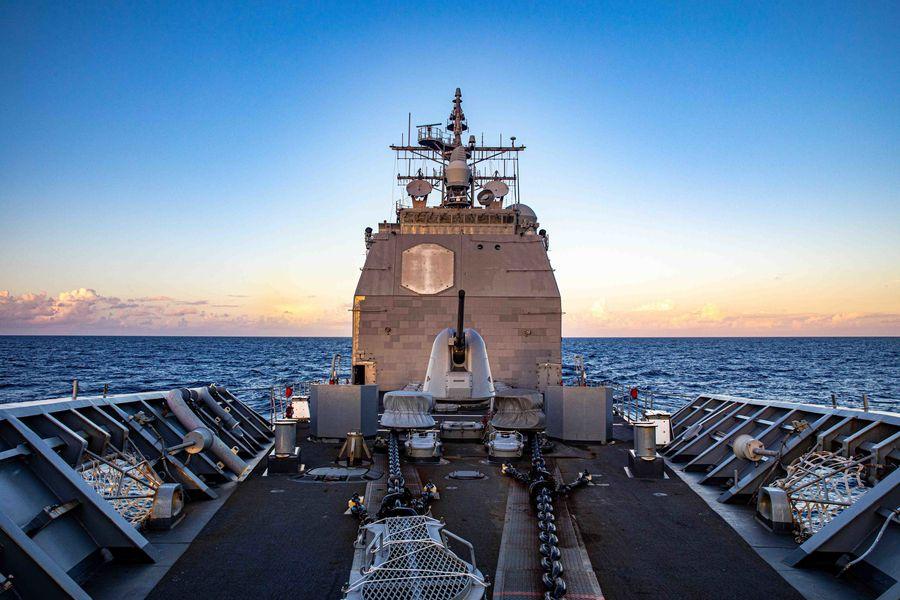
The United States faces the possibility of a global naval war around the Eurasian landmass. This is regardless of the Ukraine War’s outcome. Indeed, the perception of weakness and capacity limitations is a powerful incentive for hostile states to probe American capabilities and initiate a broader conflict.
The current geopolitical situation’s stakes are Eurasian. This stems from the nature of America’s two major competitors, China, and Russia. China’s partial about-face on Zero-Covid Policy indicates no fundamental change in the structure of its regime. The CCP remains an insular autocracy and Putin’s Russia has revealed itself as a neo-fascist dictatorship. The issue, however, is structural, albeit refracted through a historical prism.
Modern Russia and China are outgrowths of the USSR. The Russian Federation occupies Soviet Russia’s core territories, is the legal and moral successor to Soviet Russia, and most critically, is run by a coterie of Soviet-trained intelligence and security agents. Xi’s China is in part the outgrowth of the last Chinese Empire and Republic. However, the Chinese Communist Party was founded with the direct assistance of the Soviet Communist Party. The structures it employs are almost carbon-copies of their Soviet counterparts. The Political Bureau with its numerous committees, its Elite Consensus decision-making model, its rubber-stamp parliament, and especially the imbalance between the actual concentration of power in a small political elite and the pageantry of a mass electoral system, would be eminently familiar to Stalin, Lavrentiy Beria, and Georgy Malenkov.
The rulers of today’s Soviet-style states understand the geopolitical reality of autocratic power. Small autocracies can survive a significant amount of external pressure. Small pariah states can navigate the global landscape. Rhodesia and South Africa survived despite decades of international pressure, collapsing only in the context of a broader strategic competition. Libya and North Korea withstood, and in the latter’s, context still rumbles on, despite significant isolation. Their concerns are smaller, their leaders can, relatively speaking, maximize their internal control and ensure they process enough resources to shield their political economies from total ruin. By contrast, a state as massive as Russia or China will be subject to the pressures and stresses of a global system.
Prior to the Eurasianization of international trade, it was possible to monopolize one small corner of the world, even as a major power. But in a thoroughly internationalized economic system, one that stands on free trade and liberal commercial principles, the stresses of international interaction are too great. The paradox of power is that, with states as massive as Russia or China, the system must be reordered across Eurasia to ensure their domestic political systems can survive. This, in turn, requires the destruction of the U.S.-led international system.
Because this conflict is Eurasian, it is also naval. Its greatest flashpoints are enclosed maritime spaces, commercial and strategic nexus points in the Eurasian littorals – the Black Sea and Eastern Mediterranean, Strait of Hormuz, and Bab-el-Mandeb, and South and East China Seas are all crucial chokepoints for global commerce. The contest for supremacy may have landward elements, but it is essentially naval in character. This is readily apparent in Asia, where the CCP’s PLA has expanded its capabilities for the express purpose of an assault on Taiwan and concurrent naval war with the United States and its allies.
It is marginally less apparent in Europe, where Russia wages a ground war in Ukraine. Even in Ukraine, however, Russia’s objectives have been maritime in nature, if not in character. Russia seeks to conquer a country that, if added to its productive power, would give the Kremlin a stranglehold over the global wheat, corn, barley, and fertilizer supply. Ukraine added to the Kremlin’s domain would also provide it with an ideal base from which to dominate the Mediterranean, play a decisive role in the Middle East, and regulate the Suez chokepoint. Thus, even a power so decidedly continental as Russia still employs a maritime strategy.
The United States can, in the abstract, encounter each threat individually. Yet the issue is twofold.
First, these threats are likely to come in sequence. This may be intentional: a coordinated trans-Eurasian campaign is possible. Indeed, the issue of force coordinated is largely overrated. China and Russia need not fight alongside each other in the same battlespace apart from if Russia deploys its submarines to support China in the Western Pacific. Hence the question is not of operational coordination or even theater strategic coordination, but very general coordination at the political level. It may also be opportunistic at a lower level.
Major power war will be foreseeable in an operational context: it is hard to move masses of men and materiel to readiness without detection. But smaller probing actions are more difficult to anticipate. Minor revisionist powers, Iran for example, may take advantage of American distraction and use limited capabilities to stress the U.S.’ strategic position. Larger powers may employ opportunistic pressure.
Second, these threats can be deterred only by a comprehensive military prepared for large-scale war. The U.S. military is not prepared for this. It lacks the stockpiles, manpower, or industrial base to sustain a major confrontation. Ukraine would burn through American annual 155-millimeter shell production in two weeks, and annual American Anti-Tank Guided Missile production in two months. Unmanned Aircraft System platforms in Ukraine last three or so missions and are destroyed at 90 percent. War is massively expensive and requires a massive amount of equipment. This is true on land and at sea. Platforms themselves are irrelevant if they cannot be sustained in combat. And the U.S., with its atrophied industrial base, will struggle to expand production within the next two to five years.
There is a significant danger that the U.S.’ allies identify a window of opportunity in which, despite its nominal military superiority, it lacks the stockpiles to fight and win a long-term major-power war. A multi-front war would be immensely stressful to American capabilities. It may be reasonable to expect, despite capability gaps that persist between the U.S. and its rivals, that a coordinated campaign in Europe, Asia, and the Middle East would crack the United States. This can be prevented. The U.S.’ ability to deter conflict should be regained.
Meanwhile the U.S. Navy - the primary warfighting arm for any future Eurasian conflict, must be expanded and better-resourced. The current NDAA is a start, providing $45 billion more than the Biden administration's initial proposal. Yet this is, at best, a minimal initial move. The Pentagon expects China's combat fleet to grow from its current level of 340 ships to 400 by 2025, or 20 ships yearly. Were the U.S. to build 20 each year, it would reach—in 2025—slightly above China’s current fleet size, but the Biden administration isn’t even planning to build half that number.
The U.S. should accelerate the production and delivery of the Navy's new Constellation-class frigates and deliver the new Ford-class carriers more rapidly. Equally relevant, it must keep older ships in the fight: it is unacceptable to retire submarines at a rate faster than they are built, particularly when the retired boats are eminently capable combat platforms. To undergird this all, the Navy in particular, and military in general, must recruit far more effectively without sacrificing standards of seamanship and competence.
Seth Cropsey is the founder and president of Yorktown Institute. He served as a naval officer and as deputy Undersecretary of the Navy and is the author of Mayday and Seablindness.
Don’t Be Swayed by Tactical Nukes
By Benjamin Giltner • RealClearDefense
How Seoul’s Break With Kyiv Serves Trump’s Russia Turn
By Sang Won Pyo • RealClearDefense
When the Grid Goes Down, the Mission Must Go On. Solar and Storage Can Help.
By John Szoka • RealClearDefense
Data and Communications Technology are the Hidden Keys to Success for Golden Dome
By Eric Velte • RealClearDefense
The Dual Threat: Why Beijing’s Collapse Is Just As Dangerous as Its Rise
By Efraín Vázquez-Vera • RealClearDefense
USS Stout Loses Power During Port Visit Due to ‘Engineering Casualty’
By USNI News
Air Force Lessons Learned From Operation Epic Fury
By Tabitha Reeves, National Defense
Marines Need Nine More Amphibious Warships To Carry Out Its Missions
By TWZ
AFRL, ACC Fly XQ-67A Drone To Test Autonomous Teaming
By Airforce Technology
F-35B Releases Meteor BVRAAM for the First Time
By Parth Satam, The Aviationist