
Shaping Maritime Security in the Gulf: How Maritime Autonomous Systems Can Help
Last updated 07:19 AM EDT • Read time: 4m
The threats to maritime security in shipping in the Gulf and the littoral regions including the Red Sea are significant and deadly. There is a baseline interest the nations who ship through these waters have in terms of maintaining maritime security. And the Houthi attacks only underscore the need for a comprehensive international monitoring and defense capability to be put in place for the long term.
Fifth Fleet is uniquely positioned to lead a way forward. It is double hatted as a CENTCOM component and as command of the Combined Maritime Forces headquartered in Bahrain.
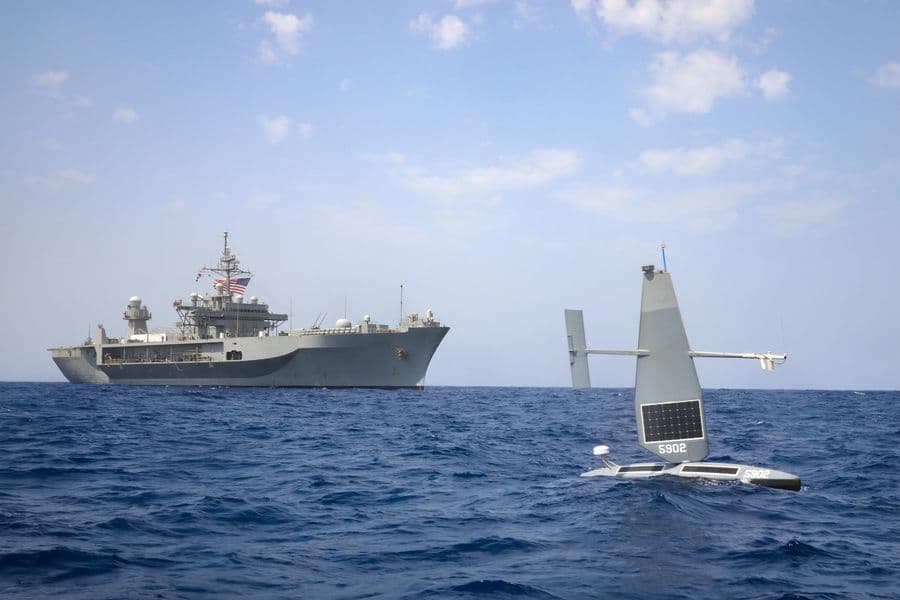
Fifth Fleet has also has led the U.S. Navy’s efforts in working maritime autonomous systems through Task Force 59. And in those exercises, maritime autonomous systems have successfully contributed not only ISR payloads but have been able to test the use of weapons launched from a MARTAC USV.
It is now prime time to establish an ISR USV enabled grid in the region which the Combined Maritime Forces command can leverage to enforce maritime security operations against threats to shipping. The command can use the unmanned platforms to deploy a variety of ISR payloads contributed by the member nations to create a common ISR data space which can leverage the kinds of actions deemed necessary and appropriate.
Putting high value U.S. Navy manned assets in harm’s way makes absolutely no sense. The future is now not in some distant force redesign future.
I have focused on the here and now and how to build forward from that point into the future in my new book entitled, The Coming of Maritime Autonomous Systems: Empowering and Enhancing the Kill Web Force. The payload revolution is here but if the United States simply wants to focus on what capital platforms can do, we will never effect the change that is available now.
As Lt Gen (Retired) Steve Rudder, the former MARFORPAC Commander, underscored in the foreword to the book:
“To date, the U.S. has limited experience in this rapidly evolving area. The Navy has invested heavily with a strategic plan to acquire medium, large, and extra-large “unmanned vehicles” to operate both on the surface and underwater, but relatively little effort on small and very small USVs.
“The Navy and Marine Corps also face a major problem of coming to terms with how to use a kill web of USV and UAVs. As speed and response time provide the physical attributes of unmanned maneuver and fire, USV lethality options come in many different categories from providing targeting solutions for joint weapons to being a weapon itself as in Ukraine.
“The book highlights the ability for unmanned craft to operate as a lethal system integrated with the fleets. USVs operating at speeds of 100 knots would have great effect with the Switchblade loitering munition, Naval Strike Missiles and/or torpedoes. Large numbers of networked maritime USVs would be very difficult to detect and equally as difficult to fire upon with today’s defense systems.
“Although the potential for lethal operations for USVs is impressive, it is also about the full spectrum of operations from ISR, Personnel Recovery, and Logistics. For each maritime problem around the world, there are simply not enough ships or aircraft for persistent domain awareness. We will not in the foreseeable future have the capacity to put capital assets continually forward to fill that gap. UAVs and USVs, notably working together, can fill such a gap cost effectively.”
What Rudder highlighted can be got on with now in shaping a new approach to managing maritime security in the littoral region of the Gulf. It is nice to have a Replicator project, but when you have a real world problem staring you in the face, we do not need another programmatic “solution.” We need creative real world action.
Robbin Laird is A long-time analyst of global defense issues, he has worked in the U.S. government and several think tanks, including the Center for Naval Analysis and the Institute for Defense Analysis. Read Robbin's latest book: The Coming of Maritime Autonomous Systems: Empowering and Enhancing the Kill Web Force
The Unfinished Reform
By Mark W. Castillon • RealClearDefense
Winning the Data Advantage
By Turin Pollard • RealClearDefense
The Pentagon’s Quantum Race Needs a Warfighter’s Scorecard
By Burak Oktenli • RealClearDefense
The F/A-XX and the AIM-260 Reclaim the Perimeter
By Bruce Allen Lubbering • RealClearDefense
Iranian Cyber Operations
By Michael Groen • RealClearDefense
Winning the Data Advantage
By Turin Pollard • RealClearDefenseThe F/A-XX and the AIM-260 Reclaim the Perimeter
By Bruce Allen Lubbering • RealClearDefenseWinning the Data Advantage
By Turin Pollard, RealClearDefenseThe F/A-XX and the AIM-260 Reclaim the Perimeter
By Bruce Allen Lubbering, RCD
F-22 Pilot Directs CCA in Flight as ‘Airborne QB’
By Stephen Losey, Air & Space Forces