
An Island Surrounded by a Ring of Fire
Last updated 05:28 PM EDT • Read time: 11m
Jordan, Its Strategic Importance, and What the U.S. Can Do to Help in the Current CrISIS
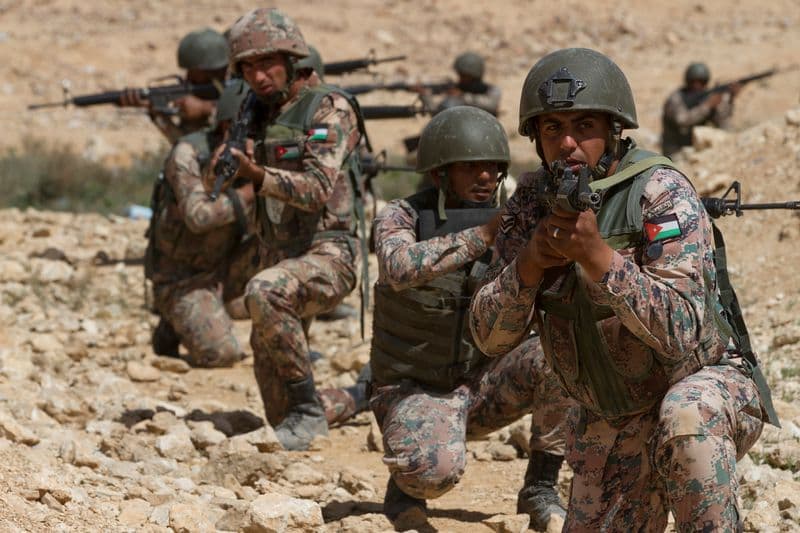
An “island surrounded by a ring of fire” is how General Mahmoud Freihat, the Jordanian Chairman of the Joint Chiefs-of-Staff, once described Jordan.i Its location (next to Israel, Egypt, Syria and the Gulf States) and political climate have played a key role in helping the United States combat Islamic extremism and promote the rule of law in the region. To better understand Jordan’s strategic importance to the United States, it is critical to understand the broader issues in the Middle East causing instability and Jordan’s posture in meeting these challenges.
The Ring of Fire: Islamic Terror Has Surrounded Jordan
Today, Jordan is surrounded by the growing threat of Islamic terror. Bordered on the North by Syria, and Iraq to the East, where both countries are now home to thousands of Da’esh fighters and their families. Though Da’esh is losing ground almost daily their ability to infiltrate Jordan remains a threat. Saudi Arabia to Jordan’s South is among the world’s leading exporters of radical Islam. Israel, the Gaza Strip, and the West Bank to Jordan’s West are home to Hamas and their terrorist factions the Israelis have been combatting since 1948. Hezbollah, another terror threat, is not far away in Lebanon to Jordan’s Northwest. Egypt’s Sinai Peninsula, just a few short miles from Jordan’s only port city, Aqaba, is yet another growing hotbed for Da’esh. Despite the threat of terror in neighboring, Jordan has continued to exist relatively free from the influence of this “ring of fire.”
Saudi Arabia is a cultural breeding ground for extremists, derived from Wahhabist . Exporting religious extremist ideology from Saudi Arabia represents a growing threat to the stability of the region. Jordan shares its longest contiguous border with Saudi Arabia. The export of this brand of extremism is realized through a network of charities supporting the transplantation of Wahhabi doctrine internationally which are supported by the Kingdom of Saudi Arabia and its citizens. These so-called charities fund the building of madrassas and mosques all over the world, staffing them with theologians of the Wahhabist doctrine. This carefully crafted strategy serves to spread this extremist ideology around the world leading to new generations of potential new extremists. To be fair, Saudi Arabia’s efforts to stamp out pro-terrorism ideologues are ongoing, but as of yet, are largely ineffective and lack full support. In fact, government rehabilitation centers in Saudi Arabia for terrorists likely promote individuals to return to terrorism.
To Jordan’s west, like Saudi Arabia to the South, instability has been boiling over for decades. Israel and the West Bank, with the Gaza Strip, Lebanon, and Egypt all very close by, are gripped to forestall extremists. For Israel, terrorism and small wars are all too common part of life. Since Israel’s establishment in 1948, they have fought fifteen separate small and large scale engagements with their Arab and Palestinian neighbors. Through it all, Israel has more experience battling domestic terror than any other country today. Persisting tensions exist between Israel and the Palestinian Liberation Organization in the West Bank and Hamas, in the Gaza Strip. Similarly, Lebanon is home to Iranian proxy Hezbollah. Da’esh is also developing a strong following in Egypt’s Sinai Peninsula. Despite Israel’s relative stability, the trend indicates the growing presence of extremist sympathizers in the Western Levant and North Africa who seek the destruction of the Jewish state.
Finally, to Jordan’s north and east lay Iraq and Syria, the homeland of Da’esh and their adherents, the greatest existential threat to Jordan’s stability. Jordan has taken a proactive approach by helping the U.S. led international coalition in displacing and eradicating Da’esh, but they still face significant challenges, such as Da’esh members still emanating from Iraq and Syria. Many of these members are looking to Jordan as a result of Turkey pressing hard from Northern Syria, the U.S. multinational coalition fighting Da'esh in Northern Iraq and Eastern Syria, and the Assad led Syrian Army, along with Russian support, attacking from the West. The single natural line of escape left open is south to the desert lands leading into Northern Jordan. Among the many problems facing Jordan is their inability to monitor and control their northern border. This same threat is exacerbated by refugee camps located along the Jordanian-Syrian border that hold tens of thousands of Syrian refugees that can easily blend in with the civilian refugee populace before entering Jordan. The most successful at infiltrating Jordan, whether by legal means, bribery, or otherwise will likely continue spreading their extremist ideology in Jordan.
The International Monetary Fund characterized Jordan as “preserving in a difficult regional environment.” The regional outlook for the past seven years has been bleak with the rise of Da'esh. There is promise ahead as shown by Da'esh’s recent losses of Mosul, Raqqa, and significant swaths of land in Iraq and Syria. The region, however, will continue to be plagued by extremism for the foreseeable future. The defeat of terrorist groups on the battlefield is attainable, but eliminating ideologies takes decades of reverse education and opportunity building. Ensuring Jordan and the international community maintain the fortitude and economic capacity to undertake this enormous endeavor is crucial. Since ideology is not limited by borders, ensuring Jordan’s regional neighbors can do the same will be critical.
The Island: Jordan, Their Struggles, and Importance to U.S. Interests
Despite all of the issues Jordan’s neighboring states now face, it has continued to exist relatively free from the “ring of fire” surrounding them. Jordan has many of its problems which in-and-of-themselves are significant. In the past couple of years, terror incidents have been on the rise in Jordan. Four separate terror incidents took place in 2016 alone. Jordan’s larger problem, however, is the economic depression gripping the country which has lasted over a decade. Economic reform efforts only manage to keep the country floundering in the face of a rising Da’esh. The rise of Da’esh has been a severe hit to Jordan’s private sector, placing a significant strain on the country with the largest part of their workforce employed by the government. These economic factors feed the rise of the disenfranchised and those more susceptible to promises of change by radical terror groups.
Jordanians are a proud people not concerned about Da’esh coming over their border. However, they are concerned about the growing internal threat of Da'esh and their supporters. The number of terror incidents in Jordan has risen substantially. The Monarchy did escape the 2011 Arab spring, but the mass protests demonstrated the existing divide between the elite and the disenfranchised. Before a Jordanian pilot being burned alive by Da'esh in 2014, only 62 percent of Jordanians considered ISIL a terrorist organization. That number changed to over 90 percent after the incident, demonstrating that much of the Jordanian populace is susceptible to Da’esh ideology. This radical ideology emanates throughout every social class in Jordan, including the political elite and highly educated. As of 2016, approximately 2500 Jordanians have joined the ranks of Da'esh in Syria.
As troubling as the rise of terror incidents and extremist views in the region is Jordan’s economic outlook. The country continues to slide closer to insolvency. Between 2010 and 2015 Jordan’s debt doubled, ballooning to 90 percent of Gross Domestic Product (GDP). In large part, this rapid growth in debt was due to an Egyptian natural gas pipeline being abruptly cut off due to attacks on it in the Sinai Peninsula. Subsequently, the Jordanian government implemented more expensive alternatives for their country’s energy needs. Reliance on foreign aid continues to grow, with the majority of support coming from the U.S. and Gulf countries. Today, almost 10 percent of Jordan’s government spending comes from foreign aid. The U.S. alone directly contributed $1.3 billion in aid in 2017. While spending has risen, Jordan continues to show limited signs of turning around its perennially weak economy. Jordan’s largest employer, the government, employs a staggering 42 percent of the country’s workforce, many of whom still struggle to make ends meet. Due to the instability in the region, tourism levels have dropped 70 percent since 2010. Compounding the problem is Jordan’s growing humanitarian requirements to support the 1.3 million Syrian refugees.
Lack of economic and social opportunity are some of the biggest factors contributing to the rise of extremism worldwide. People are coming from poverty with little to no opportunity and are far more likely to gravitate towards the temptations offered by extremist organizations. In Jordan, women constitute 13 percent of the labor force while youth unemployment hovers around 30 percent. Officially, overall unemployment is at 15 percent. However, the female and youth unemployment rates have led critics to believe that the official numbers are dramatically understated. Even more disconcerting considering Jordanian’s median age is 22 years old, a prime age for Da'esh recruits. Da'esh recruiters offer new opportunities for the disenfranchised, such as Jordan’s refugee population, who have even fewer opportunities. Indeed, the refugee crisis alone has added 20 percent to Jordan’s total population creating a shortfall of resources within the country.
Jordan’s importance to U.S. interests in the Middle East has become even more critical with the rise of Islamic extremism. While the Islamic State is showing signs of waning, extremism is not. Jordan has, thus, been called “too strategic to fail.” Except for a couple of miles of coastline, Jordan is a crucial juncture uniting the Arab world with Africa and Asia by land and sea. The Suez Canal and the Red Sea are some of the most trafficked and important sea-lanes in the world’s economy. A collapse of the Jordanian government could create a new tidal wave of support for the extremist movement around the world and could unite terror groups in North Africa, the Levant and the Arab world, threating sea-lanes vital to world trade.
What the United States Can Do
General Freihat’s metaphor for his country as “an island surrounded by a ring of fire” is sound reasoning. Jordan has made a commendable effort isolating itself from the fires of extremism around them. However, the fact remains that those fires still pose a significant threat. Da'esh is reeling from its recent defeats in Mosul and Raqqa but is still functioning. Geographically, Jordan is in the midst of all the Middle Eastern and North African turmoil, and many of its people are likely recruiting targets of Da’esh. The country’s economic anemia only heightens Da’esh’s appeal to Jordan’s disenfranchised. To prevent a tide of extremism from pulling Jordan under, the United States must expand economic and military aid to Jordan.
Militarily, Jordan must be capable of identifying and defeating pockets of extremism internally and externally. The United States’ experience in these areas can help hone their military capabilities. Furthermore, many of Jordan’s military problems stem from budgetary constraints. The United States’ financial aid to Jordan continues to be critical to the operations of their government. We must remain a consistent ally and source of aid for them.
Military support to Jordan requires concurrent diplomatic efforts aimed at economic and financial assistance to the country. Jordan’s economic stability is paramount to their security, and they are already on the edge of an economic precipice. The United States can do more to support the country’s private sector development through government assistance. Greater infusions of money and diplomatic efforts to reduce the costs of trade would help significantly. The U.S. Department of State must do more to help influence matters of state and policy in Jordan to spur economic and legal reform too.
More than anything else, economic development and job opportunities will stymie the tide of extremist fervor. That effort will also require a commitment to the economic development of the entire region since extremist ideology knows no borders. A must for the United States as long as extremism remains a threat to our way of life. Failing to support Jordan now could result in the United States having to dedicate exponentially more resources to the region in the future.
Captain Robert Clifford is an infantry officer in the United States Marine Corps. Any views in this article belong to Robert Clifford and do not represent the views of the United States Marine Corps.
Note:
i. General Friehat, Mahmoud. (2017, January 14). Eager Lion Initial Planning Conference Opening Remarks. Amman, Jordan.

The Services Do Not Need a Four-Star Autonomous Warfare Command
By Steven Wills • RealClearDefense
Honor Them While There Is Still Time
By Jeffrey Rosales • RealClearDefense
From Siberia to Fairford: How Operation Spider’s Web Has Changed the Rules of Airpower
By Frank A. Rose • RealClearDefense
Faster Simulations, Better Defense Decisions
By Rut Lineswala • RealClearDefense
Will HASC Have an Oversight Subcommittee in the Next Congress?
By Christopher J. Bright • RealClearDefense

Hegseth Barred Trans Troops. Military Boards Are Rejecting Those Orders.
By NYT
Closing the Sea: Lessons from Ancient Mediterranean Blockades
By DeCasien, CIMSECFrom Siberia to Fairford: How Operation Spider’s Web Has Changed the Rules of Airpower
By Frank A. Rose • RealClearDefenseFaster Simulations, Better Defense Decisions
By Rut Lineswala • RealClearDefense
Bombers Could Have a Major Air-to-Air Combat Role
By Joseph Trevithick, The WarZone