
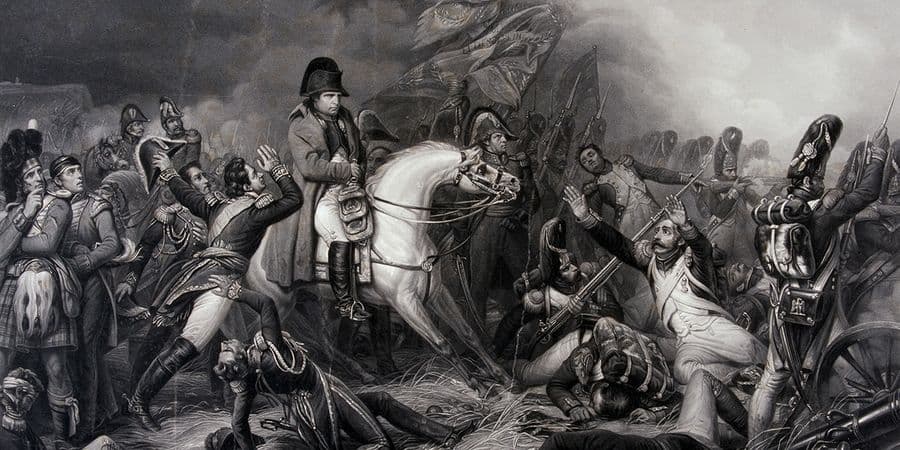
The Battle of Waterloo – Lessons for Warfighters Today
Last updated 08:15 AM EDT • Read time: 12m
The battle would “reverse the tide of European history,” wrote the eminent British military historian John Keegan. On this date—June 18th—two-hundred ten years ago on a Sunday in 1815, one of the most decisive battles in human history was fought near the quiet Belgian village near nine miles south of Brussels known as Waterloo. Combatants facing off were the Allied armies of the British and Prussians (led by Wellington and Blucher respectively) and the French army of Napoleon.
In three previous days of combat, Napoleon’s reconstituted Armée du Nord moving north from France had soundly defeated the Prussians at Ligny and fought the British and Allies to a draw at Quatre-Bras. Following those actions, with his Allied army in retreat, Wellington made his decision to stand and turn to face the French at the wide valley south of Waterloo village to confront Napoleon’s advancing army.
It is difficult for military personnel today to conceive just how compact the dimensions of Waterloo battlefield are and how localized the various actions were that day. The combined armies, numbering over 140,000 combatants, started only 1,200 yards apart and the nature of the combat meant that much of the fighting was in close quarters. Of participants, one in three would be a casualty (killed, wounded, or missing) that day. The action took place in a box that was just two miles long and about one mile deep; meaning visitors today can walk between the two most distant points on the battlefield in about thirty minutes.
Untold written volumes thoroughly dissect both the battle and its central figures—Wellington and Napoleon. But the intent here is to offer for consideration three very human battlefield lessons—plus questions—with applicability for warfighters even today from events that Sunday two hundred-plus years ago.
Do Warfighters Have Ideas Where They Will Fight Tomorrow’s Battles?
One of the most fascinating, but little-known, facts about Waterloo is that the Duke of Wellington had selected his defensive positions on the gentle northern slopes of the valley south of Waterloo in the summer of 1814, a year earlier.
Wellington was travelling from London to Paris to assume his appointment as British ambassador to the new French regime of King Louis XVIII. While also visiting the newly created Kingdom of the Netherlands, the Duke agreed to inspect defenses along the French border as well as British troops stationed there as guarantors of its security. At the time, prospects of renewed war with France seemed unlikely and remote given that Napoleon was then in exile on the island of Elba.
Still, Wellington spent a fortnight touring the borderlands and making recommendations on restoring fortifications of a handful of towns. As he travelled “old habits die hard” and he found many places which, as he noted, were “good positions for an army.”
One of those good positions was a valley, unremarkable to an untrained eye, but for Wellington, a place where an invading army, marching from France towards Brussels, would “find life horribly difficult.” It was not the only route an invading army might follow, and not the only defensive position Wellington noted in his two weeks, but the ridge and its strongholds stood crosswise to a very likely invasion route (with the key city of Brussels the prize) a French army might follow. Wellington took note of this place.
Today, “old habits [must again] die hard.” Since a U.S. warfighting commander will be, like Wellington, at least initially on the defensive if war broke out, have they previously surveyed their theater to consider where they may have to confront and engage their adversary? Are today’s commanders versed in geography, topology, meteorology, climatology, and other factors shaping their potential battlespaces? Are warfighters conversant on how those factors may influence the employment of joint forces and capabilities in a particular location, situation, or environment? Are there assessments of what objectives an adversary would pursue and how that adversary would employ its forces and capabilities in those same spaces? Do warfighters have in mind their countermeasures needed to blunt initial adversary offensive operations?
If Wellington had to determine both whether Napoleon’s larger objective was Brussels or the Channel ports, and when and where were best to engage him, have today’s warfighters at least considered their own viable responses to the “what ifs” of their theater? Have warfighters, like Wellington, proverbially “walked the ground”—today in all domains—beforehand, where their battles, engagements, and combat would potentially take place?
Such determinations will be an even greater challenge for commanders given the extended distances and dimensions involved in warfare today; the speed, sophistication, variety, and range of capabilities and forces to employ, not only by their own component but by other joint forces; along with advanced and rapid command, control, and communication of those capabilities.
Do Warfighters Know How to Wield the Variety of Forces and Capabilities Available to Them?
To a Napoleonic era field commander, the forces, and capabilities available to them consisted primarily of three combat arms: cavalry, infantry, and artillery, with those arms employed on land at the speed of human and animal (mostly horses) endurance. Yet, despite the comparative simplicity and straightforwardness of combat with only those three arms, there were still principles, maxims, practices, and ‘art’ to their employment that could determine a commander’s battlefield success (or failure).
For example, the insertion of cavalry into a battle required firsthand observation and a sense of timing. The prompt decision of an officer in the field could count for more than the judgment of his commander in chief. Further, when a cavalry charge is not supported with advancing infantry to exploit the chaos and disruption imposed on opposing formations, a commander may have expended his cavalry arm with little to show for the effort. Conversely, at Waterloo, French cavalry famously was never able to break the Allied infantry squares that were employed as such an effective countermeasure to massed cavalry attacks.
For infantry, would a unit best achieve its objectives by advancing in line or column? How would infantry be employed in coordination with the cavalry arm? Would topography of the battlefield area dictate how infantry units were best employed? Would skirmishers go in front of advancing infantry formations attempting to break up and disorganize opposition defensive formations? Which formation boosted firepower or instead favored deployment or speed of advance? How would such maneuvers be coordinated and synchronized with other units to successfully culminate a movement, engagement, or battle?
Artillery employment during the Napoleonic wars, if properly handled, eclipsed all other arms for sheer destructive capacity. But there were decisions for a commander to achieve the desired, or maximum, effects of their guns. What type of ordnance would be used? Solid shot, anti-personnel cannister, or explosive? Was movement necessary, and when, to evade counter-battery fire? Where was artillery fire directed at or concentrated on?
In short, a Napoleonic era commander had to know how to ‘wield’ their forces of the three arms—cavalry, infantry, and artillery—coordinated and synchronized to function as one to achieve success—and victory—on the battlefield.
Today, a warfighter has multiple arms—to now include joint forces and capabilities employed from the domains of air, maritime, space, and cyber—to complement more traditional land arms. All can operate from great distances and at extraordinary speeds up to the speed of light. The term for this is “multi-domain operations” (MDO) and today U.S. forces cannot effectively prosecute a campaign using MDO unless it is joint. But there are still principles, maxims, practices, and ‘art’ to their employment as one force that will apply.
So, where do warfighters today learn those principles, maxims, practices, and ‘art’ of employing the many and varied capabilities available, particularly of joint forces and capabilities outside their own component expertise? Do present day warfighters know, or have experience with, deciding which domain(s) they would select—with what capabilities—to achieve military objectives? More importantly, where do warfighters get to practice their skills—even their “art”—to synchronize, coordinate, and employ joint forces and capabilities to maximize and optimize combat power?
In Napoleon’s time, his subordinate combat arms commanders gained their experience conventionally by attending military schools and participating in constant drill with field exercises, but those still with him at Waterloo honed their skills and knowledge by almost two decades of near constant campaigning, engagements, and battles. Likewise, Wellington brought with him to Waterloo battle-hardened veterans of six years fighting the French in Spain.
Will U.S. warfighting commanders have time in their careers to attend the requisite professional military education, exercises, and wargames to acquire the needed skills and experience to confidently wield joint combat power—forces and capabilities—effectively against peer-level adversary forces and capabilities? Can the U.S. professional military education system provide a program (with schools, wargames, and exercises) with the necessary rigor, thought, and expertise to prepare warfighters for what they might encounter on modern battlefields?
Do Warfighters Expect Subordinate Commanders to Conduct Operations From “Mission” Orders?
At the opening of hostilities as the French army crossed the border into (then) the Netherlands, it was Napoleon’s operational plan to prevent one Allied army from joining the other, while separately defeating each in turn. To this end, he relegated nearly a third of his strength (some 33,000 troops) to his newly created Marshal, Emmanuel Grouchy. Napoleon issued to Grouchy what today are called “mission orders,” or a directive emphasizing to his subordinate desired results, but not how to achieve them. Grouchy’s mission orders were to pursue the retreating Prussians after Ligny, detect and prohibit any Prussian attempt to join Wellington, and cover Napoleon's right (eastern) flank while Napoleon first defeated Wellington’s army. Napoleon expected his marshal (like warfighters today would expect subordinate commanders) to make the necessary tactical and operational decisions for all that to happen and he entrusted Grouchy with that objective.
What occurred is that Grouchy failed to achieve his objective, allowing the Prussian army’s arrival on the field to join with Wellington at Waterloo thereby contributing to Napoleon’s defeat. Grouchy’s failure stemmed from receiving rushed, incomplete instructions from Napoleon, further compounded by uncertainty over the Prussian army’s movements. Even after hearing the cannonades in the distance at Waterloo, Grouchy continued to pursue the Prussians along their assumed route rather than take the initiative to move towards the main battle and adjust to changed conditions. Historians would further criticize Grouchy for lack of initiative and failure to act decisively despite hearing the guns at Waterloo; even arguing he may have intentionally held back.
Today, mission orders are a key component of mission command, which empowers subordinate decision-making and decentralized execution appropriate to the situation. Mission orders are directives to subordinates emphasizing objectives, but not how they are to achieve them. Mission orders enable subordinates to understand the situation, their commander’s mission, and intent, and to formulate their own tasks. Warfighters today will, like Napoleon, expect their subordinates to make the necessary tactical and operational decisions to achieve the objectives of the commander’s intent communicated via mission orders.
But, will warfighters today issue rushed and incomplete—or even too complex—mission orders to subordinate commanders? Will subordinate commanders understand the overall warfighter’s intent and pursue objectives with appropriate strength, speed, and initiative? Conversely, will the overall warfighter communicate clear, unambiguous mission orders to geographically separated joint forces; particularly if subordinate joint commanders come from divergent backgrounds and expertise? Will there still be situations today like Marshall Grouchy’s—"new to his high rank and nervous of failure”—where human or personality traits adversely affect actions by a subordinate commander that impact overall outcome from joint operations, and winning or losing a battle or campaign?
While warfare today continues to rely more on technological enhancements, the persistent and timeless importance of the human element influencing military effectiveness remains. Even as modern warfare incorporates ever more sophisticated technologies including unmanned systems, artificial intelligence (AI), and advanced weaponry, superior combat effectiveness is attributed to moral, intellectual, and behavioral factors such as judgment, creativity, leadership, and initiative—distinctly human phenomena. Events long-ago at Waterloo, driven by the decisions and behavior of its central figures, still offer today’s warfighters very human considerations of these three questions (and more) that are just as relevant now as they were that Sunday two hundred ten years ago.
Today, Waterloo battlefield remains remarkably well preserved, located south of Waterloo village in Belgium, about 15 km (9 miles) south of Brussels. It retains its rural agricultural character, though the landscape has been altered over the years. Key locations from the 1815 battle like the fortified farms of Hougoumont and La Haye Sainte still stand as historic sites, while ruins of Mont-Saint-Jean farm, Wellington's command post, also remain. The most prominent landmark overlooking the battlefield is the Butte du Lion or “Lion’s Mound,” an artificial hill constructed in 1820 and commissioned by King William I of the Netherlands to commemorate the wounding of his son, the Prince of Orange.
The site draws hundreds of thousands of visitors each year interested in the history of Waterloo and Napoleonic warfare. Waterloo Battlefield Park is worth a visit if one is interested in that period of European history and wants to “walk the ground” that Napoleon and Wellington strode that Sunday two hundred ten years ago.
Colonel Chris J. Krisinger, USAF (Ret) served policy advisory tours at both the Pentagon and at the Department of State. He is a U.S. Air Force Academy graduate, honors graduate of the U.S. Naval War College, and was also a National Defense fellow at Harvard University. Reach out to the editor David Craig dCraig@realcleardefense.com if you would like to contact Chris to advance the discussion of this historic battle.
The Services Do Not Need a Four-Star Autonomous Warfare Command
By Steven Wills • RealClearDefense
Honor Them While There Is Still Time
By Jeffrey Rosales • RealClearDefense
From Siberia to Fairford: How Operation Spider’s Web Has Changed the Rules of Airpower
By Frank A. Rose • RealClearDefense
Faster Simulations, Better Defense Decisions
By Rut Lineswala • RealClearDefense
Will HASC Have an Oversight Subcommittee in the Next Congress?
By Christopher J. Bright • RealClearDefense
Hegseth Barred Trans Troops. Military Boards Are Rejecting Those Orders.
By NYT
Closing the Sea: Lessons from Ancient Mediterranean Blockades
By DeCasien, CIMSECFrom Siberia to Fairford: How Operation Spider’s Web Has Changed the Rules of Airpower
By Frank A. Rose • RealClearDefenseFaster Simulations, Better Defense Decisions
By Rut Lineswala • RealClearDefense
Bombers Could Have a Major Air-to-Air Combat Role
By Joseph Trevithick, The WarZone