
The Supreme Commander – A 50 Year Review
Published May 9, 2020 • Read time: 6m
Friday, May 8th, marked Victory in Europe Day – the end of the Second World War in Europe – or what we've commonly come to call V-E Day. V-E Day was, of course, followed by Victory over Japan Day – V-J Day for short – which occurred on August 15th, 1945, when Japan officially surrendered to the Allies. Seventy-five years ago, these two days capped the long and bitter struggle against the dastardly ambitions of the Axis Powers.
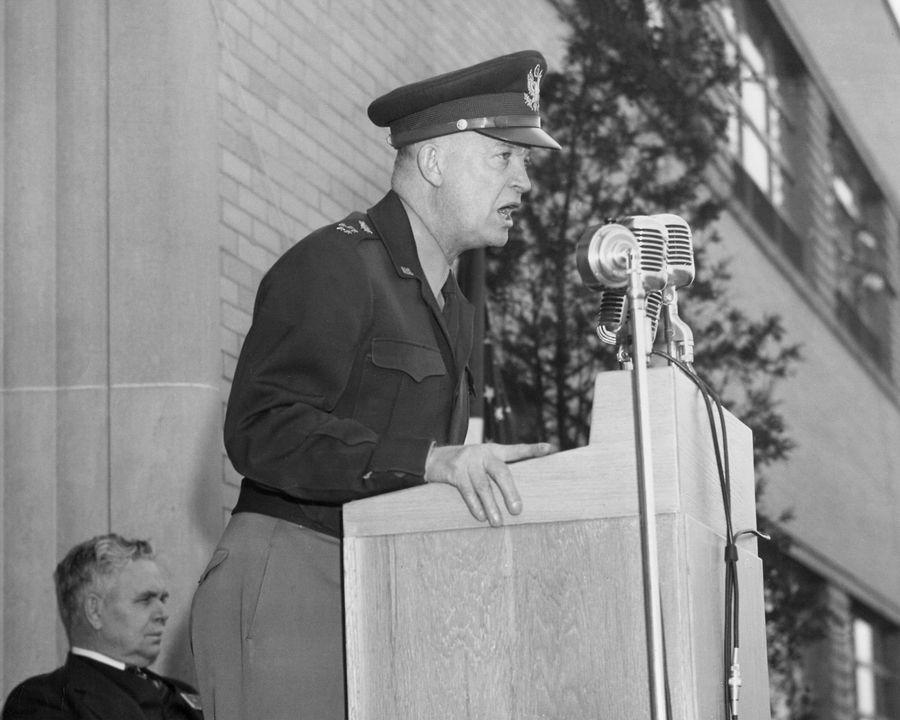
Incidentally, this year also marks the 50th Anniversary of the publishing of “The Supreme Commander,” American historian Stephen Ambrose’ landmark biography of Dwight D. Eisenhower during the Second World War. Published in 1970, The Supreme Commander focuses on Eisenhower as a military leader – a man with immense responsibility and under enormous pressure to plan, organize, and lead U.S. and Allied Forces in the European Theater.
The primary takeaway from Ambrose's work is that Eisenhower was the right man for the job – every job, in fact – that he performed in service to the Nation from 1942 to 1945. His duties over the war period went from building war plans on the General Staff to Chief of the War Plans Division to Assistant Chief of Staff of the Operations Division under George Marshall to Supreme Commander Allied Expeditionary Force of the North African Theater of Operations, to Commanding General – European Theater of Operations and finally, to the Supreme Allied Commander in Europe. His ascendency was remarkable in a number of respects, not the least of which, his lack of combat experience. But reading this book, you quickly understand what George Marshall, President Roosevelt and others saw in Ike.
The Supreme Commander is not a biography covering all of Eisenhower’s life or even his entire military career – which spanned nearly five decades, including time at West Point. It only centers on the war years, where Eisenhower quickly rose through the Army general ranks to eventually become the Supreme Commander of the Allied Expeditionary Force in Europe. That said, the book is not an action-packed military history either – and those looking for a chronicle on the grind of combat should probably look elsewhere. Nonetheless, the value of this book is enormous for several reasons.
First, The Supreme Commander reminds us of how vital Eisenhower was in so many areas and ways. He was an honest broker with keen judgment, heavily relied upon by Roosevelt and Churchill to make the best decisions in support of the war effort. He was a patient and tolerant arbiter who calmly dealt with the endless squabbles, tensions, perceived injustices, and ulterior motives among a horde of egos – from Patton and Montgomery to De Gaulle and Brooke. Finally, he was often a de facto politician, navigating the trickiness of divided France, negotiating with wavering Italy, and preserving the harmony of the alliance amidst the creeping interests of post-war victors. While military leaders sometimes perform political functions in war, one gets the impression from reading The Supreme Commander that Ike’s trials in managing the alliance served as excellent training for his eventual career in U.S. politics.
Second, this book helped fill several important gaps that have been forgotten or overlooked in the history of World War II. Over time, we have tended to simplify our recollection of the war, its parts and personalities; we remember the striking, like D-Day – or the flashy, like MacArthur – but we tend to glaze over other things, like the political wrangling that often paved the way for operational success. Through the lens of Eisenhower, The Supreme Commander provides a great refresher of several key aspects of the conflict – America’s evolution as a wartime nation, the constant logistical and supply concerns, the inter-service rivalries, the competing strategies for victory, the parochial interests of the allies, and the political complexities that underlie – and often threatened – the success of operations in North Africa, Italy, Normandy and Germany.
And third, as much as The Supreme Commander is a biographical snapshot of Eisenhower as one of America’s top generals, it is also an excellent resource on leadership. Through Ambrose’ examination of Eisenhower, one gains useful insight into the burdens of command; triaging problems, prioritizing resources, motivating subordinates, managing egos, satisfying competing interests, focusing on the task, recognizing talent, assessing risk, fostering new leaders, and building units greater than the sum of their parts. For those in military service, business, or government, The Supreme Commander offers a wide spectrum of models and insights.
Following the war, Eisenhower went on to become the 13th President of Columbia University and the 34th President of the United States. After the White House, Ike retired to his farm in Gettysburg, Pennsylvania – the only real permanent home that he and the First Lady, Mamie Eisenhower, enjoyed after decades of itinerant public service. Long considered by many of the political cognoscenti to be a rather mundane, detached, and ineffective President, Eisenhower’s stature as a Chief Executive has risen markedly in recent years. For a host of reasons – from clarity due to new material to nostalgic yearning – Ike has received a fairer and more accurate appraisal over time. And while Eisenhower now consistently ranks in the top tier of U.S. Presidents – for whatever value those rankings are worth – a reading of The Supreme Commander prompts one to ask why he ever ranked so low to begin with?
To say that Eisenhower led an impressive life is to categorize his existence and accomplishments with the most understated of descriptions. He was, in fact, the kind of leader all Americans should want when the chips are really down, and when the most important thing to get us through stormy waters is a firm and steady hand on the tiller. Decisive, but not rash. Thoughtful but not obsessive. Tolerant, but not a pushover. The Supreme Commander details these qualities and attributes in abundance.
So, this year, as we recognize the 75th Anniversaries commemorating the end of the Second World War – including events like the opening of the new Dwight D. Eisenhower Memorial in Washington DC – and as we reflect on the nature of American service, The Supreme Commander, a half-century old, is still worth a read. The lessons and inspiration that can be derived from this book are not only timeless but are – quite frankly – badly needed at this moment in our Nation.
Connor Martin is a U.S. Marine veteran and policy analyst in Washington DC.

The Army’s AI Cyber Defenders Need a Proven Stand-Down Order
By Gleb Tsipursky • RealClearDefense
After the Silence
By Chase Skylar DeMayo • RealClearDefense
Defense Chip Procurement Needs a Recovery Test
By Percy Yixuanchen Yu • RealClearDefense
FORTRESS America Must Measure Missions, Not Megawatts
By Burak Oktenli • RealClearDefense
After the Midterms, the Right Strategy Against Iran
By Lance Gordon • RealClearDefense
After the Silence
By Chase Skylar DeMayo • RealClearDefense
Underwater Arms Race Puts U.S. Naval Supremacy at Risk
By Tom O'Connor, Newsweek
New Facilities To Pump Out Upgraded F/A-18E/F Super Hornets
By Trevithick, WarZone
U.S. Navy Expands Tomahawk Warhead Production
By Naval News Staff, Naval News
SSN(X) Attack Boat Will be a Swift, Lethal Mothership for Undersea Drones
By USNI N.