
Democratic Deterrence Has a Time Problem
Published Aug. 17, 2026 • Read time: 5m
Beijing can apply pressure continuously. Democracies must turn episodic promises into routines that survive budgets, elections and leadership transitions.
Deterrence in the Taiwan Strait has a time problem. The usual debate asks whether the military balance and official statements are strong enough today. Yet Beijing can apply pressure continuously, while democratic commitments are renewed in episodes. Budgets expire. Legislatures deliberate. Governments change. A policy may remain intact while its political foundations become harder for an adversary, an ally or Taiwan’s own public to read.
The answer is not to insulate security policy from democracy. It is to make democratic renewal more regular, legible and resilient. Deterrence should be understood as a serial political performance, not a single threat.
That shift changes what counts as a credible signal. A presidential statement or weapons announcement may command attention, but neither proves that a commitment can be implemented months later. Credibility also rests on mundane evidence: appropriated money, trained officials, tested authorities, replacement plans and institutions that keep working when politics moves on.
Coercion runs continuously
Taiwan’s Ministry of National Defense publishes a near-daily record of People’s Liberation Army aircraft, naval vessels and other activity around the island. These official reports do not independently establish Beijing’s intent, and not every operation carries the same risk. They do show the tempo of the environment in which Taiwanese decision-makers work.
Grey-zone coercion gains leverage through repetition. It tests procedures, stretches attention and makes exceptional pressure feel ordinary. It also lets Beijing vary intensity without announcing a formal change of policy. The coercive clock keeps running even when no crisis dominates international headlines.
Democratic security policy operates on a different schedule. In the United States, the Taiwan Relations Act assigns decisions about defense support and responses to threats to the president and Congress through constitutional processes. That structure is a source of accountability. But appropriations, notifications, oversight and elections produce visible intervals between one authorization and the next.
Those intervals can create ambiguity of the wrong kind. Observers may struggle to distinguish careful review from administrative delay, coalition friction or fading resolve. An unchanged commitment can therefore appear politically discounted before it changes on paper.
The timing problem is especially acute when routine coercion falls below the threshold that normally accelerates democratic decision-making. Each incident may seem too small to demand a major response, even as their cumulative effect changes expectations and consumes readiness.
Democratic commitments arrive in episodes
It is tempting to reduce the problem to a slogan: autocracies are fast and democracies are slow. That is misleading. Centralized systems can issue rapid signals while concealing poor information, internal disagreement or weak implementation. Democratic contestation can make a commitment more credible when rival parties, institutions and successive governments repeatedly accept its costs.
Public argument is therefore not the opposite of deterrence. It can reveal that a policy rests on more than one leader’s preference. The problem arises when debate produces no predictable record of renewal. An ally, adversary or market then sees political noise but cannot tell which commitments have actually been tested and sustained.
Continuity should not mean louder threats or automatic military responses. It should mean that democratic institutions can deliberate under pressure without starting from zero each time.
Turn promises into routines
Four routines would make commitments easier to read without removing democratic choice.
First, legislatures can use multiyear but reviewable funding for resilience, training and supply continuity. Benchmarks, audits and scheduled votes would preserve oversight while reducing avoidable gaps between authorizations.
Second, governments can schedule cross-party briefings and public progress reviews across the electoral calendar. The aim is not artificial consensus. It is a recurring forum in which disagreements, implementation failures and shared commitments become visible before a crisis.
These reviews should distinguish settled objectives from genuinely open choices. Publishing that distinction would help outside audiences see that disagreement over methods does not necessarily mean abandonment of the underlying commitment. It would also make backsliding harder to conceal behind vague declarations of continuity.
Third, agencies should rehearse the administrative authorities that a confrontation would strain: logistics, cyber incident coordination, export licensing, emergency communications and essential-service continuity. Deterrence depends on whether institutions can execute decisions, not only announce them.
Fourth, Taiwan and its partners can publish bounded resilience benchmarks and conduct regular exercises. Taiwan’s Whole-of-Society Defense Resilience Committee already brings government, industry and civil society together. Its June 2026 tabletop exercise tested responses to grey-zone aggression and high-intensity maritime coercion. Repetition turns preparedness from a special event into a governed process, provided that exercises produce measurable follow-through rather than ceremony.
Credibility comes from renewal
These routines speak to several audiences at once: Beijing, Taiwan’s public, partner governments, bureaucracies and markets. Each needs evidence that commitments can survive foreseeable political transitions. Repetition supplies that evidence more credibly than an attempt to sound permanently certain.
Routines also carry risks. If they become automatic or opaque, they can narrow political discretion and appear escalatory. That is why each should remain reviewable, publicly bounded and subject to legislative scrutiny. The goal is not to pre-commit democracies to war. It is to pre-commit them to being able to decide.
Weapons and force posture still matter. But their meaning depends on the political institutions expected to fund, maintain and employ them. Democratic deterrence becomes credible through renewal, not permanence. The strongest signal is not a timeless vow. It is a contested commitment that survives the next budget, the next election and the next test.
Percy Yixuanchen Yu is the inaugural Visiting Research Fellow at Nanjing University’s School of International Studies and a Visiting Scholar at the Huazhi Global Governance Institute. His work focuses on U.S.–China–Taiwan relations, democratic legitimacy and strategic agency under contested sovereignty. His commentary has appeared in 9DASHLINE and Taiwan Insight.
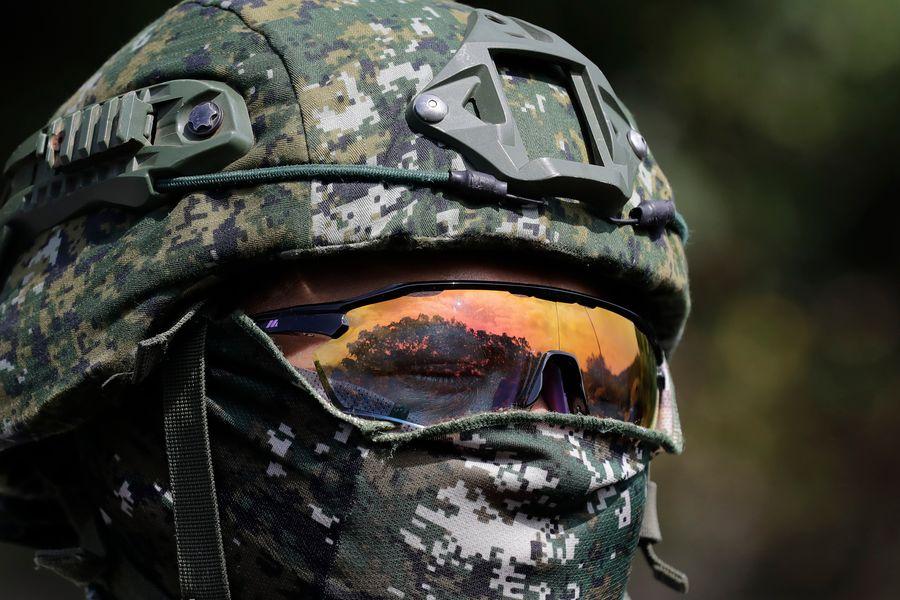
image: A soldier wears sunglasses reflecting the surrounding scenery during the annual Han Kuang military exercises in Yilan, northeastern Taiwan, Monday, Aug. 10, 2026. (AP Photo/Chiang Ying-ying, Pool)

The Army’s AI Cyber Defenders Need a Proven Stand-Down Order
By Gleb Tsipursky • RealClearDefense
After the Silence
By Chase Skylar DeMayo • RealClearDefense
Defense Chip Procurement Needs a Recovery Test
By Percy Yixuanchen Yu • RealClearDefense
FORTRESS America Must Measure Missions, Not Megawatts
By Burak Oktenli • RealClearDefense
After the Midterms, the Right Strategy Against Iran
By Lance Gordon • RealClearDefense
After the Silence
By Chase Skylar DeMayo • RealClearDefense
Underwater Arms Race Puts U.S. Naval Supremacy at Risk
By Tom O'Connor, Newsweek
New Facilities To Pump Out Upgraded F/A-18E/F Super Hornets
By Trevithick, WarZone
U.S. Navy Expands Tomahawk Warhead Production
By Naval News Staff, Naval News
SSN(X) Attack Boat Will be a Swift, Lethal Mothership for Undersea Drones
By USNI N.