
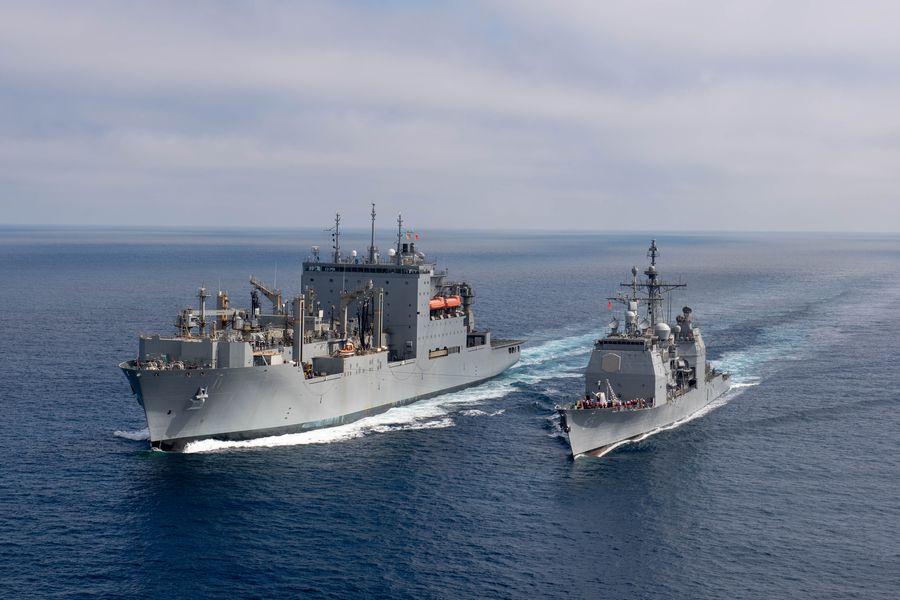
The Ticonderoga-class guided-missile cruiser USS Chosin (CG 65) steams alongside the Lewis and Clark-class dry cargo ship USNS Washington Chambers (T-AKE 11) during an at-sea demonstration of the Transferrable Reload At-sea Method (TRAM) while underway in the Pacific Ocean Oct. 11, 2024. Sailors aboard Chosin used the hydraulically- powered TRAM device to load an empty missile canister into the ship’s MK 41 Vertical Launching System (VLS) while off the coast of San Diego. (U.S. Navy photo by Mass Communication Specialist 2nd Class Charlotte Dudenhoeffer) (Petty Officer 2nd Class Charlotte Dudenhoeffer)
When Access Becomes the Fight
Last updated 07:00 AM EST • Read time: 11m
Join the Conversation
0What Hormuz Can and Cannot Teach INDOPACOM About Sustaining Combat Power
I have chartered commercial Mutipurpose Supply Vessels (MSPV) from the Oil & Gas industry for military support and have run marine operations for a global oceanographic research firm and its fleet of vessels. Getting a ship underway depended on more than its condition. Crew changes, flag, and class compliance/regulatory, insurance terms, vessel inspections, QHSE, port services and host-nation permits could each hold it at the pier.
Military freedom of action does not guarantee dependable commercial access. The 5 October 2026 attack on the tanker On Peace in the Strait of Hormuz, which injured 12 seafarers, shows why the distinction matters in planning for Pacific conflict.
Nearly five months earlier, U.S. Central Command (CENTCOM) commander ADM Brad Cooper reported the destruction of 161 Iranian vessels and assessed that Iran could no longer deter U.S. freedom of action at sea. He also acknowledged that Iran retained the means to harass shipping, along with low-end drone and rocket capabilities. For commercial operators, the remaining threats can still affect crewing, coverage, and the decision to sail.
The International Maritime Organization recorded 13 incidents involving commercial vessels across the Persian Gulf, Strait of Hormuz, and Gulf of Oman from 5 to 11 October. On 30 October, Maersk cited disruption around Hormuz and regional port congestion in announcing temporary booking restrictions for Khor Fakkan, Fujairah and selected Upper Gulf destinations. Affected cargo already in transit remained subject to delays, and alternatives depended on operational conditions and available capacity.
A route is useful to a campaign when required cargo reaches the required destination at the volume and cadence the campaign demands. That takes hulls, crews, war-risk coverage and working ports, with decisions made in time to support operations. A successful transit proves a route can be used. Sustained throughput shows what it can support.
For INDOPACOM, the test is whether the military and commercial sustainment network can keep a distributed force fueled, armed, repaired and moving after first contact. Commanders need to measure what reaches the force against what the campaign requires through the second and third turn.
Measure the Second and Third Turn
The first turn gets the force forward and produces the opening effect. The second requires the force to recover, refuel, rearm, repair, and operate again. The third tests whether it can continue after disrupted communications, damaged infrastructure and casualties change the problem.
I learned that sequence as a U.S. Marine. The first insert got the rehearsal time and the attention. The plan for refit, resupply and going back out was usually thinner, and that is where the friction showed up. That same imbalance needs to be tested at campaign scale.
Exercises should carry that sequence beyond the opening exchange. Simulated campaign time can test a longer horizon, but its assumptions must be based on measured handling, repair and reload performance. Exercise control should distinguish physical events, modeled outcomes, and assumed capacity. Otherwise, a staff can solve a physical bottleneck by changing an assumption, transferring risk to the force.
Measure the quantities of fuel and ammunition delivered within the required window against the quantities the campaign requires, by type and destination. Include unmet requirements for which no movement could be scheduled. Record late arrivals and the time needed to shift from a damaged node, restore a platform to its required mission, and complete another cycle.
Run casualty evacuation, replacement crews, spare parts, and ammunition through the same transportation picture. They cannot each receive an unconstrained allocation. Track what civilian capacity remains available as risk increases, and require the staff to identify which missions lose support when demand exceeds capacity.
What Hormuz Can and Cannot Teach the Pacific
Iran is not the PRC. Hormuz is not the First Island Chain. The geography, military balance, alliance structure, and economic exposure differ. Hormuz provides evidence of disruption and adaptation; it does not predict the outcome of a Pacific campaign. It shows how commercial risk can persist despite military success.
In September, the International Energy Agency reported that Saudi and Emirati exports through Yanbu and Fujairah had offset part of the lost flow through Hormuz. Attacks also reduced bypass flows, while oil continued through the strait. The example concerns oil exports; it does not establish dependable access for every cargo. Pacific plans must demonstrate what their own alternatives can actually deliver.
Nor can every disruption be attributed to Iran's surviving weapons. CENTCOM's May statement also described the U.S. blockade of Iranian ports and merchant vessels. The wider war, trade restrictions and commercial decisions all affect movement. A tally of destroyed platforms cannot isolate those effects or establish that dependable access has been restored.
An adversary can suffer major military losses while movement remains dangerous, restricted, or unreliable. A resilient network can absorb some of that pressure. Our planning must establish how much it can absorb, for how long and which missions still get their cargo on time.
Washington Has Named the Requirement
In his 10 August remarks in Manila, Under Secretary of War for Policy Elbridge Colby tied denial defense along the First Island Chain to distributed theater logistics, prepositioned assets and shared infrastructure with allies and partners. On 16 September, Chairman of the Joint Chiefs Gen. Dan Caine warned that future conflicts would require operating without assumptions of uncontested access, secure rear areas, or uninterrupted sustainment.
ADM Samuel Paparo's April posture statement identified regional munitions storage, repair hubs and additional fuel locations as priorities. It also warned that tanker capacity fell below requirements and munitions production timelines were misaligned with operational expenditure. We need to prove that the network can keep delivering what the force needs when parts of it are unavailable.
Factory output, theater inventory, and weapons available to a commander are separate measures. All three need to appear in the same assessment of readiness. Procurement decisions should account for how each capability will be delivered, fueled, rearmed, and repaired through repeated use.
The First Island Chain Depends on the Network
Across the Western Pacific, access depends on ports, airfields, fuel sites, repair facilities, commercial routes, and host-nation permissions. Those arrangements can fail locally or temporarily while much of the force remains intact.
An alternate port is useful only if it can receive the required cargo. Demonstrate the handling equipment, workers, onward transportation, and host-nation permissions needed to use it. Test the switch after a primary node is lost, including the delay and throughput penalty. Assess dispersed, mobile, afloat, and allied capacity by what it can deliver and what it takes to support it.
In March, Gen Randall Reed, commander of U.S. Transportation Command (USTRANSCOM), stated that the Voluntary Intermodal Sealift Agreement (VISA) provides more than 95% of ocean-based dry-cargo sustainment capacity when activated for wartime operations. That figure does not cover all military lift or all sustainment.
Enrolled carriers are contractually committed to provide capacity when VISA is activated. We still have to prove those movements can be completed. Shipowners, mariners, terminals, pilots, and tug operators belong in practical planning. Rehearsals should test crewing, port services, war-risk coverage, and rerouting when infrastructure or data systems fail.
In commercial fleet operations, a missed crew change can hold a vessel at the pier just as an engineering casualty can. Military control of the sea lane does not, by itself, resolve that problem.
Government coverage should be part of that rehearsal. The Maritime Administration already has a war-risk insurance program for situations in which commercial coverage is unavailable on reasonable terms. INDOPACOM should work with USTRANSCOM and the relevant civilian agencies to identify gaps in that backstop, vessel eligibility, approval authorities, and the time needed to put coverage in place. Financial coverage alone cannot make a damaged port usable or supply a missing crew.
The Joint Force also draws from overlapping global pools of lift, tankers, repair capacity, and munitions. A theater plan needs to survive competing demand. An asset committed elsewhere cannot be counted again because a second staff needs it on the same day.
Readiness Has to Show the Mission
In June, the Government Accountability Office (GAO) identified a measurement problem in the KC-135 and KC-46A aerial refueling fleets. The fleets missed Air Force availability and capability standards across FY2019–FY2025. Those metrics did not isolate their ability to perform the primary refueling mission. An aircraft could count as mission-capable for another task while unable to refuel. Conversely, an aircraft unable to perform all its missions could still be available for refueling.
How many aircraft can deliver the required fuel, in the required window, with the crews and support available? The answer has to survive maintenance failures, competing missions, and losses.
The standard should be mission output under stated conditions. A green platform status, a stocked depot or a completed infrastructure project is useful information. It becomes a credible readiness claim when the force demonstrates how those pieces deliver and regenerate combat power.
Reload and Repair for the Next Turn
In October 2024, USS Chosin used the Transferrable Reload At-sea Method, or TRAM, to load empty missile canisters into a vertical launching system (VLS) while underway. In July 2025, Navy Expeditionary Logistics Support Group reported another evolution: SS Gopher State transferred missile canisters to USS Farragut's forward and aft VLS cells while anchored alongside.
The demonstrations took place under different conditions. Johns Hopkins Applied Physics Laboratory describes continuing TRAM redesign and a broader study of reload methods. Those demonstrations show progress. They do not, by themselves, show how many ships can be rearmed repeatedly under a campaign's operating conditions.
The test is whether trained teams can get ships rearmed and back into the fight repeatedly, with the ammunition and transfer equipment available. Reload capacity has to be assessed with the rest of the distribution system. An improved transfer method does little for a ship whose replacement rounds have not reached it.
Apply the same test to repair. In remarks reported by the Air Force in September, Air Mobility Command commander Lt Gen Daniel Tulley described forward depot work at RAF Mildenhall that had replaced 30 KC-135 boom assemblies in theater, avoiding a return to the United States for that work. That put repair capability closer to the force. The next test is the repair rate that can be sustained when facilities, parts or maintainers become unavailable.
Assign Responsibility for the Shortfalls
The Department of War already has a structure to build on. Reed's March testimony described a Global Contested Logistics Posture Management plan led by the Deputy Secretary of War, the Vice Chairman of the Joint Chiefs and the USTRANSCOM commander. INDOPACOM should use that structure to assign an owner to each theater shortfall and identify the decisions and resources needed to fix it.
Make assured movement a continuing command priority. The staff should show what is moving, what will miss its window, which alternate is usable and what decision is required. When the network cannot meet demand, the commander needs to know which operations will be delayed, reduced or forgone in time to act.
Resolve who can authorize route changes, emergency repairs, contract actions, and cross-servicing before a crisis. Rehearse those decisions with civilian partners and allied authorities at the appropriate level of disclosure. A physically available alternate that cannot be approved in time will not meet the requirement.
I have worked both sides of this problem, as an operator depending on what was supposed to arrive and as the one chartering commercial vessels and arranging crews to deliver it. Military and commercial operators have different obligations and risk thresholds. The plan has to reconcile both before the fight, not after it.
For INDOPACOM, credible denial depends on sustaining the force after the opening exchange. Ammunition in a depot is inventory; ammunition delivered to the force in time to affect the fight is combat power. The same test applies to fuel, parts, and people. Access must be created, protected and restored as the network takes losses and adapts. Commanders need to know how much combat power that access can sustain tomorrow. That is the standard to fund, rehearse and prove.
Richard Byno is Head of Strategic Integrations, Global Strategic Group, at Red Cat Holdings. His maritime experience includes executive leadership at Eureka Naval Craft and service as Director of Marine Operations and Chief Security Officer at TDI-Brooks International. He founded and sold Maritime Support Concepts LLC and Tideborn Defense LLC, which chartered commercial vessels for military operations. He spent more than two decades in Marine Corps, Special Operations and U.S. government Intelligence Service, including 1st Force Reconnaissance Company and MARSOC. The views expressed are his own.
After the Midterms, the Right Strategy Against Iran
By Lance Gordon • RealClearDefense
The Color Revolution Came Home
By Emzari Gelashvili • RealClearDefense
When Access Becomes the Fight
By Richard Byno • RealClearDefense
What the 2026 Midterm Results Mean for U.S. Strategic Competition with Rivals
By Dean Chen • RealClearDefense
Measurable by Design: Project Meridian
By Alex Willard • RealClearDefense
New USAF Force Design Bets on Technology
By Stephen Losey, Air & Space Forces
DoD Pushes $450M in Loans To Bolster U.S. Space Companies
By Hitchens, BrDefense
The U.S. Navy Needs a New Battlecruiser. Will It Get One?
By Sadler & Ouellette, NatInt
U.S. Army Rehearses Rapid HIMARS Rocket Launcher Deployment
By Global Defense N.
Coding Commander's Intent into Unmanned Systems
By Thomas Baumstark, Proceedings