
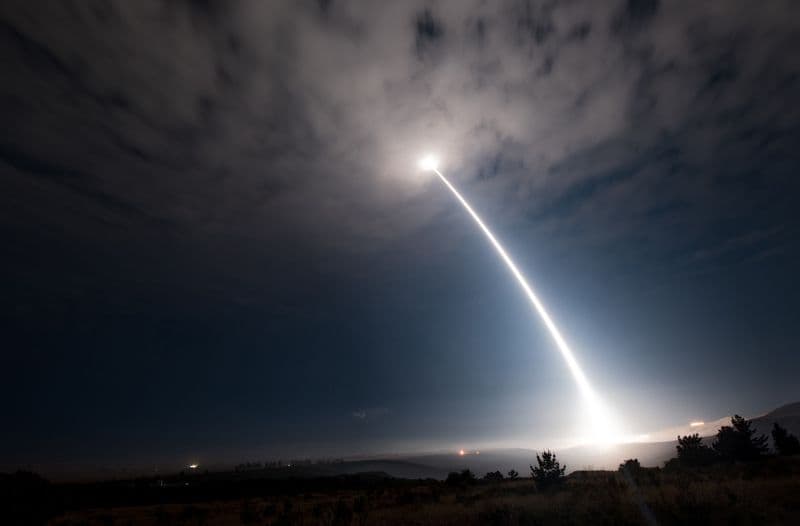
Going Nuclear? The Optimal Posture and Force Structure for Australia
Last updated 05:30 PM EDT • Read time: 5m
In a recent piece published by The Strategist titled "Going Nuclear?," Malcolm Davis discussed the hard choice of Australia potentially requiring nuclear weapons to combat coercion if the U.S. extended nuclear deterrence concept disappeared. This would indeed be a hard pill to swallow from both sides of politics, but in the face of a revisionist power determined to expand influence and hegemony in the region, as discussed by Hugh White in the latest Quarterly Essay “Without America,” " ... nuclear weapons may one day be the only option to adequately deter and defend Australia’s sovereignty."
I will not attempt to discuss the long and difficult road ahead if Australia chose to develop nuclear weapons, but it is worth analyzing the optimal nuclear posture and force structure that would best suit Australia’s geography and geopolitical position.
Each of the nine current nuclear powers is relatively unique in how they deploy their nuclear arsenals in conjunction with the posture they adopt. The U.S., for example, possesses silo-based ICBMs, air dropped gravity bombs (both strategic and non-strategic) air-launched cruise missiles and SLBMs for a survivable second-strike capability. Russia possesses much the same but has a substantially more diverse non-strategic nuclear capability, encompassing various platforms and mobile ICBM launchers in its strategic arsenal.
The states with smaller nuclear arsenals including, France, China, India, Pakistan and Israel each adopt one of three postures according to Vipin Narang. These being, a “catalytic posture” whereby a state that is being threatened attempts to use its nuclear arsenal to compel, or catalyze, third-party intervention on the state’s behalf. An “assured retaliation posture” whereby a state can threaten nuclear retaliation if it suffers a nuclear attack. Lastly, an “asymmetric escalation posture” that enables the first use of nuclear weapons in the event of a conventional attack.
Each posture requires a different force structure that is optimal for the state’s perceived needs but what would work for Australia? It is my opinion that if Australia were ever to consider going down the nuclear path, it would be best suited to an “assured retaliation posture.” This would provide the capability of deterring a nuclear attack and nuclear coercion. Australia’s conventional force would continue to be modified and strengthened, but an “assured retaliation posture” would enable the country to free itself from the potential fear of not being able to counter nuclear blackmail. With an adequately deployed nuclear force suited to the concept of assured retaliation, the strategic nuclear option would be off the table for any future adversary determined to use threats to obtain resources, economic gain, territory or any form of strategic dominance.
This begs the question, what nuclear force structure would best work for Australia that acts to provide an “assured retaliation posture?” This posture requires a nuclear force that is survivable. If an adversary can locate the state’s nuclear weapons, they might be tempted to launch a surprise first-strike attack, eliminating Australia’s ability to respond with a retaliatory strike.
Before we look at survivability, the factor we must address is that of range. Based on Australia’s land mass and geographic position, the only viable option would be missiles in the intercontinental range. Anything with a shorter reach than an ICBM would severely limit the ability to retaliate with a second-strike. If Australia’s missiles cannot reach an adversary determined to threaten a nuclear strike, they are fundamentally useless.
The need for both range and survivability work hand in hand in choosing the country’s best option and eliminating options that would not work. Silo-based ICBMs like that of the U.S. Minuteman IIIs would provide Australia with the range required but would be vulnerable to a disarming counterforce strike as their location is static and can be readily detected. Bombers would require bases or mid-air refueling, are vulnerable to a strike on the ground and would need to penetrate air defenses. Ballistic missile submarines would provide Australia with the range as well as survivability, but the costs would be astronomical, not to mention the immense infrastructure requirements and engineering capability.
This leaves the road or rail-mobile ICBMs as the best option for Australia. Much like the Russian, SS-27 Mod 1 (Topol-M) and Mod 2 (RS-24 Yars), these missiles would have the range to retaliate against targets across the globe and would be more survivable than fixed based nuclear forces. The mobile ICBMs would have the capability of transiting through the remote geography of Australia, reducing their vulnerability and providing the option of launching from any location in the event of a nuclear attack.
As Malcolm Davis rightly points out, “Australia would not consider such a step lightly,” but history has shown that changes in geopolitics can sneak up on nations before they are aware of the dangers they face, Let’s not fall victim to this. Let’s be ready and discuss options now before it is too late.
Adam Cabot has a Masters in International Relations and is currently researching Russian nuclear strategy.
The Unfinished Reform
By Mark W. Castillon • RealClearDefense
Winning the Data Advantage
By Turin Pollard • RealClearDefense
The Pentagon’s Quantum Race Needs a Warfighter’s Scorecard
By Burak Oktenli • RealClearDefense
The F/A-XX and the AIM-260 Reclaim the Perimeter
By Bruce Allen Lubbering • RealClearDefense
Iranian Cyber Operations
By Michael Groen • RealClearDefense
Winning the Data Advantage
By Turin Pollard • RealClearDefenseThe F/A-XX and the AIM-260 Reclaim the Perimeter
By Bruce Allen Lubbering • RealClearDefenseWinning the Data Advantage
By Turin Pollard, RealClearDefenseThe F/A-XX and the AIM-260 Reclaim the Perimeter
By Bruce Allen Lubbering, RCD
F-22 Pilot Directs CCA in Flight as ‘Airborne QB’
By Stephen Losey, Air & Space Forces