
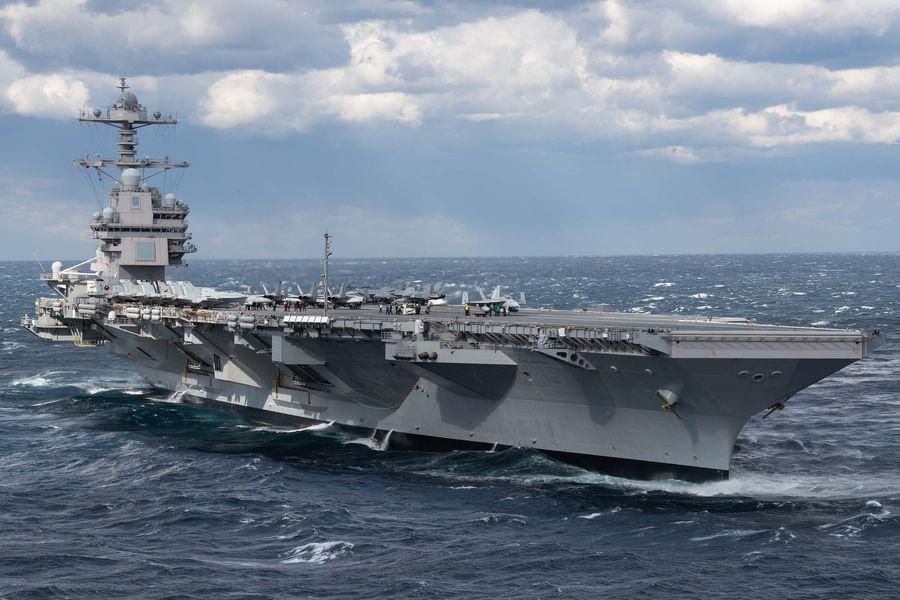
Roadmap for a Stronger Defense Strategy
Published April 1, 2022 • Read time: 5m
Vladimir Putin’s brutal assault on Ukraine is plowing into another week of attacks on civilian hospitals, homes, and markets. The free world is watching, horrified that our alliances were not enough to deter an unhinged brute from invading a sovereign, democratic nation. It is a sobering wake-up call: our allies are vulnerable to attacks from Russia and China, and we are too.
During another time, about a different adversary, Ronald Reagan said, "our best hope of persuading them to live in peace is to convince them they cannot win at war."
That was more than forty years ago at the height of the Cold War, but prescient. Unfortunately, it is clear today that our adversaries need a lot more convincing. In the coming days, the Biden Administration will officially roll out its National Defense Strategy and the details of their funding request, which will demonstrate whether they have calibrated for real deterrence.
The current strategy is built on two assumptions: 1) an alliance of Western powers would deter Russian aggression in Europe; and 2) a growing group of allies and partners, led by the United States, would curb China's malign intent in the Indo-Pacific and beyond. Not only was that strategy never fully resourced, but recent events have proven that it was insufficient.
A more robust national defense strategy and greater resources will be required to counter the new age of authoritarian aggression in Europe while protecting our interests around the world.
The Biden Administration is due to officially unveil a new strategy in the coming days. The time has come to fashion and resource a security strategy that builds a military capable of simultaneously prevailing in a conflict with China, our primary adversary while deterring Russia. Our strategy must also extend to the Middle East, where deterring Iran and countering terrorism remain a national interest. Achieving this construct will be difficult and expensive, especially given the advanced capabilities required to counter China.
U.S. and Australia Should Give ANZUS Teeth
How to Win Without Military Victory
Tailored Deterrence and Nuclear First Use in Europe
When Access Becomes the Fight
The President should learn from the flaws in our current strategy and resist the temptation to focus our efforts on one region while outsourcing security leadership to others. Recent events in Ukraine have demonstrated that doing so will only invite strategic vulnerability.
How we equip our forces is as important as where we focus them. Chinese military modernization and its continued saber-rattling over Taiwan already necessitated a strategic shift in U.S. military assets and resources to the Indo-Pacific. Meanwhile, Putin’s naked aggression in Ukraine underscores why we cannot, as some in the Biden Administration propose, divest today’s conventional military capabilities in favor of investing in technologies that will define tomorrow’s battlefield.
Few would dispute the necessity of investments in game-changing technologies, like quantum computing, hypersonics, artificial intelligence, and machine learning. The United States is behind in many of these areas and catching up will be expensive. Until we do, as Vladimir Putin has reminded us, conventional forces still matter – ships, submarines, tanks, fighter aircraft, and end strength cannot be sacrificed in favor of a future capability that exists on a PowerPoint slide. Even when we have caught up, many of these technologies are designed to enhance conventional forces, not replace them.
The war in Ukraine is the latest real-world event that demonstrates why we need to pair this strategy with a robust investment in our military strength. That means an annual five percent real growth increase to our defense budget. Despite Congress’ best efforts to correct the Administration’s inadequate FY22 budget request, the current funding levels do not keep pace with inflation. With some experts predicting that inflation will rise further into double digits, the buying power of the Department of Defense (DOD) has already been severely undermined and diminished.
The Biden Administration's response is a $773 billion-dollar Pentagon budget request, a 3% net cut when inflation is as high as 7%. That funding level isn't enough to keep pace with inflation and it isn't enough to deter Russia or China. America's security requires a higher investment, one that, if sustained annually, will likely exceed one trillion dollars by 2026. Even more, the military may require more funding if we fail to arrest inflation. Some historical context should help absorb the sticker shock: measured as a percentage of gross domestic product this level of defense spending would be lower than defense spending during the Koran War (11%), the Vietnam War (8.6%), the Cold War (6%), and the height of the Afghanistan and Iraq Wars (4.5%).
The price of peace has gone up, but the harrowing cost of war – innocent lives lost and democracies overtaken – will always be immeasurably more expensive. The Biden Administration should invest in deterrence, with enough power and resources to convince adversaries in Europe and the Indo-Pacific they cannot win a war.
Roger Zakheim is the Washington Director of the Ronald Reagan Presidential Foundation and Institute. Prior to joining the Institute, he served in a number of senior national security roles, including General Counsel and Deputy Staff Director to the House Armed Services Committee and on the Commission on the National Defense Strategy of the United States.

When Losing Control of AI Becomes a Weapon
By Yunus Emre Tumen • RealClearDefense
International Allied Reliability of States: Criteria and Evolution
By Sergey E. Ivashchenko • RealClearDefense
Your Military Paycheck Has an End Date
By Sean Ofeldt • RealClearDefense
Masters of Command
By Travis A. Karnes • RealClearDefense
A Sweet American Original
By Greg Maresca • RealClearDefense

Monty: Riding the Pendulum
By Zachery Thomas, DODReads
Sign of the Times: CCAs Dominate a Major Fighter Conference
By Bill Sweetman • The Strategist (ASPI)
Marines Want Naval Strike Missiles With Double The Range
By The WarZone
U.S. Navy Targets 79 New Cutter-Based FF(X) Frigates
By A. Servaes, Global Defense
The Hegseth Grenade: A Sea Change at Newport
By Robert C. Rubel, CIMSEC