
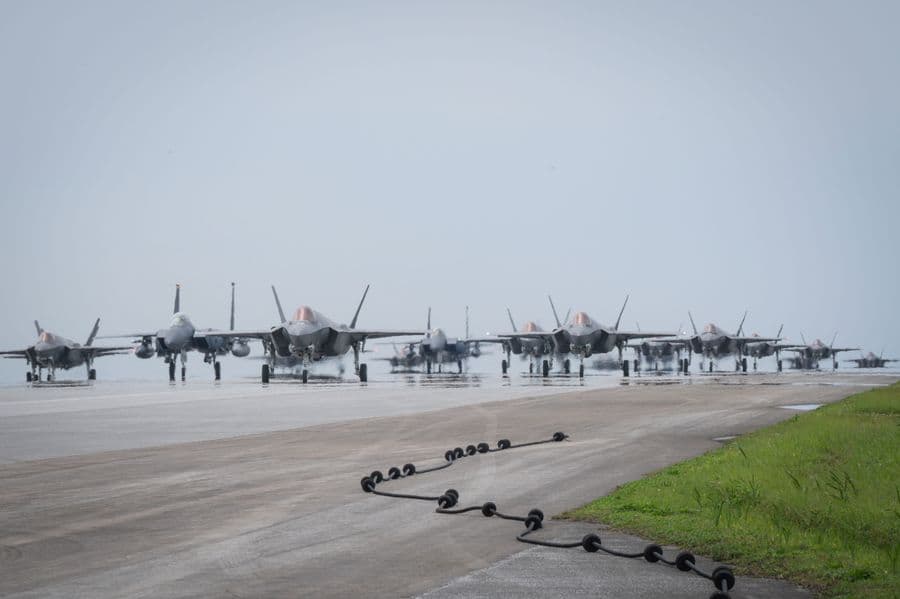
To Deter in the Present Tense
Last updated 06:55 AM EDT • Read time: 5m
Modernizing existing platforms isn’t as flashy as new, expensive programs, but they bring no less capability to the fight. In an era of fiscal restraint and rapidly evolving threats, modular, cost-effective, and upgradeable platforms are vehicles of deterrence for the foreseeable future.
America’s military has a long, successful history of doing that for the modern battlefield, and today’s international security situation, especially in the Western Pacific, requires this adaptability more than ever.
While the country must invest in next-generation military capabilities, it is also, unfortunately, out of time. With the “Davidson Window” in which the PRC has the military and political power to take Taiwan well in hand, America needs combat-ready air, land, and sea capabilities now. Waiting for next-generation platforms to finally reach initial operating capability is not an option.
The recent strikes against Iran’s nuclear facilities show air dominance remains a significant but insufficient condition for winning wars. And as America pursues next generation capabilities here, it is crucial that it rapidly upgrades existing platforms, wherever possible, in creative, even heterodox ways, to deliver capability that can deliver deterrence now.
The next war won’t wait for the next generation. We must confront this reality head-on. America's deterrence strategy must be built on what we can field now, not what might arrive in 2035.
Upgrading Unlocks Advantage
A bias against contenting ourselves with marginal advantage has been a hallmark of American ingenuity, serving the nation through projects from Manhattan to Stargate (the AI, not Richard Dean Anderson). But America has also developed a long and storied parallel history of battlefield improvisation.
With the Rolls-Royce F130 re-engine program, upgraded AN/ASQ-236 radar, and integration with AGM-158 JASSM-ER and future hypersonic weapons, the B-52 Stratofortress, a Cold War-era bomber first introduced in 1955, is expected to remain in service until at least 2060 – over a century after it first took flight (not yet to the incredible service life of the noble M2 Browning HMG, but staying in the fight). Future integration with stand-off weapons and hypersonic capabilities will ensure continued utility.

The lessons learned from legacy systems are obvious: open architectures and adaptable frames allow for long-term modernization. Upgrades cost a fraction of replacement while maintaining mission relevance. Critically, the crews and logistics systems already exist, reducing retraining and infrastructure costs.
Earlier this year, Lockheed Martin CEO Jim Taiclet leaned into this approach when he directed his company to upgrade the F-35 to be the near-equal of the yet-to-be delivered F-47: “My challenge to my aeronautics team is, let's get 80% of sixth-gen capability at half the price...”
The existence of a platform is the prerequisite for deterrence. The trade-off between future capability and current need is nothing new in the defense space, but there are moments when the current need is more acute, more severe. The F-35's Distributed Aperture System and AN/APG-81 AESA radar already provide proven situational awareness, but integrating next-generation capabilities such as advanced EW suites and AI-driven threat processing could deliver near-peer deterrent effects without waiting for the F-47 NGAD program to mature. Lockheed has already indicated its intention to upgrade the fighter to fifth generation plus capabilities. This flexible approach must be applied across the defense enterprise to surface ships, crewed and uncrewed, and land-based assets in order to deliver a decisive impact.
The U.S. Navy’s surface fleet, including destroyers, frigates, and amphibious ships, faces production delays and capacity constraints, as seen with the Constellation-class frigate program, which has been hampered by changing design requirements. Upgrading existing platforms can bridge some of these gaps.
The munitions sector faces bottlenecks in surge capacity and reliance on foreign critical minerals (owing largely to China’s control of 70% of rare earth elements). Upgrading existing munitions designs with advanced technologies can enhance lethality and affordability. The Harpoon, first fielded in the 1970s, has been modernized with Block II+ upgrades, including advanced targeting for contested environments. Making enough to them to swarm and overwhelm enemy CWIS would ensure its relevance against Chinese naval forces, as well as enabling it to support more expensive hypersonics. The AIM-9X Block II Sidewinder is still a front-line missile despite being first deployed in 1956. Upgraded with thrust-vectoring, IR sensors, and compatibility with modern fighter avionics like the F-35’s Distributed Aperture System.
Existing EW and cyber systems, often built on legacy hardware, are also ripe for modernization. The AN/ALQ-184 electronic countermeasures pod, a legacy system, could be upgraded with AI-driven jamming to counter Chinese radar threats, mirroring the F-35’s integration of sixth-generation technologies and ensuring deterrence in the electromagnetic spectrum.
The Time for Deterrence is Now
Lockheed’s bold move with the F-35 signals a potential shift in thinking in the legacy primes within the defense industrial base, but this cannot be ‘a one and done’ decision. The rest of the industry should follow suit. The Pentagon has roughly eighteen months before China's window of military opportunity fully opens. Upgrading existing platforms isn't just cost-effective, it's the only path to getting deterrent capabilities in the hands of the warfighter. The alternative is hoping untested future systems arrive before Beijing decides the correlation of forces favors action.
A fifth gen plus F-35 deployed to Kadena Air Base in Japan today is worth infinitely more than an F-47 NGAD that won't achieve initial operating capability until 2035. The same logic applies to every weapons system from the Harpoon missile to the AN/ALQ-184 jamming pod. In deterrence, presence matters more than perfection.
America's adversaries are calculating windows of opportunity. Chinese production lines don't pause for American acquisition cycles. Every month spent debating the theoretical capabilities of future platforms is a month closer to a conflict we might have prevented with the upgraded systems we could have fielded today.
As any servicemember will tell you, a bird in the air beats two on the drawing board every time.
Peter Mitchell is a strategist and air defense expert. You can follow him on X @peternmitchell.
The views expressed are those of the author and do not reflect the official position of the Department of the Army or Department of Defense.

Putin, Plague, and America’s Biodefense Gap
By Ryan Kane • RealClearDefense
From Hormuz to the South China Sea: Defending Freedom of Navigation in Contested Waters
By David F. Lasseter • RealClearDefense
Checklist for Modern Conflict Readiness
By Sergey E. Ivashchenko • RealClearDefense
AUTOWARCOM Is Heading for a Command-and-Control Collision
By Michael Carvelli • RealClearDefense
The Unfinished Reform
By Mark W. Castillon • RealClearDefense
U.S. and Japan Begin Naval Exercises Near Taiwan
By Mari Yamaguchi • Associated PressFrom Hormuz to the South China Sea: Defending Freedom of Navigation in Contested Waters
By David F. Lasseter • RealClearDefense
National Guard Soldier Shot While Breaking Up Fight in Washington D.C.
By Military.com
‘No Marine Fights Alone’
By Gidget Fuentes, USNI News
Sea Services Weigh How to Embrace Autonomous, Attritable Tech
By Reeves, NatDef