
Washington's Weak Link in Defending Taiwan: Canada
Last updated 08:55 PM EDT • Read time: 9m
In a war over Taiwan, it is almost certain that the U.S. will conduct stand-off missile attacks on sensors, missile bases, and port infrastructure targets along the Chinese coast. It is highly likely that Canada’s navy will join a coalition enforcing a blockade and conducting escort duties within just a few days. The Russo-Ukraine War and the Iranian/Houthi long-range missile attacks against Israel, have demonstrated that states can safely engage in conventional missile and drone strikes, even targeting capitals, without the immediate threat of nuclear escalation. Beijing is therefore likely to reciprocate with missile strikes against targets in the continental U.S., and because of Canada’s geographic proximity and economic integration with the United States, it will likely also be subject to attack.
Given Canada’s diplomatic feebleness and capitulation to China’s demands resulting from the arrest of Meng Wanzhou between 2018 and 2021, Beijing will almost certainly recognize an opportunity to coerce Ottawa to leave the U.S. coalition. A similar attack by Takfiri militants in Madrid, targeting social fissures, influenced Spain’s 2004 withdrawal from the coalition in Afghanistan. The growing political influence of China’s immigrant voters on Canada’s political landscape has a similar implication. If China’s mainland has been struck by U.S. ordnance, then China may reciprocate by firing long-range conventionally armed rockets, likely to include hypersonic and ballistic missiles, at Canada. Russian attacks on Ukraine’s electrical distribution network during the winters of 2022-23 and 2023-2024, highlighted the brittleness of development economies with their unhardened and undispersed energy infrastructure, which is the case with Canada.
Beijing would most likely fire an 8,000 km range, conventionally armed 600kg high explosive payloaded Dong Feng 27 ballistic missile, which once it becomes exo-atmospheric, would deploy its direction-changing Hypersonic Glide Vehicle (HGV). The DF-27 forms part of China’s “global” precision strike capability, a program with an operational goal of 2025. The transpolar path across the Arctic makes missiles launched from Chinese bases nearly equidistant between Eastern and Central Canada, although both of these would need to fly over the Russian Far East. Because the China’s DF-27 can circumnavigate the globe, it will have time to alter its trajectory and can therefore approach Canada from any direction.
The Pentagon has already assessed that “there is a high probability” that the Chinese DF-27 hypersonic missile can penetrate the missile defense base at Fort Greely Alaska (equipped with 44 Ground Based Interceptors (GBI) ). GBIs are primarily designed to intercept missiles following a ballistic trajectories, such as ICBMs (Intercontinental Ballistic Missiles), not cruise missiles on non-parabolic paths. Even with ICBMs, the estimated interception rate is approximately 55 percent, although GBIs operate as part of a layered defense including the air defense system of warships and theatre interceptors. While it is impossible to determine whether any specific Chinese missile is carrying a thermonuclear warhead, even after the warheads are released for re-entry exo-atmospherically (in space), Beijing is unlikely to escalate so provocatively. Were this to occur, Washington is almost certain to respond with a prompt and retaliatory nuclear attack, in order to maintain the credibility of its extended nuclear guarantees to its allies. Even a brief exchange would inflict damage greater than the expected political payoff of conquering Taiwan.
One of the most lucrative Canadian targets for a Chinese strike would be the oil sands refineries, and natural gas infrastructure, throughout British Columbia, Alberta, which account for 80 percent of Canada’s crude oil production, and Saskatchewan. Alberta’s five refineries: Strathcona (Imperial Oil), Edmonton (Suncor), and Scotford (Shell) in the Edmonton area; Sturgeon (NWR) in Redwater; and Lloydminster (Cenovus), together account for 28.5 percent of Canada’s total refining capacity (at 542.4 Mb/d). It would severely disrupt both Western Canada’s economy, 13.7 percent of Canada’s total GDP, some of which is fossil fuel based, and it would hurt the U.S., which obtains 52 percent of its petroleum imports from Canada.
An equally vulnerable energy infrastructure is the facilities of Quebec’s energy provider, Hydro-Quebec. They are slated to provide 1.25 gigawatts of electrical power to New York State alone, enough for a million households. These extend from the James Bay region, such as the Robert-Bourassa facility, to the La Grande group of dams which are part of the 11 highest producing hydroelectric projects in the region with a combined capacity of 16,527-MW. Quebec generates 94 percent of its electricity through hydropower, and as demonstrated by the January 1998 ice storm in Quebec, when 1.4 million households were left without power in mid-winter, an entire Canadian city can be reduced to subsistence survival if an energy stoppage cuts heating. Canada’s manufacturing sector, which makes up more than 10 percent of the GDP, will certainly suffer as well, even if it is not directly targeted.
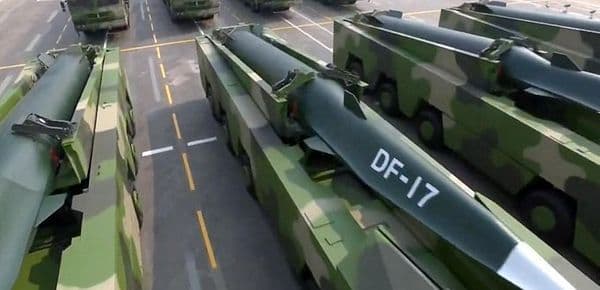
Hydro-Quebec’s giant dams are generally impervious to the estimated 600 kg high explosive payload carried by China’s DF-17 hypersonic rocket. It took Russia eight cruise missiles (of unknown type, but possibly 480 kg warhead Kinzhals) to destroy the Karachun Dam. However, sub-stations, especially those facilitating 735kV transmission lines connecting the generating stations (of at least 250MW) to the metropolitan areas of Montreal an Quebec City, are far more vulnerable. In 2013, criminals armed only with firearms attacked the PG&E Metcalf substation in Coyote, California, damaging 17 transformers (although power was rerouted quickly and repairs only cost US$15 million). In 2022, another firearm attack was carried out on Duke Energy substations, in Moore County, North Carolina, cutting power to 40,000 residents, and causing the imposition of a curfew.
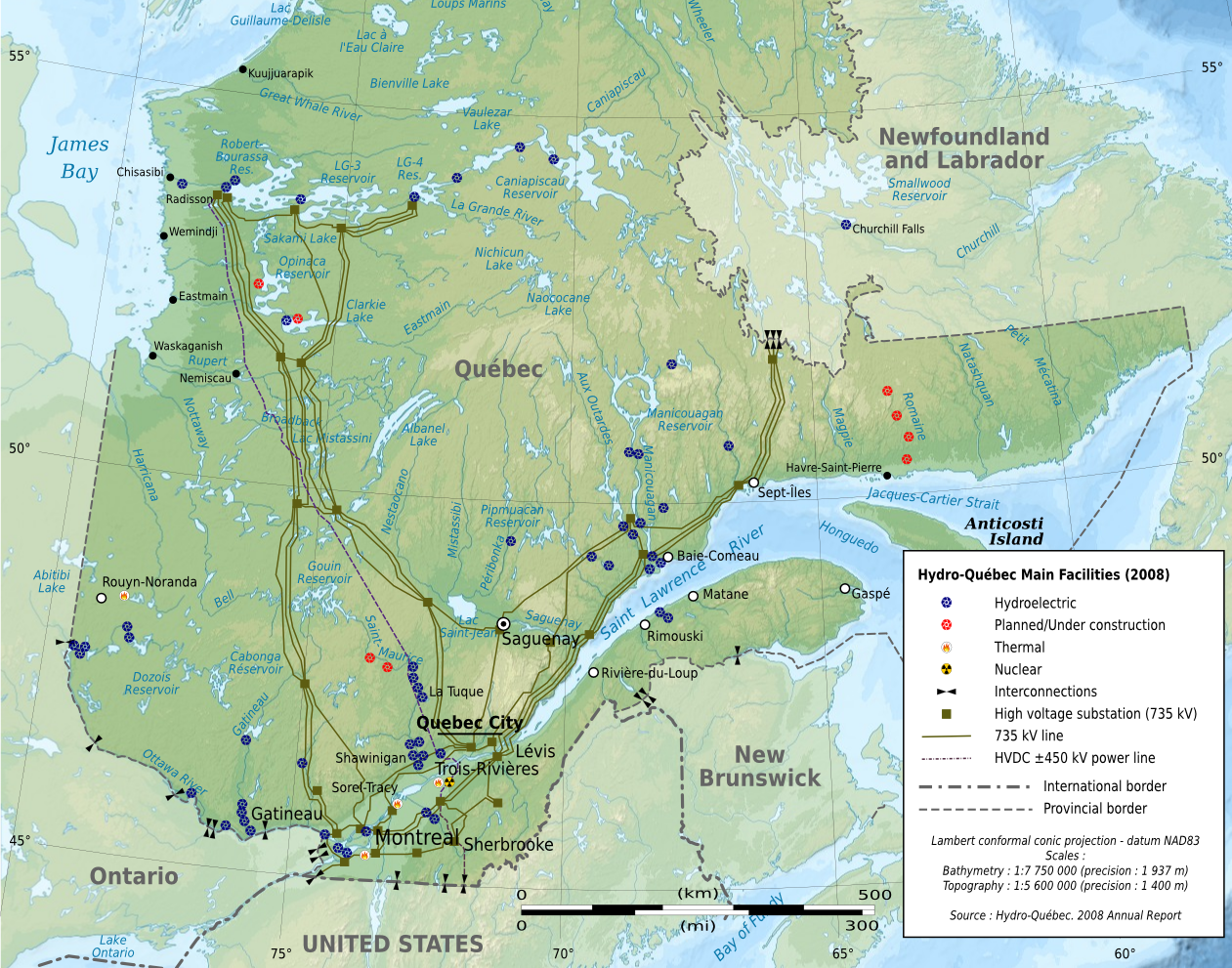
For example, the switch yard for Churchill Falls generating station is particularly remote and isolated, hampering repairs to supply disruption, as was the case in the 1977 power failure at its Poste Montagnais Substation, which caused a major blackout for almost the entirety of Quebec. The cost to benefit ratio for a strike here by China in terms of economic damage to Canada’s second wealthiest province, and the time it would take to remedy the issue, translated into political gains (measured in Canadian concessions through favorable policies to Beijing), against the costs of the expended missiles, makes Churchill Falls a worthwhile strategic target. Some authorities in Hydro Quebec may be aware of these vulnerabilities, given selective pixilation of sites on Google maps, such as the Poste Albanel station.
Remote bombardment, despite its similarity to the effects of terrorism and natural disasters, is not one of the explicit responsibilities of Public Safety Canada. In contrast, re-establishing critical infrastructure and contributing to national reconstruction is a core function of the U.S.’s FEMA (Federal Emergency Planning Agency), for which it ran drills during and since the Cold War. Canada’s Cold War equivalent, now discontinued, was the Emergency Measures Organization of the Department of National Defence. The Oceans have not protected Canada from relatively inexpensive conventional strikes since the 1940s. Canada was in fact the target of strategic attack by balloon-carried explosives launched by Japan during the Second World War, though the small scale of the bombardment led Ottawa to the simple expedient of censorship. The emergence of the more severe threat of bombing by aircraft in 1930s Europe and Asia, led to the physical and organizational hardening of state structures, which was termed the Garrison State. The failure of Ukraine to develop a pre-war general mobilization plan, including the dispersion of its civilian infrastructure, demonstrably increased its vulnerability to Russian drone and missile strikes. It behooves Ottawa to prepare contingency plans to deal with the emergence of these new cost-effective missile threats. Some measures could include investing in aircraft or satellites possessing electronic (ELINT) and signals (SIGINT) intelligence capabilities, to enhance early-warning and missile-detection architecture. Furthermore, vulnerable electrical distribution grids could be made more redundant, and a federally funded program could subsidize the stockpiling of key spare parts. Furthermore, given the provincial responsibility for maintaining Canada’s energy infrastructure, detailed inter-governmental coordination would be required to ensure the resources are available for efficient mobilization in the event of a loss of service.
Regardless of whether Ottawa is as determined as the Pentagon that war with China is a possibility, not preparing for a reality where Canada is susceptible to billions of taxpayers’ dollars in damages from bombardment, poses a grave risk. Canada has already committed to upgrading its Northern Warning Systems of sensors and NORAD infrastructure, although its unclear when it will be capable of tracking hyper-velocity vehicles, given the tendency of how plasma reflects radar signals. China’s capability for hypersonic strikes, which with counter-measures will likely be able to evade interception by the U.S. missile defense base in Alaska, means that Canada should also reconsider integrating into Washington’s deterrence architecture. Other U.S. allies, including Australia, Japan, and South Korea, all host Ground-based Ballistic Missile Defense systems and associated U.S. military bases.
Thus, Ottawa’s posture should be both offensively and defensively minded. Defensively because the state must seek to negate Beijing’s harm-based bargaining power by preparing to promptly repair damage to its vulnerable infrastructure, which is no longer made safe from bombardment by its distance from potential battlefields. Offensively, because Canada must show the resolve to fight alongside Pacific allies and not peel out of the coalition as it did from Afghanistan in 2014. Washington needs to remind Canada that Ottawa cannot expect unconditional protection from its allies, if it is unwilling to reciprocate. China will certainly not be dissuaded from striking Canada if Ottawa declares neutrality, nor should the U.S. feel the political compulsion to expend scarce missile defense resources in defending an ally that has committed itself to strategic free-riding on fellow democracies, and is engaging in its most comprehensive unilateral disarmament effort since the end of the Korean War.
Alexandru Filip is an International Relations student at Concordia University, Montreal, and an analyst and editor at the Canadian Center for Strategic Studies research institute. His research focus is strategic and security studies, with a particular interest in naval, air and nuclear capabilities.
Dr. Julian Spencer-Churchill is associate professor of international relations at Concordia University, and author of Militarization and War (2007) and of Strategic Nuclear Sharing (2014). He has published extensively on Pakistan security issues and arms control, and completed research contracts at the Office of Treaty Verification at the Office of the Secretary of the Navy, and the then Ballistic Missile Defense Office (BMDO). He has also conducted fieldwork in Bangladesh, India, Indonesia, and Egypt, and is a consultant. He is a former Operations Officer, 3 Field Engineer Regiment, from the latter end of the Cold War to shortly after 9/11.

In Pursuit of Nuclear Abolition
By Peter Huessy • RealClearDefense
Innovation Alone Won’t Prepare the U.S. for the Future Battlefield
By Joshua Segal • RealClearDefense
The sUAS Tactical Trifecta
By Bryan T. Woody • RealClearDefense
The Revolutionary War: When Strategic Options Share the Same Weakness
By Henry Yep • RealClearDefense
The Houthis Are Testing the Limits of Collective Defense
By Saima Afzal • RealClearDefense

Who Shoots Down the Drone Over the Shipyard?
By John Ferrari & Dillon Prochnicki • RealClearDefense
Northrop Grumman Breaks Out the Big Guns at AUSA
By Daniel Terrill, Defense News
Army Pursuing Diverse Array of New Anti-Air Interceptors
By Trevithick, The WarZoneWho Shoots Down the Drone Over the Shipyard?
By John Ferrari & Dillon Prochnicki, RCD
F-35C Lands for the First Time on a Ford-Class Aircraft Carrier
By The Aviationist