
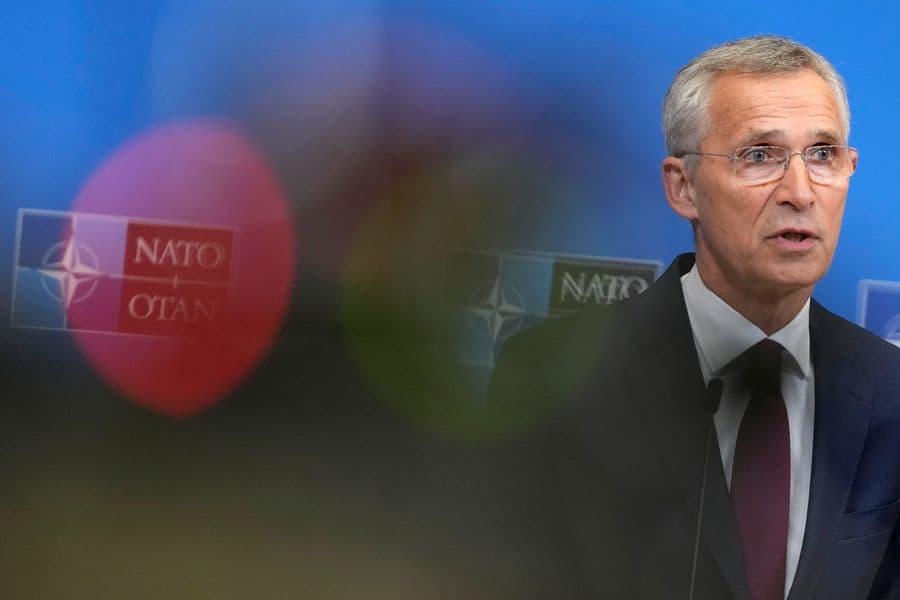
Why Jens Stoltenberg Should Be a Candidate for the Nobel Peace Prize
Last updated 06:25 AM EDT • Read time: 5m
It might seem that nominating the leader of the world’s largest and most important military alliance for a Nobel peace prize is a contradiction in terms but, the appearance of contradiction is mistaken. North Atlantic Treaty Organization (NATO) Secretary General Jens Stoltenberg is deserving of being considered for this recognition, primarily because of the way he has managed the challenge resulting from NATO’s response to the massive and illegal Russian invasion of Ukraine.
In pulling together a coalition as diverse as NATO to be marshaled for a military effort of the size and scope that was necessary to continue to support Ukraine for more than a year against the Russian invaders, Stoltenberg had to successfully manage at least three critical tasks: political unity; military interoperability; and escalation control.
NATO’s political unity in the face of Russian aggression against Ukraine has been unprecedented. Even during the Cold War, NATO leaders had to deal with challenges resulting from the Suez crisis, French President Charles de Gaulle’s withdrawal of France from the NATO military command structure, conflict between Greece and Turkey over Cyprus, and West German interest in Ostpolitik.
On the other hand, as of July 2023, no members of NATO have defected from the mission of supporting Ukrainian sovereignty and independence against Russian attackers. In fact, because of Stoltenberg’s leadership, Putin’s political miscalculation, that his war against Ukraine would divide and weaken NATO, has had the opposite effect. NATO has never been stronger, and Putin never weaker or Russia in more disarray as many members of his national security team have turned against the war. Even Finland decided to abandon its historically neutral status and join NATO! (With Sweden waiting in the wings). That in itself represents a strategic setback for Russia, regardless of the outcome of military operations in Ukraine.
While Ukrainian soldiers have been fast learners, they still needed to receive expert training from NATO on an enormous tranche of weapons. NATO has brought interoperability by providing guidance in C4ISR (command, control, communications, computers, intelligence, surveillance and reconnaissance), drone warfare, deception and disinformation, and other military arts. Although Russia always produced larger numbers of ground force combatants and reservists than Ukraine, Ukrainian commanders and troops with NATO guidance and assistance have made quality more important than quantity. Whether the projected counteroffensive makes decisive gains against Russian forces in eastern and southern Ukraine, or is stalemated in the attempt, it remains the case that, for the first 500 days of war, NATO - coached Ukrainian forces fought with more agility and closed the OODA loop (observe, orient, decide, act) faster than their Russian counterparts. Even in Bakhmut in the spring of 2023, where superior numbers of the Wagner group and other Russian fighters claimed victory after many months of exhaustive battle, it was such a humanitarian disaster that the embittered Wagner leader Yevgeny Prigozhin publicly attacked the Russian Defense Ministry and its top military commanders for their alleged incompetence and even went so far as to try to remove them by force in an attempted coup.
Escalation control was NATO’s third challenge and is often misunderstood or mistakenly explained. It is not only about nuclear weapons and Putin’s repeated public threats of nuclear first use in case of unacceptable military losses for Russia. Escalation control also applies to NATO’s definition of its political objectives with respect to this war. In the face of considerable controversy about this matter, Stoltenberg has held fast to a clear position that NATO is defending Ukraine against aggression – not undertaking a war between NATO and Russia. Even if some commentators refer to this as a NATO “proxy war” against Russia, this has never been NATO’s public position and Stoltenberg has made it remain thus. Unfortunately, this situation frustrates certain elements in the American media commentariat, the U.S. Congress, and the national security and foreign policy bureaucracies. Some would prefer an open embrace by NATO of more ambitious political and military objectives, including the infliction of such devastating battlefield losses on Russian forces that the Putin regime will fall. Short of that, but also ambitious, is the desire among some of the same chorus of commentators and policy makers for the incorporation of Ukraine into NATO, first as a “partner” and eventually as a full member.
A major escalation of NATO political aims in Ukraine has an understandable appeal to many individuals who are justifiably horrified by Russian aggression and war crimes, but as a matter of policy and strategy it would be a serious mistake. Eventually, negotiations to end this war will have to take place between Ukraine and Russia, and neither Putin nor Ukrainian President Zelenskyy is going anywhere, at least in the near term. For these negotiations to be successful, they will have to involve bargaining and marginal trade-offs that both sides can live with, even if they are far from ideal as seen from Kiev, Washington, Brussels or Moscow. It’s a long haul and heavy lifting, but that’s where diplomats, like Stoltenberg, earn their money, and it is better than endless numbers of dead Ukrainians and Russians. And, if a durable peace returns to this embattled war zone, Jens Stoltenberg’s indispensable leadership, which has been extended for another year, should be taken into account by those considering who should receive the Nobel Peace Prize.
Lawrence J. Korb is a Senior Fellow at the Center for American Progress and a former Assistant Secretary of Defense.
Stephen Cimbala is a professor of political science at Penn State University, Brandwine.

The First Test of Peace Lies in Ukraine's Borderlands
By Dennis T. Cosgrove • RealClearDefense
The VFW’s Gambling Addiction Victimizes Veterans
By Jack Yoest • RealClearDefense
Superintelligence Exposes a Gap in the Law of Delegated Authority
By Sue Ghosh Stricklett • RealClearDefense
When the Network Goes Dark, Who Controls the Battlefield?
By Jonathan K. Corrado • RealClearDefense
We Cannot Build Tomorrow's Weapons With Yesterday's Alloys
By Joseph F. Krause • RealClearDefense
When the Network Goes Dark, Who Controls the Battlefield?
By Jonathan K. Corrado • RealClearDefense
Air Force Should Buy 250 Blended-Wing Tankers, as 2027 Demo Looms
By A&SF Mag.
Long Deployments to Be Navy Standard For Next Couple Years
By Mongilio, USNI NewsWhen the Network Goes Dark, Who Controls the Battlefield?
By Jonathan Corrado, RCD
Marines Deploy Neros Archer Drone in Live Fire Exercise for First Time
By USNI News