
The Civil War Over Missile Defense
Last updated 05:28 PM EDT • Read time: 5m
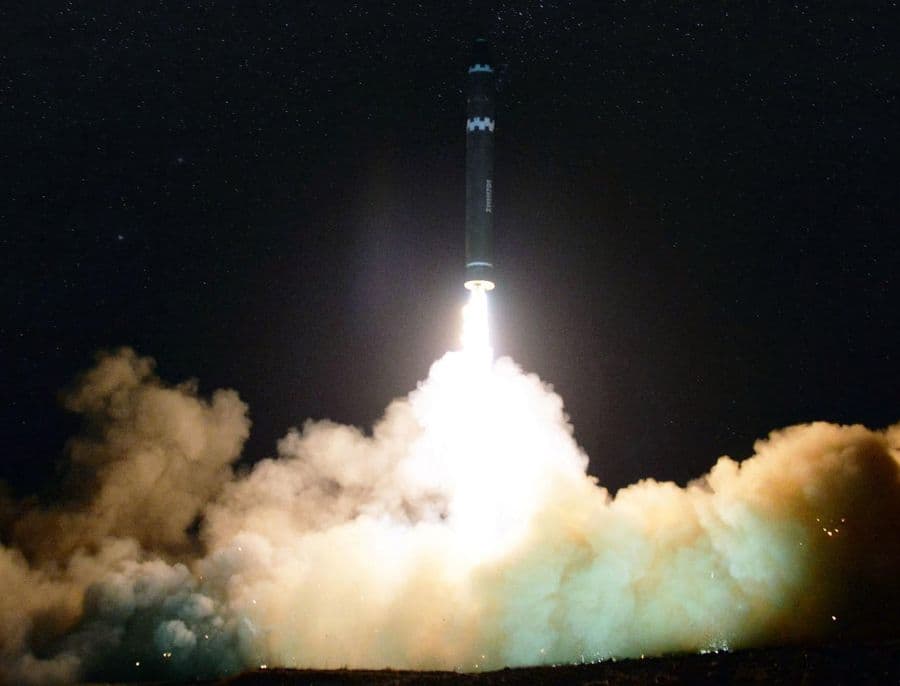
In February, the New York Times opined that missile defense was a “dangerous illusion” and criticized the Trump administration for persuading Congress to increase the 2018 missile defense budget from $10 billion to $14 billion in response to North Korea’s test of intercontinental ballistic missiles (ICBMs) that can reach North America. Revealingly, the Times dislikes that the administration is pursuing “the ability to defeat missile threats prior to launch,” in other words, when they are a stationary target.
The Times looked backward and criticized the Bush 43 administration for rushing missile defense into service “without proper engineering and testing” ignoring that some of the Trump budget increase will be spent on…engineering and testing. The paper of record then avers that “missile defense needs to be part of the United States’ strategy” which is already the view of the Trump administration. The 2018 National Defense Strategy identifies missile defense as one of several modernization programs the U.S. will use to maintain its competitive advantage.
The Times then argued for more aggressive sanctions on North Korea. Two weeks later, Trump obliged the paper by sanctioning 56 entities involved in the North’s maritime smuggling.
Reflexive critics of missile defense like the Times fail to note that the Trump administration did not arrive in Washington, D.C. primed to ratchet up spending in missile defense. Credit for that decision goes to North Korean leader Kim Jong-Un.
The Trump administration’s May 2017 budget request for fiscal year 2018 would have maintained a level of missile defense funding similar to that in the last years of the Obama administration. In the wake of North Korean ICBM tests in 2017, Congress approved a White House reprogramming request to allocate an additional $368 million to missile defense, and continued North Korean tests spurred the $4 billion dollar increase for 2018
The only missile defense system the Times saw fit to “name and shame” was the Ground-Based Midcourse Defense (GMD) system, the only system that protects the continental United States. GMD is the only domestically-based system that intercepts missiles in space – over the Pacific Ocean in the case of North Korean missiles – so missile debris and nuclear warhead material don’t rain on the U.S.
GMD critics are entitled to their opinion, but their negative assessment of the system stands in contrast to the people who are actually accountable for protecting the United States. Having GMD in her arsenal is why, Air Force General Lori Robinson, Commander of the North American Aerospace Defense Command, testified to the Senate, “I am 100 percent confident in my ability to defend the United States of America."
Missile defense nay-sayers prefer to hold systems like GMD to a standard that few man-made objects can meet, and are careful to obscure that each component is not foolproof, and is not the only answer, but is one part of a broader approach. And never mentioned is the fact that defending against missiles is harder than launching them, which is why advanced technology programs will demonstrate failures along the way. Mainstays of our defense, such as the F-16 Fighting Falcon and the C-17 Globemaster suffered numerous test failures and delays that are now lost in the mists of time.
The real timeline of missile defense development is revealing. In March 1983, President Ronald Reagan announced his vision for a system to protect America against the Soviet Union missile threat. At the time, however, the U.S. was bound by the 1972 Anti-Ballistic Missile Treaty which only allowed the defense of Washington, D.C., or a military base elsewhere in the country. It wasn’t until 2002, in the wake of 9-11, that President George Bush ordered the deployment of 44 missile interceptors in Alaska and California.
So, instead of “35 years of failures” as critics would claim, GMD has been developed, tested, and deployed within 16 years, including the 8-year tenure of the hostile Obama administration.
And the development and limited deployment of 44 interceptors may be paying off already. Before his recent request for a meeting with President Trump, North Korea leader Kim Jong-Un likely connected the facts that the U.S. was not only buying more interceptors but, more importantly, the President would use them to defend America.
Missile defense opponents consider it more important to stay the hand of the democratically elected leader of the United States rather than the current occupant of North Korea’s hereditary dictatorship, a man who killed his uncle and half-brother and who thinks “The Godfather” is a how-to manual. An inside-the-Beltway, civil war shouldn’t be allowed to place the nation at risk of the surging ballistic missile threat from Pyongyang.
James Durso (@james_durso) is the Managing Director of Corsair LLC. He was a professional staff member at the 2005 Defense Base Closure and Realignment Commission and the Commission on Wartime Contracting in Iraq and Afghanistan. Mr. Durso served as a U.S. Navy officer for 20 years and specialized in logistics and security assistance. His overseas military postings were in Kuwait and Saudi Arabia, and he served in Iraq as a civilian transport advisor with the Coalition Provisional Authority. He served afloat as Supply Officer of the submarine USS SKATE (SSN 578).

We Cannot Build Tomorrow's Weapons With Yesterday's Alloys
By Joseph F. Krause • RealClearDefense
Americans Will Sacrifice for Their Country, Not for Politicians
By Jane Li • RealClearDefense
No Need for a New World Order
By Will Thibeau • RealClearDefense
Congress: Don’t Let the NDAA Hand China Our Defense Blueprints
By Richard Newton • RealClearDefense
Washington Cannot Ignore Afghanistan’s Weapons Legacy
By Saima Afzal • RealClearDefense

Marines Deploy Neros Archer Drone in Live Fire Exercise for First Time
By USNI News
Confessions Of An SR-71 Blackbird Pilot
By Howard Altman, The WarZone
Air Force Exploring Creative Ways to Produce More Pilots
By Laura Heckmann, NatDef
"Super F-22' Propels Rator to Fly With F-47 Into 2060s
By Kris Osborn, Warrior Maven
GA-ASI and Saab Test AEW Payload on MQ-9B
By Stefano D'Urso, The Aviationist