
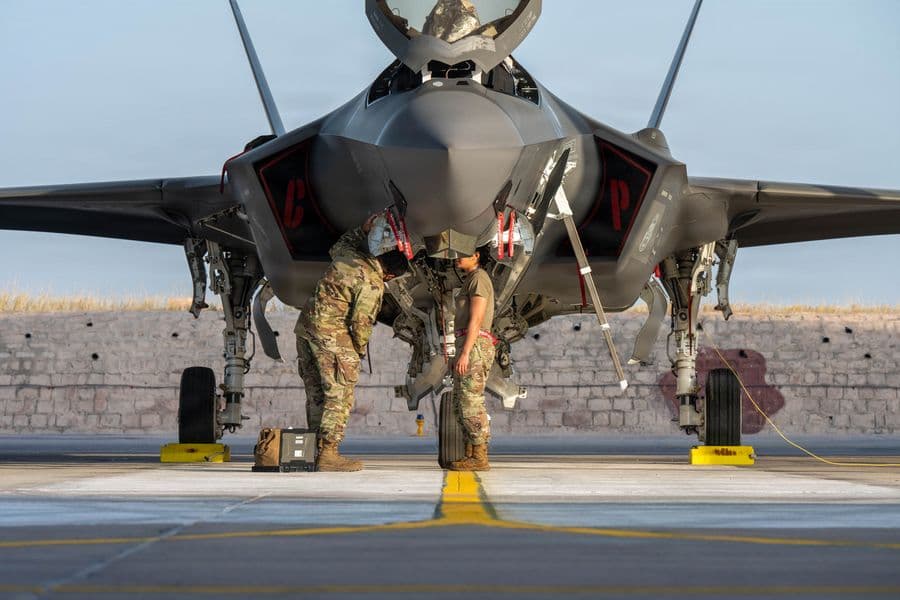
U.S. Air Force Airmen assigned to the 13th Aircraft Maintenance Unit perform preflight maintenance on an F-35A Lightning II during Tarang Shakti 26 at Jodhpur Air Force Station, India, Sept. 30, 2026. Maintainers inspect and service the aircraft before flight operations, ensuring the F-35 is ready for its next flight. (U.S. Air Force photo by Airman 1st Class Nathaniel Jackson)
Congress: Don’t Let the NDAA Hand China Our Defense Blueprints
Last updated 05:56 AM EDT • Read time: 4m
The Pentagon has launched an investigation after sensitive F-35 fighter jet components, including a cockpit canopy and a weapons-bay door coated with specialized radar-absorbing stealth technology, reportedly ended up in the possession of the Chinese government earlier this year.
Ask any senior U.S. military leader and they will tell you that F-35 parts could allow the Chinese Communist Party (CCP) to reverse engineer U.S. stealth technology. That is a threat to our service members and national security. So why are a number of U.S. lawmakers championing “Right to Repair” legislation, which could make it easier for bad actors and foreign competitors to obtain the trade secrets behind critical U.S. defense systems?
Rep. Raja Krishnamoorthi (D-IL), a member of the U.S. House Committee on Intelligence, recently wrote to Secretary of War Pete Hegseth about the intellectual property (IP) breach, saying, “We cannot allow advanced military technologies to fall into the hands of U.S. adversaries.”
Rep. Pat Harrigan (R-NC), a member of the U.S. House Armed Services Committee, called this a "MASSIVE problem," saying, “China spends enormous resources trying to penetrate our most advanced military technology, we cannot make their job easier through failures in our own supply chain.”
Yet “Right to Repair” legislation would do exactly that: “make their job easier.” It is not too late, however, to make meaningful changes that narrow the scope of the legislation and strengthen IP security for critical defense systems.
It’s ironic that members of Congress like Rep. Harrigan, along with Rep. Maggie Goodlander (D-NH) and Senators Elizabeth Warren (D-MA) and Tim Sheehy (R-MT), are championing “Right to Repair” while decrying the CCP’s attempt to reverse engineer a major American military platform. The legislation would expand access to, and disclosure of sensitive technical information regarding how the defense industrial base manufactures defense platforms.
Proponents of “Right to Repair” argue it is necessary to ensure warfighters can repair their own equipment, but the legislation goes well beyond that. The provisions being considered for the Fiscal Year 2027 National Defense Authorization Act (NDAA) would expand the Department of War’s rights to share sensitive technical data outside the U.S. government.
Chief among the many problems with “Right to Repair” is that the more widely sensitive technical information is shared, the more opportunities America’s adversaries have to obtain facts and/or data and use them against our own warfighters. If possession of F-35 components rings alarm bells because it could help China reverse engineer American technology, then broader access to the information needed to reproduce those components, among other weapons systems, should warrant the same scrutiny. In this case, focused, narrow legislation is what U.S. military readiness requires; Right to Repair” misses the mark entirely.
The U.S. House passed its version of the $1.15 trillion defense bill in July by a partisan vote of 216 to 212. That was before the current mishandled shipment of F-35 spare parts ended up in Hong Kong. Meanwhile, the U.S. Senate is still negotiating its version of the proposed legislation. Senate Armed Services Committee Chairman Roger Wicker (R-MS) has said the committee is committed to finishing before the end of the calendar year.
We have a rare moment of bipartisan agreement that we should not hand national security IP over to China, or any other adversary for that matter. Clearly, we should strip away the high-risk “Right to Repair” provisions from the NDAA before any more security risks occur.
The U.S. Congress should be concerned about F-35 components, and other U.S. weapons systems, falling into China’s hands. Members should thus think twice about supporting “Right to Repair."
Passing "Right to Repair” legislation would turn a known national security vulnerability into federal policy. That would be a costly unforced error.
Lt Gen Richard Newton (U.S. Air Force, ret.) served as Assistant Vice Chief of Staff of the U.S. Air Force and Director of the Air Staff, Headquarters, U.S Air Force. He was later Executive Vice President of the Air Force Association.

We Cannot Build Tomorrow's Weapons With Yesterday's Alloys
By Joseph F. Krause • RealClearDefense
Americans Will Sacrifice for Their Country, Not for Politicians
By Jane Li • RealClearDefense
No Need for a New World Order
By Will Thibeau • RealClearDefense
Congress: Don’t Let the NDAA Hand China Our Defense Blueprints
By Richard Newton • RealClearDefense
Washington Cannot Ignore Afghanistan’s Weapons Legacy
By Saima Afzal • RealClearDefense

U.S. Intel Confirms This Is China’s Secret Spaceplane
By Joseph Trevithick, The WarZone
Navy Sees 10-year High For Class A Aviation, Afloat Mishaps
By H. Mongilio, USNI News
U.S. Navy To Install AI Vessel Detection System on Five Destroyers
By The Defense Post
U.S. Navy’s CHAOS Program
By Dylan Malyasov, Defence Blog
Two U.S. Navy Carriers Ready to Operate New MQ-25A Tankers
By Global Defense News