
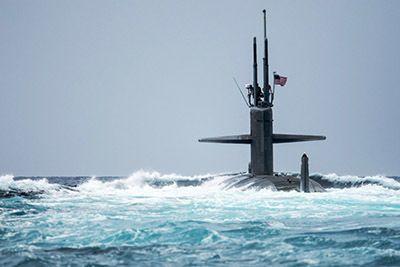
The Los Angeles-class attack submarine USS Newport News (SSN 750) conducts a brief stop for personnel with Coastal Riverine Squadron (CRS) One in the Gulf of Tadjoura on Jan. 31, 2020. NUWC Division Newport is continuing to ensure the Navy’s warfighters have the tools they need to succeed through Other Transaction Authority, which enables effective, flexible and agile acquisitions for emerging research and prototyping.
Pentagon’s Pursuit of Faster Acquisition
As the Pentagon Pursues Faster Acquisition, Restricting OTAs Would Be a Massive Misstep
Published Nov. 14, 2026 • Read time: 6m
Join the Conversation
0A breakthrough in autonomous systems, artificial intelligence, or advanced manufacturing can change the battlefield quickly. Yet under traditional defense acquisition processes, it can take years to get that same technology into the warfighter's hands. By then, the technology may be outdated, or the threat it was designed to address may have changed entirely.
This is one of the biggest challenges facing the Pentagon today, and a major reason why Other Transaction Authorities (OTAs) have become an increasingly important part of how the Department develops and acquires new capabilities.
As OTAs have grown in use, some have raised questions about the Pentagon's increasing reliance on them, particularly around transparency, competition, and financial oversight. Those concerns deserve consideration, but any discussion about the future of OTAs should also recognize the role these authorities play in helping the Pentagon keep pace.
For much of the Cold War, the federal government was at the forefront of developing advanced technologies. The traditional acquisition system was built around that model, with established contractors, detailed requirements, and development timelines that stretched for years.
That is no longer the world we operate in.
Today, some of the most promising national defense technologies are being developed in the commercial marketplace, often by companies that have never worked with the Pentagon. Advances in AI, autonomous systems, advanced materials, and manufacturing are happening faster than traditional acquisition processes were designed to keep up with. Meanwhile, our adversaries are quickly incorporating many of these same technologies into their military capabilities.
The Pentagon needs to move just as quickly. And it needs a way to work with innovative companies that have neither the resources nor the appetite to spend years navigating the complexities of traditional government contracting.
OTAs help address both challenges. They give government acquisition professionals greater flexibility to work with industry, evaluate new technologies, and adapt requirements as programs develop. Consortium-based OTAs take that a step further by bringing together companies of different sizes, backgrounds, and technical specialties to compete for opportunities that might otherwise be difficult to access.
Consider the rise of companies like Anduril, X-Bow (pronounced crossbow), Kratos, and Saronic. Their emergence reflects a broader shift in the defense industrial base, as innovative companies challenge longstanding assumptions about how quickly new capabilities can be developed and delivered. Flexible acquisition pathways play an important role in ensuring the Pentagon can benefit from that innovation.
At the National Armaments Consortium (NAC), we've seen what this approach can accomplish.
Every prototype award through NAC is competed, with an average of more than five submissions per requirement. Seventy percent of our members are small businesses, and more than half of the awards competed among NAC members go directly to nontraditional defense contractors. Importantly, many of the remaining awards also include significant participation by nontraditional companies, extending their involvement well beyond those serving as direct award recipients.
These results matter because they show that acquisition flexibility can go hand in hand with meaningful competition. By creating opportunities for small and nontraditional companies to participate as both direct award recipients and partners on larger efforts, the consortium model gives these businesses a practical way to enter the defense marketplace, build relationships, demonstrate their capabilities, and grow within the defense industrial base. At the same time, the government gains access to a broader pool of potential solutions and suppliers.
There is also a misconception that OTAs' flexibility necessarily comes at the expense of transparency or accountability. In the NAC structure, the Government retains responsibility for final technical evaluation and selection, while the NAC (via its consortia management firm) administers the OTA and enters into member-level initiative agreements with selected NAC participants. Award information is made publicly available where required or as directed by the government.
Concerns about exemptions from Cost Accounting Standards (CAS) also deserve some context. Small businesses are already exempt from CAS under traditional FAR-based contracts. And while OTAs are not subject to the same regulatory framework as conventional procurement contracts, agreements can still include financial reporting, cost verification, and other oversight requirements.
Imposing Cost Accounting Standards (CAS) on OTAs would create unnecessary barriers for innovative companies that have other commercial opportunities. Competitive consortium-based models already provide an important check on costs by allowing the government to evaluate multiple solutions and pricing approaches. Taxpayer accountability remains essential, but it should not come at the expense of attracting new companies into the defense industrial base. The Pentagon's recent push toward Generally Accepted Accounting Principles (GAAP) offers a more practical approach that balances financial oversight with acquisition flexibility.
The Department surely can improve how it tracks and reports OTA performance. More consistent data on acquisition timelines, program outcomes, and transitions to production would help policymakers and acquisition leaders better understand where these approaches are delivering results and where changes may be needed.
But imposing additional restrictions on OTAs could have consequences that extend well beyond the contracting process.
One proposal raised would limit OTAs to research and development and require traditional procurement approaches for production. That may sound reasonable, but it overlooks one of the most difficult challenges in defense acquisition: moving a successful prototype into the hands of the warfighter. That’s often referred to as the Valley of Death.
Developing a promising technology is only part of the job. The government also needs a practical way to test it, refine it, and begin producing it at a scale that meets operational needs. Forcing programs to navigate an entirely new contracting process after successful prototyping can add months or years to that transition, even when the technology has already demonstrated its value.
The ability to move from prototyping to appropriate follow-on production is one of the most useful features of the OTA framework. Losing that flexibility would risk recreating the very acquisition bottlenecks the Pentagon has spent years trying to overcome.
None of this suggests traditional FAR-based contracting no longer has a place. It remains essential for many established programs, particularly those with mature technologies, stable requirements, and large-scale production needs. But the Department's acquisition system must accommodate both those programs and emerging technologies that demand a different approach.
The Pentagon is already pursuing significant acquisition reforms intended to move capabilities into the field faster and strengthen the defense industrial base. OTAs are well suited to support that direction, and consortia offer a practical example of how to use them responsibly.
Success should not be measured by how closely every acquisition resembles past processes. It should be whether we are expanding competition, strengthening the industrial base, protecting taxpayer investments, and delivering relevant capabilities to the men and women who need them.
That is the standard our acquisition system must meet.
Ben Harris is Executive Director of the National Armaments Consortium (NAC), a nationwide consortium of more than 1,370 organizations from industry and academia collaborating with the Department of War to accelerate the development of critical armaments technologies and strengthen the U.S. defense industrial base.
Pentagon’s Pursuit of Faster Acquisition
By Ben Harris • RealClearDefense
The Army’s AI Cyber Defenders Need a Proven Stand-Down Order
By Gleb Tsipursky • RealClearDefense
After the Silence
By Chase Skylar DeMayo • RealClearDefense
Defense Chip Procurement Needs a Recovery Test
By Percy Yixuanchen Yu • RealClearDefense
FORTRESS America Must Measure Missions, Not Megawatts
By Burak Oktenli • RealClearDefense
After the Silence
By Chase Skylar DeMayo • RealClearDefense
Underwater Arms Race Puts U.S. Naval Supremacy at Risk
By Tom O'Connor, Newsweek
New Facilities To Pump Out Upgraded F/A-18E/F Super Hornets
By Trevithick, WarZone
U.S. Navy Expands Tomahawk Warhead Production
By Naval News Staff, Naval News
SSN(X) Attack Boat Will be a Swift, Lethal Mothership for Undersea Drones
By USNI N.