
Bringing Geopolitics Back: Ukraine, Peace, and the Art of the Deal
Last updated 07:30 AM EST • Read time: 9m
President-elect Donald Trump has promised to end the Russian-Ukraine war soon after entering the White House. Peace, however, is only one value in an array of American interests. Of greater significance is re-ordering Eurasian geopolitics in the interest of the United States.
Ever since Halford John Mackinder delivered his 1904 masterpiece, “The Geographical Pivot of History,” the grand strategy of the dominant maritime power has been to “distract” the territorial power occupying the Eurasian “heartland.” According to Mackinder, this required identifying “bridge heads” on the Eurasian landmass to capture the attention of the heartland power and prevent them from building fleets that might threaten the maritime power. If circumstances permitted, as was the case in the aftermath of World War I, the USSR might be “confined” to the heartland by advancing national independence for states from the Baltic Sea to the Adriatic and Black Seas.
Today, an emerging alliance among the autocratic powers of Eurasia – China, Russia, Iran, and North Korea (CRINK) – is the primary threat to maritime powers. These allies have launched three fronts of a four-front war (here, here, and here): Russia’s war on Ukraine, Iran and its proxies against Israel, Iran and the Houthis against maritime shipping. What remains to be attempted is the Chinese conquest of Taiwan, either through economic coercion, blockade, or military action. Beyond sharing military hardware and knowhow among the CRINKs, their common purpose is also revealed by the North Korean commitment of troops to reconquer the Kursk region.
In reaction to these developments, maritime powers have awakened to the danger of the CRINK axis. Japan, Australia, India, and the United States (the Quad) have explored the necessity of common naval action to keep sea lanes open in the Indo-Pacific. In addition, with the accession of Finland and Sweden to full NATO membership, the Baltic Sea has been turned into a “closed sea,” or a “lake,” dominated by NATO powers. Finally, Russian access to the Baltic Sea is now at risk: Kaliningrad and Saint Petersburg front onto the Baltic Sea; Kaliningrad, Russia’s military base, is cut off from Belarus, a Russian client state, by the Suwalki Gap. This borderland between Poland and Lithuania may one day become a geostrategic flashpoint, should Russia attempt to end Kaliningrad’s exclave status.
Given a global geopolitical outlook, American negotiators should not ignore the geostrategic position of Ukraine in the struggle between maritime and territorial powers for preeminence across Eurasia.
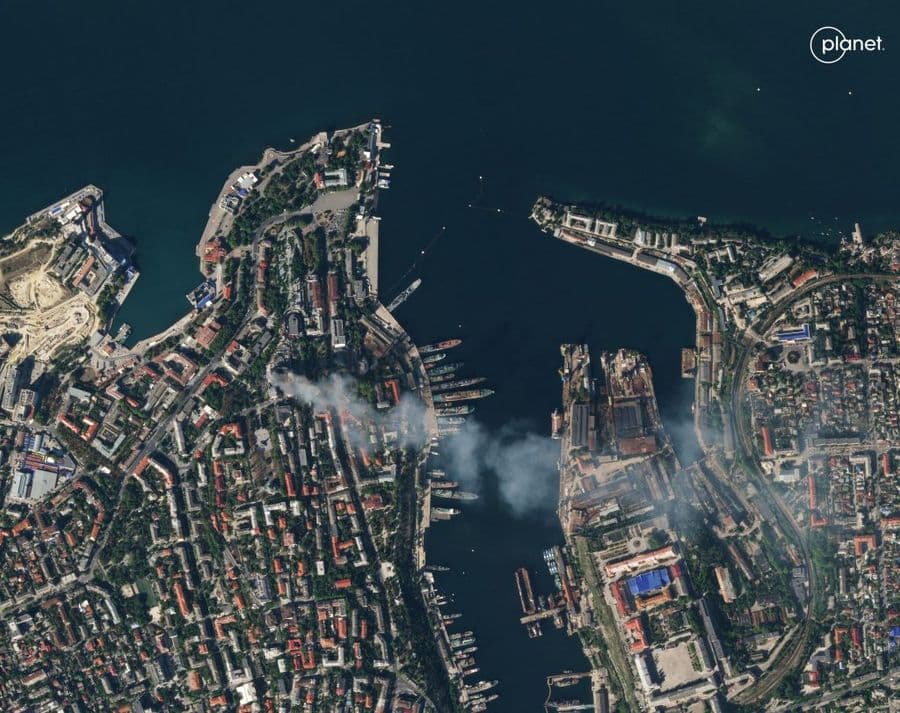
Should Russian maritime forces successfully block shipping from Odessa, the Ukrainian economy would be in grave danger. Conquest of the Black Sea littoral would enable Russia to turn whatever remained of Ukraine into a landlocked state. Concessions to Russia of territory along the northern Black Sea littoral put Odessa at risk in a future conflict and may eventually tempt Russian geostrategic thinkers to attempt a land bridge between Russian territorial conquests in Crimea with Russian irredentists in Transnistria. Moldova would then be in the crosshairs. The Russian fleet, should it survive the war as an intact organization, would pose a threat to the remaining Ukraine frontage on the Black Sea. In considering these varied geopolitical imperatives, the Trump team should focus on the Crimea. Conceding Crimea to Russia to secure what is likely to be a temporary peace is a mistake. Crimea is the Eurasian bridgehead to the heartland of the Black Sea.
Crimea has a geostrategic significance from a deterrence perspective as well: The Baltic States, Finland, and Ukraine provide three military fronts along which it is now possible for NATO to launch a counterattack should Russia invade a NATO-allied state. While NATO has no intention of doing so, this possibility is a critical piece of strategic calculus from a Russian perspective, given their history of invasions from the west.
If territorial concessions must be made to reach a deal, then the lands occupied by ethnic Russians in eastern Ukraine might be conceded to give Putin a face saving “victory.” After all, Putin’s initially announced war aim was to protect the ethnic Russians in Ukraine from what he (absurdly) alleged to be a Nazi government bent on destroying their culture, language, and community. Such a concession, however, may come to be regarded internationally not as a mere concession but, more troublingly, as a reward for aggression – an outcome to be emulated by autocrats elsewhere.
Regrettably, Putin has no immediate incentive to end this war. Our desire for peace does not match his intentions. Putin seeks to reestablish a Russian empire, dominating the ethnic populations along Russia’s near abroad, and turning these regions into geopolitical buffers and dependencies. Given Chinese and Iranian provisions of war materiel, North Korea’s supply of new troops, and the Russian demographic advantage over Ukraine, Putin’s forces could “shatter” the Ukrainian military. A Ukrainian defeat is more likely the longer this war of attrition continues unless the West is prepared to step up support.
The Biden administration responded to the deployment of 10,000 or more North Korean troops to the Kursk front, where Ukraine conquered territory earlier from Russia, by granting the Ukraine government permission to use Army Tactical Missile Systems, or ATACMS, to attack distant targets. According to the BBC, “Ukraine’s military … confirmed that it had struck an ammunition warehouse in the Russian region of Bryansk, but it did not specify whether ATACMS had been used. It said the attack, on a depot around 100km from the border near the town of Karachev, had caused 12 secondary explosions.”
In response, Putin has once again threatened the use of nuclear weapons. He announced a new nuclear doctrine which “allows for a potential nuclear response by Moscow even to a conventional attack on Russia by any nation that is supported by a nuclear power.” The United States should not back down in the face of nuclear threats: The consequent loss of deterrence will lead allied and client states, including the frontline NATO powers, to rightly question American resolve.
The Biden administration has handed the incoming Trump team a new bargaining chip. The Trump administration may now threaten to supply weaponry that will enable Kyiv to launch attacks, not only on weapons storage facilities but more significantly on Russian infrastructure: Oil refineries, pipelines, pumping stations, port facilities, etc. Only by plausibly threatening such attacks will the Trump administration bring Putin to make meaningful concessions at the negotiating table.
When Russia experienced its initial defeat on the road to Kyiv, the United States had several options (here, here, and here) for how the Biden Administration might implement an endgame in Ukraine. Today, American diplomacy must search for the least bad outcome among a set of unpalatable choices. Driving toward a peace today, but on bad terms, may not be the least-bad outcome: It may well be continued war, and escalation, in service of a better outcome later.
Allowing whatever remains of Ukraine to be turned into a neutral buffer state invites Russian gray zone warfare, the consequence of which will likely eventuate in the election of future leaders in Ukraine that would align the country more closely with Russia. Georgia and Armenia are recent examples of “Finlandisation.” Should the United States secure an agreement allowing Ukraine to join NATO at a future date, Russia will in all probability reignite gray zone warfare as a means of forestalling full membership. As Melik Kaylan has argued: “By treaty law, Nato [sic] doesn’t accept new members that are in mid-conflict or even in a frozen conflict. As a result, accession will take time, and Russia will not stand still. Even supposing Ukraine gets into Nato [sic], what guarantees that its members, if called upon, will actively engage in a direct military confrontation with Russia when they won’t now?” Should Ukraine fall into a Russian sphere of influence, the challenges of maintaining effective deterrence simultaneously in Asia and Europe will be enormous.
The Trump team will have to judge the trustworthiness of Putin in the context of the 2014 war on Ukraine and the abrogation of the Budapest Memorandum of 1994. Ukraine’s territorial integrity and sovereignty was backed by the Russian, British, and American guarantees in exchange for Ukraine giving up its stockpile of nuclear weapons. Putin recently made his position clear: “Russians and Ukrainians were one people – a single whole. These words were not driven by some short-term considerations or prompted by the current political context. It is what I have said on numerous occasions and what I firmly believe.” Only by demonstrating militarily that they are no longer one with the Russians will the Ukrainians secure an autonomous future.
President-elect Trump and his team are to be commended for seeking peace, but seeking peace at any price would be a grave error. Advancing American national interests must remain the paramount goal in the proposed negotiations. Concessions to Russia in the hope of detaching Russia from its connections to China and Iran is an ever-present temptation. But what guarantees could Putin offer?
Given Putin’s track record, the path to peace is through escalation. The Ukrainians must demonstrate the capacity to damage Russian core interests before there will be a durable peace favorable to Western interests.
The Trump negotiators must remember that Ukraine occupies a pivotal geostrategic position in Eurasian geopolitics. Geopolitical imperatives must be the paramount strategic consideration. Sacrificing the Crimean bridge head may gain peace today, but doing so will come at a grave strategic cost tomorrow.
Michael Hochberg earned his PhD in Applied Physics from Caltech. He is currently a visiting scholar at the Centre for Geopolitics at Cambridge University and the President of Periplous LLC, which provides advisory services on strategy, technology, and organization design. He co-founded four companies, representing an exit value over a billion dollars in aggregate, spent some time as a tenured professor, and started the world’s first silicon photonics foundry service. His publications include a co-authored, widely used textbook on silicon photonics and his articles have appeared in Science, Nature, National Review, The Hill, American Spectator, RealClearDefense, Fast Company, Naval War College Review, Gatestone, etc. Michael’s writings can be found at longwalls.substack.com, and his twitter is @TheHochberg.
Leonard Hochberg is a Senior Fellow at the Foreign Policy Research Institute (FPRI) and serves as the Coordinator of the Mackinder Forum-U.S. (www.mackinderforum.org). He taught at Stanford University (among other institutions), was a Fellow at the Hoover Institution, and co-founded Strategic Forecasting, Inc. (i.e., STRATFOR). He has published work in Social Science History, Historical Methods, The Journal of Interdisciplinary History, Orbis, National Review, The Hill, American Spectator, RealClearDefense, Cartographica, Naval War College Review, Gatestone, etc. Len earned his PhD in political theory and European history from Cornell University.
The opinions expressed herein are ours alone and do not represent those of the organizations with which we are affiliated.

The Godfather of American Foreign Policy Realism Speaks to Today’s World
By Francis P. Sempa • RealClearDefense
In Pursuit of Nuclear Abolition
By Peter Huessy • RealClearDefense
Innovation Alone Won’t Prepare the U.S. for the Future Battlefield
By Joshua Segal • RealClearDefense
The sUAS Tactical Trifecta
By Bryan T. Woody • RealClearDefense
The Revolutionary War: When Strategic Options Share the Same Weakness
By Henry Yep • RealClearDefense

Navy Civilianizes Six Former Flag Billets, Reduces Six to Captains
By Mongilio, USNI N.
Raytheon's $8B Contract for Strategic Comms Terminal Modernization
By M+A El
America’s Maritime Moment Will Not Wait
By CDR Salamander
Armor Up?
By Marine Corps Compass Points
Who Shoots Down the Drone Over the Shipyard?
By John Ferrari & Dillon Prochnicki • RealClearDefense