
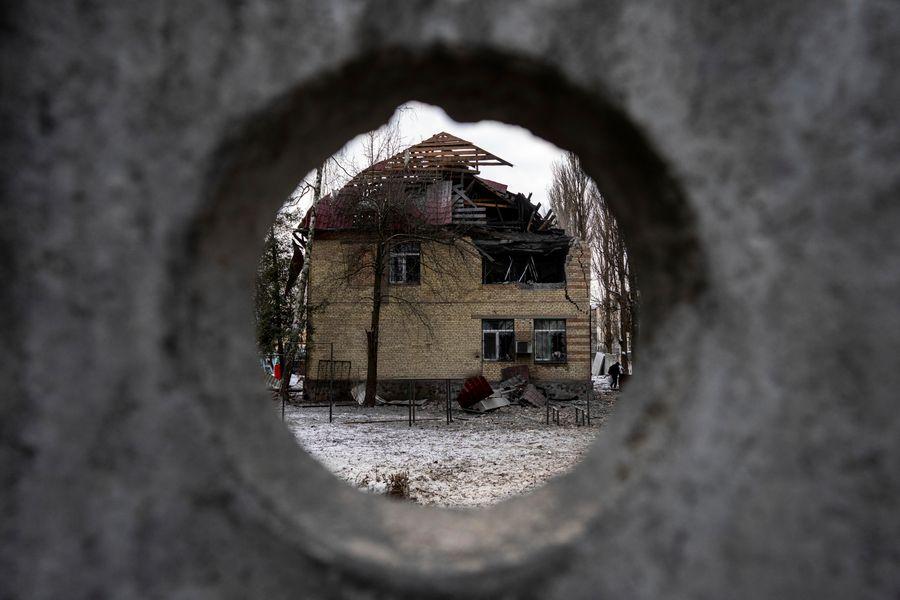
An Endgame in Ukraine: American Strategic Options Part III
Last updated 07:34 AM EST • Read time: 9m
Editor's Note: This is the third in a three part series seperated by the three strategic options for Ukraine. Read Part I, Read Part II
Option 3. Bleed Russia Dry Through a Long War
There are those who believe that U.S. interests would be served by having Ukraine engage in a long war with Russia. Certainly, there are many historical examples of wars where neither side has the means or the will to achieve a comprehensive victory. One such instance was the Iran-Iraq War, 1980-1988, a conflict about which Henry Kissinger stated, “It’s a pity that both sides can’t lose.” One option that the U.S. and NATO could pursue would be to modulate support for Ukraine in such a way as to prolong the war with Russia by providing just enough arms and finance to sustain the war but not enough to secure a comprehensive victory.
There are advantages to be gained by such a cynical maneuver. Although Russia is largely self-sufficient in food and energy, a long war would drive Russian political and economic isolation. It is reasonable to expect that the sectors of their economy that depend on advanced technology–especially computer chips–made in the West would collapse. Key sectors, like domestic civilian aviation, are already in the early stages of collapse due to lack of spare parts.
Furthermore, there is a rapid exodus of Russian military-age men occurring right now, which will present considerable economic and demographic challenges. The Russian government has implemented a policy of selectively conscripting men from minority ethnic groups; from a Kremlin perspective, sending such people to die in Ukraine would constitute a policy win, provided such units don’t eventually become disaffected and seek national autonomy for the regions from which they hail. How such troops will perform under fire is an open question, but history suggests that they are unlikely to be very effective, especially if Ukraine manages to demonstrate and advertise that they are prepared to treat POWs humanely.
The recent Russian deployment of conscripts from ethnic minorities and disaffected groups also creates a considerable opportunity for Ukraine: When these soldiers surrender or are captured, they can be trained and equipped to function as insurgents against Russia, and then returned home. Even a small-scale implementation of this tactic would sow significant enough distrust to produce dramatic, negative effects at home in Russia.
A long war serves U.S. interests in several dimensions:
- It provides an opportunity to bleed Russia dry of both manpower and military hardware.
- The conflict in Ukraine provides the U.S. and NATO with a sandbox in which to test their latest weapons systems. It likewise provides NATO a glimpse at some of Russia’s most advanced equipment.
- Given the poor performance of Russian troops and equipment thus far, the war in Ukraine is likely to hobble Russian arms exports for years to come; orders will instead flow preferentially to Western powers.
- An ongoing war will serve as a catalyst to drive continued economic and political alignment between China and Russia and continued decoupling between the China–Russia–Iran–North Korea autocratic axis and the West. China’s unwillingness to condemn Russian actions or to withdraw economic support–when considered in conjunction with their continued threats to Taiwan– will serve as a constant reminder to the West of the need to disengage and to end economic dependency on autocratic regimes. Such an outcome–a comprehensive decoupling–will harm China and Russia far more than the West, since they will lose access to key technologies which cannot be quickly replicated in China.
- A long war in Ukraine will certainly result in complete decoupling of European states from Russian energy supplies. Germany, a country which has flirted with dependency on Russian natural gas, is now caught in the crosshairs. With the disruption of the pipelines in the North Sea, the choice of German policy makers to rely on the good will of Russia, has been revealed not merely as short-sighted but also as potentially catastrophic. A long war delays the strong temptation, especially for western European states, to revert to reliance on cheap Russian oil and natural gas. A ‘return to normalcy’ by Western Europe, occasioned by a quick and comprehensive Ukrainian victory, would be a major strategic error.
- Some European demand for natural gas (in the form of liquified natural gas) will be redirected to the United States, while the rest will be directed toward U.S. partners such as Romania, Egypt, and Israel. U.S. energy exports to Europe would provide a foundation for the NATO alliance comparable to the planned Russian exports to China, leading to closer economic integration–provided of course that the current U.S. administration allows for more fracking to increase natural gas supplies.
Perhaps most importantly, an ongoing war in Ukraine will serve to enhance the understanding that Western values deserve to be defended. It will highlight to the world’s authoritarian regimes–and to citizens of the West–that adhering to Western values is a ‘force multiplier’ in international conflict. Showing that NATO and the West have an appetite for a long war, when necessary, could be a decisive factor in deterring future violations of the rules-based order by Iran, North Korea, and China.
The downsides of a ‘long war’ scenario are significant, and the burdens of such a strategy will be borne by Ukrainian civilians and infrastructure. From a rebuilding perspective, a long war will be the most expensive route to Ukrainian victory. How the U.S. participates in such reconstruction will emerge as another significant question. A long war will be expensive for the West and particularly for the United States. And any form of frozen or semi-frozen conflict, without a substantive peace settlement that both sides are prepared to accept, falls, effectively, into a ‘long war’ scenario.
Any long war will turn into a long-term test of Western resolve, and it is far from clear whether the citizens of the United States have the patience for an expensive, grinding conflict. The threat of nuclear escalation will remain an issue; while, in the absence of the actual use of nuclear weapons, we can expect the citizens of the West to become inured to Russian nuclear threats.
Conclusion:
The most important question that strategists must repeatedly ask in the midst of a conflict is, “Now what?” The U.S. intervention in the Russo-Ukraine war now precludes any attempt to turn Russia from its proto-alliance with China. Russian strategic interests and values do not align with the West. Option 1 is effectively closed.
Option 3, a long war, appears to be emerging by default. The United States and its NATO allies seem reluctant to arm Ukraine with the weapons required to deter the Russians from engaging in attacks on civilians and infrastructure, let alone providing the advanced weapons required to give the Ukrainians a decisive edge in retaking the territories lost this past year and in 2014.
Furthermore, by not adopting Option 2, the United States is squandering its chance to sequence conflicts across the Eurasian littoral. A protracted conflict gives the Iranians, the North Koreans, and the Chinese the sense that the U.S. is distracted by the Ukraine conflict and may neither have the military capacity nor the attention span to deal with multiple, simultaneous conflicts. Could the United States respond effectively to a border crisis between North and South Korea, a Hezbollah attack on Israel, the Iranian closing of the Strait of Hormuz, and/or a Chinese blockade of Taiwan? The longer the U.S. dithers in bringing the Ukraine crisis to a successful conclusion, the greater the prospect of a multifront war. China is more likely to emerge victorious as time passes by asserting and securing control over the waters adjacent to the first island chain and by forcing a territorial reintegration of Taiwan through a blockade.
An important audience watching our actions in Ukraine is the citizenry of the Baltic States, the Emirates, South Korea, Taiwan, and other states under threat from autocratic adversaries. A long, grinding war, where we are unwilling to provide the means to achieve a Ukrainian victory when it is clearly within our capability, will be seen as a failure of American will and initiative. Were the U.S. to abandon the Ukrainians in a negotiated deal, the lesson that will be taken by our allies, like Taiwan, is that we are not fully committed to their defense.
The war in Ukraine has already driven significant decoupling between Western and Russian economies and a continued growth of mistrust between authoritarian regimes—Russia, China, and Iran—and the West. Russia will likely continue to seek resources and support from China for the war, which could reinforce the emerging idea in the West that decoupling from China is as important as decoupling from Russia. Furthermore, seeing the damage that decoupling is doing to Russia, China will continue to take aggressive action to protect themselves from similar threats by becoming economically more autonomous from Western suppliers of high-tech goods. These actions will exacerbate tensions with the West, driving a cycle of continued decoupling over the coming decade.
Winning this proxy war in Ukraine is a deterrent against Chinese aggression toward Taiwan. A rapid, comprehensive Ukrainian victory would be a lesson in Western resolve and would free up resources for the great confrontation of our generation with the People’s Republic of China. Choosing how to balance the risk of nuclear escalation against the benefits of a maximalist victory in Ukraine is a central challenge facing U.S. policy makers today.
Michael Hochberg earned his PhD in Applied Physics from Caltech and is currently the President at Luminous Computing, a company building supercomputers for machine learning. He founded four companies, representing an exit value over a billion dollars in aggregate, spent some time as a tenured professor, and started the world’s first silicon photonics foundry service. He co-authored a widely used textbook on silicon photonics, and has published work in Science, Nature, National Review, The Hill, American Spectator, RealClearDefense, Fast Company, etc.
Leonard Hochberg taught at Stanford University (among other institutions), was appointed a Fellow at the Hoover Institution, and co-founded Strategic Forecasting, Inc. (i.e., STRATFOR). He has published work in Social Science History, The Journal of Interdisciplinary History, Orbis, National Review, The Hill, American Spectator, RealClearDefense, etc. He is a Senior Fellow at the Foreign Policy Research Institute and serves as the Coordinator of the Mackinder Forum-U.S. (www.mackinderforum.org).

Counterterrorism and the Growing Convergence in Homeland Security and Homeland Defense
By Austin Doctor • RealClearDefense
The Future of Space Power Depends on Integration
By Damian DiPippa • RealClearDefense
America Should Unleash Cyber Privateers
By Jacob Schelp • RealClearDefense
America Invented the Battery, but China Controls the Factory
By William Crane • RealClearDefense
A Defense Win for Americans and Israelis in Arkansas
By Bradley Bowman • RealClearDefense

F-16s Build on Iran Combat Lessons to Prepare for China Threat
By Rebecca Grant • Lexington Institute
Key Space Force Satellites Can’t Talk to Each Other
By T. Hitchens, Breaking Defense
Blue Angels Pilot Scott Laux Removed for Failing To Uphold Standards
By Johnson, PNJ
The Future of the Ground Reconnaissance Enterprise
By Joe Albano, The Connecting File
The Future of the ARG/MEU
By William Yale, Proceedings