
Forging Efficiency
Last updated 06:37 AM EDT • Read time: 6m
The Industrial Reality of Ukraine’s Leopard 1 Conversions
The logistics of mechanized warfare in Ukraine require managing a heavily fragmented armored force. The current active fleet operates on four different engine architectures and utilizes distinct ammunition calibers, including 125mm Soviet, 120mm NATO smoothbore, 120mm British rifled, and 105mm NATO standards. While Western deliveries and the refurbishment of over 500 captured Russian main battle tanks have stabilized raw inventory numbers, the maintenance pipelines are highly complex.
Within this logistical matrix, the legacy Leopard 1 platform has emerged as a central focal point for structural conversion. Originally designed during the Cold War, the standard Leopard 1A5 features 10mm to 70mm of steel armor and an EMES-18 fire control system. In a combat environment saturated with first-person view (FPV) drones and advanced anti-tank guided missiles, its thin armor and manual, four-man turret configuration leave it highly vulnerable during direct-fire engagements.
Rather than discarding these vintage chassis or deploying them in high-attrition, line-of-battle roles, defense contractors and Ukrainian maintenance depots are converting the Leopard 1 hulls into specialized platforms. This industrial pivot maximizes the utility of existing hull structures by distributing distinct operational roles across the fleet, prioritizing specialized, functional platforms over relying exclusively on low-quantity, heavy multi-mission assets.
Currently, this conversion strategy is defined by two distinct hardware programs: the Rheinmetall Skyranger 35 and the John Cockerill Defense C3105.
The Skyranger 35 Air Defense Fleet
Rheinmetall has secured a contract, valued in the three-digit million Euro range, to supply Ukraine with a fleet of Skyranger 35 mobile air defense systems. Financed by an EU partner nation utilizing frozen Russian assets, this program does not draw from Ukraine’s active frontline tank reserves. Instead, Rheinmetall is pulling dormant Leopard 1 hulls from its own European storage facilities and those of Flensburger Fahrzeugbau Gesellschaft (FFG).
The physical overhaul is conducted by Rheinmetall Italia SpA in Rome. The conversion strips the original turret and integrates the unmanned Skyranger module, which is equipped with an S-band active electronically scanned array (AESA) tracking radar. The primary armament is a 35mm KDG revolver cannon capable of firing 1,000 rounds per minute.
The system is purpose-built to counter drone swarms and cruise missiles using Advanced Hit Efficiency and Destruction (AHEAD) airburst ammunition. As the 35mm shell exits the barrel, the gun programs the fuse to detonate at a precise distance ahead of the target, releasing a kinetic cloud of 152 tungsten pellets. Because this system requires high-power cooling for radar arrays and distinct command-and-control software integration, it operates strictly as a rear-echelon and frontline aerial defense asset rather than a direct-fire support vehicle.
The Cockerill 3105 Fire Support Conversion
While the Skyranger program utilizes stockpiled European hulls, the Belgian firm John Cockerill Defense has officially proposed upgrading Ukraine’s existing active fleet of approximately 100 Leopard 1 tanks. Following the successful delivery and operational validation of a single prototype in Ukraine, the trial vehicle has been deployed to active frontline combat zones to test its electronic warfare (EW) and armor integration.
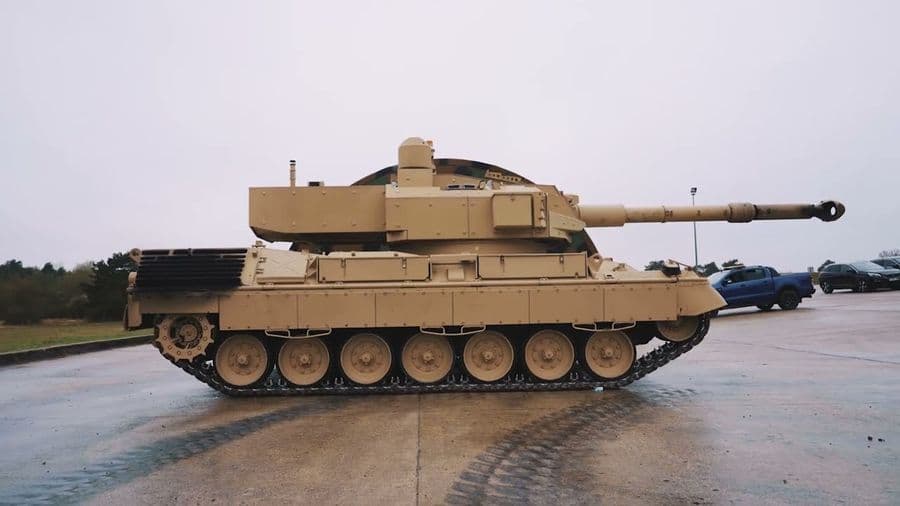
The Cockerill conversion removes the heavily manned steel-basket turret of the 1A5 and replaces it with an unmanned, welded-aluminum C3105 turret. This architectural shift moves the commander and gunner down into the armored chassis alongside the driver, reducing the required crew from four to three.
The physical armament centers on a Cockerill High-Pressure (HP) 105mm smoothbore gun fed by a 12-to-16-round mechanical autoloader. It integrates dual-stabilized digital thermal optics that provide target acquisition capabilities up to 18 kilometers during the day and 15 kilometers at night.
Crucially, the C3105 turret alters the platform's operational doctrine by providing a maximum gun elevation of +42 degrees. Traditional main battle tanks generally feature a maximum elevation of approximately +20 degrees, limiting them to flat, direct-fire velocity lanes. The +42-degree elevation allows the converted Leopard 1 to operate as a mobile, tracked artillery piece. The vehicle can utilize defilade positions—parking behind reverse slopes or tree lines, out of direct line-of-sight from anti-tank teams—to loft high-explosive fragmentation rounds into enemy positions before rapidly relocating to avoid counter-battery fire.
Industrial Throughput and Supply Chain Bottlenecks
Executing the Cockerill upgrade across the active Ukrainian fleet relies on a decentralized, modular production strategy. Cockerill manufactures the C3105 kits at its Aubange facility in Belgium and ships them to Ukraine, where domestic maintenance depots execute the physical integration. This rolling, small-batch approach allows brigade commanders to cycle vehicles through depots without stripping the front line of its localized fire support.
However, scaling this production exposes several hard constraints within the European defense supply chain.
First, the integration requires complex hull machining. The C3105 is not a standard drop-in turret; the diameter and structural interface of the Cold War Leopard 1 turret ring do not match the modern Belgian module. Ukrainian engineers must physically widen the turret ring opening on the steel hull, machine the tolerances, and weld a custom structural adapter ring to the chassis before dropping the new turret into place and connecting the digital wiring harnesses.
Second, the supply of primary armaments is constrained by metallurgical forging capacities. The C3105 utilizes a specialized high-pressure smoothbore barrel, which must be precision-machined from scratch by European steel mills. These facilities are simultaneously attempting to fulfill backlogged orders for heavy artillery barrels and airframe-grade bulkheads, creating a strict limit on how fast raw materials can be converted into finished gun tubes.
Third, the turret's operational viability depends on uninterrupted access to microchips and optical sensors required for the autoloader and targeting computers.
Finally, the electronic architecture must be customized to survive the specific conditions of the Ukrainian theater.
Conclusion
The conversion of the Leopard 1 fleet demonstrates a strict adherence to industrial pragmatism. By dissecting the components of an obsolete main battle tank and isolating its primary value—a highly mobile, tracked chassis with a mature spare-parts supply chain—defense planners are successfully bypassing the heavy capital expenditure and multi-year lead times required to manufacture new armored vehicles from the ground up.
Through the integration of modular, task-specific turrets like the Skyranger 35 and the C3105, these vintage hulls are systematically repurposed to resolve distinct frontline bottlenecks, proving that high-end optical and automated lethality can be successfully decoupled from top-tier, heavy-armor platforms.
Bruce Allen Lubbering held several management positions with aerospace manufacturing companies in a career that lasted over 30 years.

In Pursuit of Nuclear Abolition
By Peter Huessy • RealClearDefense
Innovation Alone Won’t Prepare the U.S. for the Future Battlefield
By Joshua Segal • RealClearDefense
The sUAS Tactical Trifecta
By Bryan T. Woody • RealClearDefense
The Revolutionary War: When Strategic Options Share the Same Weakness
By Henry Yep • RealClearDefense
The Houthis Are Testing the Limits of Collective Defense
By Saima Afzal • RealClearDefense

Who Shoots Down the Drone Over the Shipyard?
By John Ferrari & Dillon Prochnicki • RealClearDefense
Northrop Grumman Breaks Out the Big Guns at AUSA
By Daniel Terrill, Defense News
Army Pursuing Diverse Array of New Anti-Air Interceptors
By Trevithick, The WarZoneWho Shoots Down the Drone Over the Shipyard?
By John Ferrari & Dillon Prochnicki, RCD
F-35C Lands for the First Time on a Ford-Class Aircraft Carrier
By The Aviationist