
From Tactical Tool to Strategic Weapon
Last updated 01:05 PM EDT • Read time: 16m
Five Ways Drones Are Transforming War
Unmanned Systems (UxSs), whether airborne, maritime, or land-based, are transforming warfare and international alignments on a global scale.[1] Based on the evidence of the wars in Ukraine and the Middle East, militaries across the world are now scrambling to integrate UxSs and Counter-UxS Systems (C-UxS) to their arsenals because the evidence of their use, either alone, in swarms, or with other weapons systems, clearly generates operational and even strategic effects, signaling that these weapons have dramatically changed warfare.[2] This paper provides five strategic observations around current drone warfare and the implications drone warfare is having on conflicts writ large. Any of the implications below in isolation would cause significant upset, but taken together, they may constitute a true transformation if not a revolution in warfare after the dust has settled. Whether or not the dawn of UxS warfare is characterized as such in the future, it is clear these weapons generate significant, strategic-level impacts that must be reckoned with for any given nation to gain or maintain strategic dominance.
The transition from merely tactical to strategic effects
While UxSs began as a battlefield curiosity, operating along front lines to achieve localized, tactical effects, today they are achieving truly strategic outcomes that impact the course of war. Ukraine’s negation of the Russian Black Sea Fleet, which now has nowhere to hide and cannot leave its home ports safely, let alone strike Ukrainian ports with impunity, support Russia’s army, or launch amphibious operations; Ukraine’s ability to hold Russia strategically at risk from afar as shown by its recent strikes on Moscow, the Arctic, and distant energy installations; and Iran’s strikes on U.S. and Gulf bases are only some examples of these effects.[3] This remarkable shift is made possible by the proliferation not only of the drones themselves, but also that of satellite-based Intelligence, Surveillance, and Reconnaissance (ISR) systems to which they are linked via a stably functioning multi-domain, electronic, terrestrial, and space-based network. [4]
The low barrier to entry and the proliferation of drone warfare
Due to the low entry fee needed to build and operate UxSs, coupled with their demonstrated utility, governments around the world are prioritizing development and acquisition of these weapons for military use.[5] But it is not only governments who either are seeking or already possess such weapons. Terrorist organizations (e.g. the Houthis, Hezbollah, or Colombian or Mexican Narco-Trafficantes), already are seeking or have long possessed and used UxSs, retain their access to them, and have joined or will join the race to adapt the use of these weapons and counters to them.[6] The fact that drones are relatively easy to pilot when compared to the employment of traditional advanced military systems further accelerates this globalization of UxSs. This enables a much larger percentage of the populace to join the fight in a meaningful way with a truncated period of training. This is colorfully illustrated by the story of Natalia, a brave and patriotic grandmother who is operating as a Ukrainian military drone pilot in the Ukraine War today.[7]
However, this unfortunately also means that anyone who has become radicalized or is having a crisis could also utilize UxSs to cause great harm with minimal investment and practice. Consequently, this trend greatly enhances the opportunity for and likelihood of a mass terror attack that has strategic effects anywhere in the world. It is doubtful if governments or private owners of facilities like sports stadiums and event venues have grasped the true depth and breadth of this potential threat or taken sufficient measures to deter or thwart such attacks. Indeed, Peter Bergen has just warned that the U.S. is not ready for the likely possibility of an armed drone attack against the homeland.[8]
The democratization of deep precision strike
UxS warfare has rapidly evolved, especially over the course of the Ukraine and Iran Wars, into a precision strike powerhouse. UxSs represent a new realization of what Soviet military thinker, and Chief of the General Staff, Marshal N.V. Ogarkov (1917-1994) called the reconnaissance -fire (or strike) complex (“RUK” in Russian) whereby forces operating either at the tactical, operational, or strategic levels of warfare can accomplish their missions virtually in real time by deploying systems that unite reconnaissance and strike capabilities.[9] This outcome works best when opponents lack this capability, e.g. as in the case of Niger. Here Russia’s Afrika Corps helped beat back a coup against the government by striking the insurgents, inter alia, with drones.[10] Otherwise where both sides have many UxSs weapons as in Iran and Ukraine, the growing transparency of the battlefield leads to a new kind of war of attrition. Nevertheless, these unmanned weapons unite both reconnaissance and strike capabilities and the ability to perform tactical if not operational-strategic missions rapidly.
Transitioning from a historical lens to today’s doctrine, the three elements of precision strike are accurate weapons, suppression of enemy air defenses, and ISR.[11] Until recently, these elements were largely out of reach for any actor other than the Great Powers. However, a confluence of technological breakthroughs has come together to address all three. First, the drones themselves, established above in Point 2 as being broadly accessible, are accurate enough to achieve precision strike effects. Second, their affordability and ease of use enable an affordable means to suppress air defenses via saturation. Third, the proliferation of commercial satellite systems, coupled with covert boots on the ground, provides sufficient ISR (Intelligence, Surveillance, and Reconnaissance) to support precision strike.
UxSs are effectuating affordable deep-strike precision operations in several meaningful ways. On one end of the spectrum, Ukraine’s 2025 Operation Spider Web demonstrated the potential for small, Group 1-sized swarming drones to cause severe damage to national strategic assets[12]. These drones are so small and easy to control that the Ukrainians were able to have them “delivered” via standard box truck up to the edge of Russian airfields by unsuspecting Russian drivers, remotely deploy them from the trucks, and then pilot them to explode on Russian strategic bombers parked on the airfield. On the other end of the spectrum, larger Group 3 drones are getting faster and growing in range, e.g., Russia’s jet-powered Geran-5 and Iran’s Shahed-238, which blur the line between UAS and cruise missiles in many aspects. This trend is concerning for two reasons. First, it means that just about any nation, and even well-funded terrorist organizations, can now afford cruise missile-like systems. Second, it greatly exacerbates the already difficult cost-per-kill ratio for missile interceptors vis-à-vis unmanned systems; with “cost” in terms of both dollars and ready magazine depth. The US has already realized this struggle in Iran as it is forced to decide between shooting down a relatively cheap drone and expending a much more expensive and less readily-available interceptor, or letting it go.[13] One can expect that this issue would only intensify in the case of a conflict directly between two Great Powers, especially at sea, where multi-purpose launch tubes are few and commanders have to decide how many of these tubes to outfit with offensive versus defensive munitions Ultimately, this ability for all parties in conflict, regardless of Great Power status, to engage in these kinds of strikes leads to what we could be called the “democratization” of deep precision strike.
Active, widespread wartime use drives rapid evolution
After the world saw the outsized impact UxSs had on conventional forces in the early months of the Ukraine war (regardless of how much that was due to the capability of the UxSs themselves versus the operational failures of the Russian Army in those early days), Ukraine invested heavily in UxS capabilities. In both Ukraine and the Middle East, we see an increasing daily resort to mass missile and UxS launches. But, because so much of war now occurs in the air due to the increased use of Unmanned Aerial Systems (UASs) in particular, there has developed a ceaseless rivalry to adapt to these weapons and to their counters, or Counter-UxSs (C-UxSs. This kicked off a game of cat and mouse between UxS strike systems and C-UxS defenses, in both directions. Because UxSs and their counters are being regularly tested in active conflict, the technology and tactics have advanced much faster in UxS/C-UxS warfare than other areas of warfare. This adaptation race forces all sides not only to technologically adapt but to also translate these adaptations rapidly into mass use of these UxSs and C-UxSs.
The new affordable (and adaptable) mass
The relative design and production simplicity of UxSs platforms enables rapid scaling of production to generate thousands or even hundreds of thousands of UxSs and then rescale quickly once adaptations come into play. This ability to produce large numbers of ever-changing weapons systems at scale, rapidly evolve them over time, disseminate widespread training to use them, and generate necessary organizational and doctrinal changes can be summed up as the new affordable, adaptable weapons mass.
The wars in Ukraine and against Iran have conclusively shown that affordable and adaptable mass are required to prosecute contemporary war. And as the Israeli scholar Uzi Rubin has stated, magazine depth has become a prerequisite for victory in contemporary warfare.[14] Thus this term entails not only affordable mass production at scale but the unceasing ability to pivot production lines rapidly and adapt weapons to harness the lessons learned on the battlefield and counter the enemy’s own adaptations.
Summary and Implications
The emergence of drone warfare has multiple consequences, which won’t be fully understood until after warfare reaches its new post-UxS baseline, which could take several more years. That said, this paper seeks to outline some of the key implications that are already apparent. Each of these implications necessitates changes to the way we wage war, build and incentivize the industrial base, organize and train our forces, and bring technology to the front lines. To address these points sufficiently warrants a paper of its own. Rather than attempt to do so here with limited space, we outline a few of the key considerations and questions that should drive such a paper.
The transition from merely tactical to strategic effects
- UxSs are no longer merely toys for the frontline – they must now be a key part of the decision calculus for strategists. How can and should UxSs (both blue and red) be incorporated into grand strategy, OPLANS, and campaign models?
- UxSs pose a real threat to Strategic Systems, such as the Nuclear Triad and NC3, large surface combatants, and strategic bases. Commanders of these platforms and bases can no longer afford to be ignorant of UxS tactics and capabilities. Nuclear doctrine has long focused on assured second-strike after a nuclear exchange, but what about the threat of whittling away that capability with strikes “under the nuclear threshold” that are perhaps not immediately or cleanly attributional to a particular actor? How must not only point defense of Strategic Systems, but also declaratory policy and other deterrence measures be adjusted to account for this new threat?
The low barrier to entry and the proliferation of drone warfare
- We are only just seeing the beginning of mass strikes. Defenses need to be ready for hundreds of inbound weapons. How must air defense doctrine evolve to enable both homeland and theater defense against not just a few high-end threats, but also lower-end threats en-masse either as a precursor or alongside the higher-end systems?
- How can we use this low barrier to entry to our advantage both with one way attack drones and in C-UxS? For instance, what opportunities exist to rapidly and affordably train locals to utilize systems (e.g. defense of Taiwan with drone operators to harass amphibious landings, encourage city-wide drone defense National Guard equivalents in hot spots, observe and incorporate lessons learned from Ukraine’s concept of civilian UAS defense?)[15]
The democratization of deep precision strike
- For the past decade, the US has focused on responding to China’s development of hypersonic systems and has poured funds into high-end missile interceptor capabilities like SM-6 and THAAD. While this certainly was and is the pacing technical challenge for air defense, the introduction of affordable, ubiquitous long-range precision strike via Group 3 and above drones necessitates the ability not only to defend against exquisite threats during time of war, but also what could be considered “mid-tier” threats: drones that are fast and long-range compared to Group 1 quad copters, yet affordable and ubiquitous compared to supersonic/hypersonic and/or stealthy cruise missiles, ballistic missiles, boost-glide systems, and FOBS. These mid-tier threats saturate high-end defenses and are being used more and more regularly and by non-peer adversaries, as has been seen recently in the Red Sea with the Houthis[16], in the Iran war[17] and in Russia’s continuing assault upon Ukrainian cities and infrastructure.[18]
- Where one side can display a discernible superiority of capability with UxSs, it can achieve a decisive and rapid operational-strategic advantage. But where both sides can bring such assets to the field, attrition is a likely result. This necessitates continual operational creativity to achieve large-scale results, as evidenced by the ongoing Ukrainian counteroffensive around Lyman, which demonstrates that with proper integration of these new unmanned systems with traditional forces, electronic warfare, multi-domain networks and close attention to OPSEC (both reveal and conceal), carefully planned offensives can achieve effects that rise above attritional warfare.[19] The question then becomes how can we avail ourselves of affordable mass in ways that negate an attritional outcome, e.g. restoring maneuverability to ground and naval forces?
Active, widespread wartime use drives rapid evolution
- When technologies and tactics evolve on the order of weeks or even days rather than years, traditional acquisition processes will not suffice. How must our acquisition process change to be more agile (read: faster development cycles that get new concepts out to the end-users quicker to fail harder and faster) and intentionally and thoughtfully accept more risk in the name of speed, yet still have sufficient rigor to ensure that we are investing the systems needed most?
- How can take advantage of the orders-of-magnitude cheaper per-unit cost (PUC) in UxSs systems versus high-end weapon systems? What opportunities does this qualitatively different cost model provide for earlier and more regular field testing, both for technology and for tactics development?
The new affordable (and adaptable) mass
- What does it buy us if we choose to fully embrace this capability, and how can we maximize the benefit of doing so? How can we utilize tabletop exercises (TTXs) and campaign and mission level models to determine the right mix, sequencing, and mission assignment between these emerging systems and our conventional, higher-end (yet more costly and scarce) weapon systems? What are the unique traits of these systems that will need to be uniquely accounted for in these mission-level models?
- How do we restructure defense industry from top to bottom so that it can rapidly produce at scale UxSs and C-UxSs to enemy systems and adapt rapidly at scale and at affordable costs to counter enemy innovations?
- Despite efforts to mass produce drones, wargames, operations in Iran, and current plans indicate failures to learn, unreadiness to defend against drones, and production schedules that are insufficient to the challenges of contemporary war.[20]
- How can battlefield commanders fully unlock the benefits of an adaptable industrial base, once realized? How does the Department of War close the loop from battlefield commander to the industrial base to make this happen?
In closing, drone warfare has already changed the landscape of both the battlefield and the defense industrial base. We are still in the throes of this transformative period, which brings upset to nearly every facet of defense. During transitory periods such as this, it is those who step back from the noise, consider the broader, strategic level implications, and drive change to take full advantage of the change who emerge as the victors. Five key implications have been identified in this paper. Now, what will you do about them?
Stephen Blank is a senior fellow at Foreign Policy Research Institute (FPRI).
Jeffrey Braun is the Senior Director at Systems Planning and Analysis, Inc.
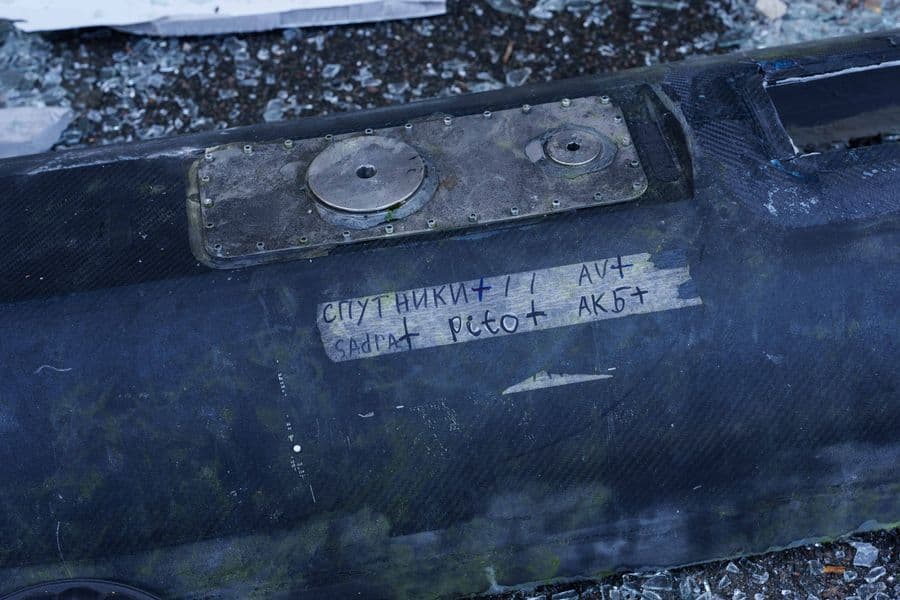
image: Fragments of a Shahed drone are seen on the ground after a Russian drone strike in Kyiv, Ukraine, Friday, Sept. 25, 2026. (AP Photo/Evgeniy Maloletka)
notes:
[1] Boris Sharov, “Exporting Combat Experience: The Drivers of Ukraine-Gulf Security Cooperation,” https://dayan.org/content/exporting-combat-experience-drivers-ukraine-gulf-security-cooperation, August 11, 2026
[2] For some recent examples, Drew F. Lawrence, “Marine Corps Looking Into New Medium-Range Tactical Drone As It Pushes Small UAS Capabilities,” https://defensescoop.com/2026/02/17/marine-corps-medium-range-tactical-drone-suas/, February 17, 2026; Umair Jamal, “The Taliban’s Drone Program, Program and Pakistan’s Counter-UAV Challenge,” https://www.cacianalyst.org/publications/analytical-articles/item/13978-the-taliban%E2%80%99s-drone-program-and-pakistan%E2%80%99s-counter-uav-challenge.html, July 13, 2026; Gene Kuleta, “Drone Warfare Comes To Latin America,” https://foreignpolicy.com/2026/08/13/latin-america-armed-groups-drones-colombia-mexico-ukraine/, August 13, 2026
[3] Kateryna Bondar, “How Ukraine’s Operation “Spider’s Web” Redefines Asymmetric Warfare,” https://www.csis.org/analysis/how-ukraines-spider-web-operation-redefines-asymmetric-warfare, June 2, 2025; Aya Batrawy, Tom Bowman, “Iran War Leaves U.S. Bases In Gulf Facing Uncertain Future,” https://www.npr.org/2026/09/08/nx-s1-5955451/iran-war-leave-u-s-bases-in-gulf-facing-uncertain-future, September 8, 2026
[4] Illia Volynskyi, “Starlink-Enabled Drones Hitting the Rear: How Russia Has Obtained Starlink and Ukraine's Potential Response,” https://www.pravda.com.ua/eng/articles/2026/02/09/8020195/, February 9, 2026
[5] Hannah Miller, U.S. Air Force Plans Cheaper MQ-9 Reaper Successor After Iran Combat Use, Targeting 2031 Fielding and Massed Drone Operations,” https://defence-industry.eu/u-s-air-force-plans-cheaper-mq-9-reaper-successor-after-iran-combat-use-targeting-2031-fielding-and-massed-drone-operations/, August 17, 2026
[6] Stephen Blank, ”RESTORING DETERRENCE AND FREEDOM OF NAVIGATION IN THE RED SEA: THE INTERACTION OF REGIONAL AND FOREIGN ACTORS,” Journal of Policy and Strategy, https://nipp.org/wp-content/uploads/2025/06/Analysis-Blank-5.2.pdf, V, 2, 2025, pp. 61-90; William J. Liffick and Peter K. Forster, “Importing Warfare: The Rise of Cartel Drone Operations,” https://smallwarsjournal.com/2026/08/30/importing-warfare-the-rise-of-cartel-drone-operations/, August 30, 2026; Alex Horton, Samantha Schmidt, Warren P. Strobel, “Drug Cartels Are Making Alarming Drone Advances, U.S. Assessment Warns, “https://www.washingtonpost.com/national-security/2026/09/22/us-assessment-warns-drug-cartels-alarming-drone-advances/, September 22, 2026
[7] Thibault Spirlet, “Ukrainian Grandma Too Old to Kill Russians, Flies Drones Instead,” https://www.businessinsider.com/ukrainian-grandma-too-old-to-kill-russians-flies-drones-instead-2023-11, November 20, 2023
[8] Peter Bergen, “We’ve Forgotten the Most Important Lessons of 9/11,” https://www.nytimes.com/2026/09/08/opinion/september-11-al-qaeda-attacks.html, September 8, 2026
[9] Mary C. Fitzgerald, “Marshal Ogarkov on the Modern Theater Operation,” https://www.jstor.org/stable/44637723?seq=1, 1986
[10] Ramesh Ramachandran, “Russia Helps Foil Niger Coup,” https://ddindia.co.in/2026/09/russia-helps-foil-niger-coup/, September 6, 2026
[11] The Elements Of Precision Strike Dominance | Lexington Institute https://lexingtoninstitute.org/the-elements-of-precision-strike-dominance/
[12] How Ukraine’s Operation “Spider’s Web” Redefines Asymmetric Warfare https://www.csis.org/analysis/how-ukraines-spider-web-operation-redefines-asymmetric-warfare
[13] Farah Stockman, “Iran’s Drones Cost a Fraction of the U.S. Weapons Shooting Them Down,” https://www.nytimes.com/2026/03/04/business/iran-shahed-drones-missiles-us-war.html, March 4, 2026
[14] Speech by Uzi Rubin to the National Institute For Deterrence Studies, NIDS, Washington, DC, July 24, 2026
[15] Anna Voitenko,”Private Air Defence Takes Off in Ukraine,” https://www.reuters.com/business/aerospace-defense/private-air-defence-takes-off-ukraine-2026-04-29/ |, April 29, 2026
[16] Thomas Harding, “How the Houthis Gained Enough Firepower To Be a Major Military Player,” https://www.thenationalnews.com/news/mena/2026/08/12/how-houthis-gained-enough-firepower-to-be-major-military-player/, August 12, 2026
[17] Dominika Kunertova, “The Iran Conflict Edges The World Closer To a New Drone Arms Race,” https://thebulletin.org/2026/03/the-iran-conflict-edges-the-world-closer-to-a-new-drone-arms-race/, March 17, 2026
[18] Steve Balesteri, “Putin Is ‘Throwing the Kitchen Sink’ at Ukraine as Drones and Missiles Attack Kyiv In A Massive Aerial Assault,” https://nationalsecurityjournal.org/putin-is-throwing-the-kitchen-sink-at-ukraine-as-drones-and-missiles-attack-kyiv-in-a-massive-aerial-assault/, September 8, 2026
[19] Institute For the Study Of War, “Russian Offensive Campaign Assessment, September 17, 2026,” https://understandingwar.org/research/russia-ukraine/russian-offensive-campaign-assessment-september-17-2026/
[20] Jack Buckby, “‘The Change Is Remarkable’: Ukrainian Drone Crews Destroyed American Armor So Fast In a Drill That Controllers Had to ‘Respawn’ the Dead Units to Continue,” https://www.19fortyfive.com/2026/08/the-change-is-remarkable-ukrainian-drone-crews-destroyed-american-armor-so-fast-in-a-drill-that-controllers-had-to-respawn-the-dead-units-to-continue/, August 13, 2026; Laura Heckmann, “ JUST IN: Northcom Lacks Sensors to Counter Drone Threat, Official Says,” https://www.nationaldefensemagazine.org/articles/2026/8/13/northcom-does-not-have-enough-sensors-for-growing-drone-threat-official-says; Michael Marrow, “’No Longer Experimental’ Navy To Deploy Drone Boats This Year,” https://www.realcleardefense.com/2026/01/19/no_longer_experimental_navy_to_deploy_drone_boats_this_year_1159418.html, January 19, 2026; David Jeans, “Exclusive: The US Navy Is Building a Drone Fleet To Take On China: It’s Not Going Well,” https://www.reuters.com/business/aerospace-defense/us-navy-is-building-drone-fleet-take-china-its-not-going-well-2025-08-20/, August 25, 2025

Innovation Alone Won’t Prepare the U.S. for the Future Battlefield
By Joshua Segal • RealClearDefenseThe sUAS Tactical Trifecta
By Bryan T. Woody • RealClearDefense
The Revolutionary War: When Strategic Options Share the Same Weakness
By Henry Yep • RealClearDefense
The Houthis Are Testing the Limits of Collective Defense
By Saima Afzal • RealClearDefense
Radio Frequencies in the Intelligence Ecosystem
By Craig Brower • RealClearDefense