
Putin Can Take Eastern Ukraine, But He Won't Like What He Gets
Last updated 07:16 PM EST • Read time: 6m
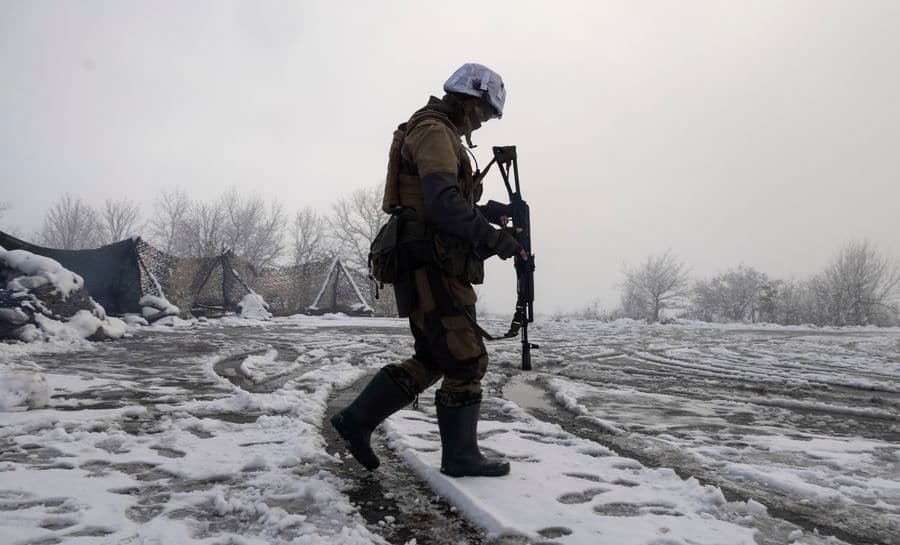
Russia appears poised to invade Ukraine. Probably over 100,000 troops are already crouched in position along the country’s northeastern and southeastern borders, ready to punch into woefully unprepared and undermanned Ukrainian defensive positions. While Russian intentions are still unclear—this could be a distraction from another hostile Russian measure, a threat to prevent eastward expansion of NATO, or a genuine prelude to war—there is a real possibility that Russia might soon invade a fledgling European democracy.
The Russian armed forces certainly have ample capability to seize and annex the eastern third of Ukraine. In 2020 my team at RAND published a two-part report analyzing Russian ground combat scenarios. We showed how the Russians could quickly mass about 130,000 troops and all of their equipment to conduct a strategic double envelopment. Eastern Ukraine is Putin’s to take.
The Ukrainians cannot effectively defend themselves against a Russian invasion without help from NATO. And Putin may have correctly judged the lack of NATO will to defend Ukrainian democracy. While NATO supports Ukraine’s armed forces with aid and advising, Ukraine is not yet a member of NATO. Bold statements of solidarity with Ukraine ring hollow after years of intra-alliance bickering and NATO’s collective abandonment of Afghanistan. President Biden’s reported plan to eliminate U.S. nuclear first strike options may have further contributed to Russian perceptions that the United States is a retreating power on the continent. Neither French nor German citizens appear interested in defending Ukraine, and without France and Germany, there is little chance of generating a collective NATO military riposte to a Russian invasion.
Still, if Putin chooses to pluck this ripe fruit, he will almost certainly find it to be poisonous. He faces at least these five major consequences in the aftermath of a successful invasion of Ukraine: (1) increased Western economic sanctions; (2) a complex military occupation; (3) a NATO-backed Ukrainian insurgency; (4) social blowback in Russia; and (5) the perpetual, isolated commitment of over one third of Russia’s ground forces.
Increased Sanctions
Presidents Obama, Trump, and Biden imposed cumulative sanctions against the Russian state, Russian companies, and individual Russian citizens—typically oligarchs, hackers, and intelligence officers—connected with malign activities in the West. It is worth reading the International Trade Administration’s summary of Russian activities and consequent sanctions here. While there is sometimes fierce debate in the national security community about the causal relationship between sanctions and limp Russian economic performance, it is safe to say that sanctions hurt Russia and reduce opportunities for Putin to expand his economic power and influence. U.S. Secretary of State Antony Blinken has already threatened Putin with additional sanctions should Russia invade Ukraine.
A Complex and Onerous Occupation
Since 2014, the Russians have been able to play to their strengths in a small pocket of southeastern Ukraine. They have provided advisors, weapons, artillery and rocket fire, limited ground support, and intelligence to the Russian separatists primarily in the isolated Donbas region adjacent to Russia’s border. With low risk and controlled casualties, Russia has used the Donbas conflict to undermine Ukrainian stability. But if Russian ground forces seize the eastern third of Ukraine, they will be directly responsible for securing a space at least twice the size of the Donbas region. Much of eastern Ukraine is populated by ethnic Russians, but not all of these people wish to be annexed by the Russian Federation. Russia’s ground forces may be ill-prepared to secure, let alone provide civil-military support to millions of new Russian citizens who have been isolated from their traditional capital and trade routes.
A NATO-Backed Ukrainian Insurgency
While Russia can count on popular support in much of its newly annexed territory in eastern Ukraine, there inevitably will be popular resistance to Russian occupiers that may be hard to stamp out. Ukraine will try to make Russia’s occupation more difficult by funneling weapons and intelligence to opposition elements seeking to disrupt Russian lines of communication, attack Russian troops, and build popular resistance against the occupation. NATO is likely to see opportunities to pin the Russians down in Ukraine by supplementing these Ukrainian resistance efforts. Russian ground forces will no longer have the luxury of hiding behind Donbas separatists: They will be dangerously exposed to Western unconventional warfare operations.
Social Disruption in Russia
Putin runs yet another risk if he decides to put over 100,000 ground troops in Ukraine. He almost certainly cannot seize and hold eastern Ukraine without relying on a good number of his perennially mistreated, ill-prepared, one-year conscript troops to flesh out the battalion tactical groups that will form the bulk of his invasion force. Putin typically deploys contract soldiers and mercenaries while keeping conscripts at home in order to reduce social blowback. Historically, Russian social groups have organized muted but heartfelt protests against the mistreatment of conscripts, conscript casualties, and unpopular wars. Dropping perhaps tens of thousands of conscripts into eastern Ukraine risks at least modest popular unrest at home.
Tied-Down Military Power
In a best-case scenario for Russia, the invasion and annexation would go smoothly, newly-minted Russian citizens would volunteer for militias and paramilitary police forces to secure their cities and villages, and most Russian troops would quickly return home. Given the vagaries of war and some inevitable resistance, this rosy outcome is unlikely. Putin may have to indefinitely leave tens of thousands of troops—perhaps over 100,000—tied down in Ukraine or wrapped up supporting the occupation from Russian soil. With a ground force of approximately 350,000 troops (including many noncombat forces), a big frozen conflict in eastern Ukraine would reduce available Russian combat power for other operations. Major Russian military exercises like Zapad and Kavkaz, which are intended to intimidate NATO, would probably have to be curtailed in following years.
We do not know if the likelihood of a Pyrrhic victory would deter Putin from seizing and annexing eastern Ukraine. He has proven willing to take risks and assume significant costs to protect a Russian-favorable status quo, intimidate the West, and increase Russian prestige in the Middle East, Africa, and previously in Ukraine. For now, the threat of a Russian invasion should be taken seriously by NATO leaders. Hopefully, Putin will also take seriously the likely costs he would incur with such a reckless act.
Dr. Ben Connable is the Director of Research at DT Institute, a peace and development organization in Washington, D.C., and an adjunct professor of security studies at Georgetown University.

Reflecting on an Epic Horse Campaign in the Mountains of Afghanistan
By Brian Glyn Williams • RealClearDefense
The Godfather of American Foreign Policy Realism Speaks to Today’s World
By Francis P. Sempa • RealClearDefense
In Pursuit of Nuclear Abolition
By Peter Huessy • RealClearDefense
Innovation Alone Won’t Prepare the U.S. for the Future Battlefield
By Joshua Segal • RealClearDefense
The sUAS Tactical Trifecta
By Bryan T. Woody • RealClearDefense

Navy Civilianizes Six Former Flag Billets, Reduces Six to Captains
By Mongilio, USNI N.
Raytheon's $8B Contract for Strategic Comms Terminal Modernization
By M+A El
America’s Maritime Moment Will Not Wait
By CDR Salamander
Armor Up?
By Marine Corps Compass Points
Who Shoots Down the Drone Over the Shipyard?
By John Ferrari & Dillon Prochnicki • RealClearDefense