
Russia After Ukraine Determines Where Army Prepositioned Stocks Should Go
Last updated 07:06 AM EDT • Read time: 8m
Congress is asking the right question about the wrong thing. The House FY2027 NDAA directs the Army to report on dedicated prepositioned stocks in Estonia, Latvia, Lithuania, and Romania, covering brigade equipment sets, rail compatibility, and time-to-combat. The Senate prohibits removing existing stocks from Europe and requires U.S. European Command (EUCOM) to report on the North Atlantic Treaty Organization (NATO) conventional deterrence readiness. Although both chambers focus on locations, neither starts with understanding Russia.
Army Prepositioned Stocks (APS) serve as a tool for operational reach, reducing the time between strategic decisions and ground combat power in the European theater. Their value depends entirely on what Russia does after Ukraine and what EUCOM needs to answer it. Geography-first framing skips that step.
Vladimir Putin seeks a Russian veto over the former Soviet space. His December 2021 security demands formalized the goal: no further NATO enlargement, no NATO military activity in Ukraine, Eastern Europe, the Caucasus, or Central Asia, and no NATO forces in post-1997 member states. Putin wants neighboring states unable to align fully with the West. Georgia in 2008, Ukraine in 2014 and since 2022, and the ongoing Black Sea campaign all follow from that logic. Putin's binding constraint is capacity, not ambition. Russian losses of 30,000–34,000 personnel per month in 2026 against about 27,000 recruits force a near-term deficit in usable combat power. Understanding that constraint should drive every APS decision in Europe.
Ukraine has three plausible endings, and each produces a different Russian ground-force posture pointing to different APS requirements. Congress should require EUCOM and the Army to analyze all three before approving a single site.
The variable Congress is missing is not geography but Russian force availability. If Russia must keep hundreds of thousands of personnel along a 1,200-kilometer front because Ukraine remains capable and Western-supported, its options differ entirely from a Russia free to redeploy those forces to Belarus, the Baltic border, or another contingency. That condition, not the map of NATO's eastern flank, should determine where APS goes. Equipment stored in Estonia does not solve a Black Sea problem. Equipment in Romania does not shorten closure time to the Baltic flank. The scenario determines the theater, and the theater determines where operational reach matters.
Scenario one: Russia regains the offensive. If Russia presses toward Kharkiv, Zaporizhzhia, or Odesa, Moscow's ground-force problem becomes mass: breakthrough, exploitation, occupation, and protection of expanded lines. The NATO risk concentrates on the southeastern flank. Russian pressure moving toward Odesa puts Moldova, the Danube delta, and Romania's Black Sea position in play. Russia has attacked Odesa-area ports, which handle all Ukrainian iron-ore exports and more than 90 percent of agricultural exports, according to Reuters reporting in June 2026. Russia treats Crimea as an anti-access/area denial platform and the Black Sea as a protected maritime bastion, making southeastern Europe the more consequential flank in an offensive scenario. APS in Romania answers a southeastern flank problem directly.
Scenario two: The war freezes. If Russia holds occupied Ukraine and pauses, Moscow will carry a large ground-force bill. It must hold the line, secure rear areas, protect Crimea, manage counterinsurgency risk, and force-integrate occupied territory through law, courts, police, and settlement policy. Russia is using legal mechanisms through 2030 to seize and reassign Ukrainian property in occupied areas, integrating terrain it has no intention of returning. Russian manpower is under strain: the willing recruiting pool is shrinking and force quality has deteriorated, making occupation a heavier burden than Moscow anticipated. A freeze ties Russian ground forces to the occupation. APS in this scenario gives EUCOM credible ground options before Russia converts a frozen front into a renewed offensive or a regional crisis.
Scenario three: Ukraine rolls back Russian gains. If Ukraine recovers occupied territory or threatens Crimea, Russia faces political pressure and military vulnerability simultaneously. Ukraine is targeting fuel movement across the Kerch Strait and transport infrastructure in Crimea, according to ISW assessments in June 2026, creating logistics disruption. Moscow would likely raise nuclear signaling, strike Ukraine harder, and increase pressure on NATO's eastern flank to fracture allied support. APS functions as a speed tool in this scenario, giving EUCOM ground options without waiting on strategic sealift while escalation pressure builds.
Across all three scenarios, Russia's most probable immediate ground-force use remains Ukraine itself. Holding and integrating seized territory requires continuous effort: protecting Crimea, thickening buffer zones, pushing remaining Donetsk and Luhansk objectives, and screening against Ukrainian strike campaigns. A frozen front is contested terrain under operational load, not settled ground.
Russia's next priority is coercion of Moldova. Moscow can tighten its grip through Transnistria as a lever, energy as a weapon, and disinformation infrastructure in place. Russia has run a multi-year hybrid campaign to destabilize Moldova and block EU accession, and Moldova's vulnerability increases in nearly any Ukraine settlement scenario. Russia can achieve meaningful political results there through hybrid tools without a ground operation.
Georgia offers a limited-force option, with Russian access established through occupied Abkhazia and South Ossetia. Russia stations forces in Georgia and Moldova without host-nation consent, giving Moscow military leverage over both countries without firing a shot. Moscow can pressure South Caucasus energy corridors and block Western alignment without a large ground commitment. Georgia functions as a supporting effort in Russian strategic logic, not a main one.
The Baltics present a provocation zone. Article 5 reshapes Putin's calculus significantly. GPS spoofing and jamming have reached hundreds of kilometers into NATO territory, documented by Lithuania and reporting in May 2026. Drone incursions near NATO borders occurred throughout 2025 and into July 2026. Zapad-2025 demonstrated escalation signaling through nuclear-weapons planning and Oreshnik missile drills, showing Russia's ability to blend conventional coercion with deniable pressure along NATO's edge. The threat in the Baltics is sustained pressure and friction designed to test alliance cohesion. Gray-zone tools answer gray-zone threats, and APS is not among them. That calculus changes if a Ukraine settlement frees Russian forces from the occupation bill. At that point, Belarus and the Baltic border re-enter the conventional force-posture problem.
Forward basing gives presence, rotational forces show commitment, and APS gives operational reach. Reach is about time and access, and the distinction should shape how Congress evaluates every proposed site. Operational reach through APS depends on the full network: rail compatibility, fuel, maintenance capacity, ammunition, host-nation access, airfields, ports, and reception, staging, onward movement, and integration infrastructure. APS becomes operational reach only when the network delivers combat power to the right theater in the right window against a specific Russian ground-force problem.
Operationally, APS placement should reflect distinct regional roles: Romania supporting Black Sea and Danube security, Poland supporting central reach, Germany providing strategic depth and sustainment. Each site answers a different operational problem, and the Army and EUCOM should name that problem for each proposed location before Congress approves a single warehouse.
The NDAA reporting requirements give Congress the right opening. Sharpening those requirements into scenario-driven demands will produce the analysis the situation requires. Congress should require EUCOM and the Army to identify, under each Ukraine outcome, where Russia concentrates ground forces and which threats require U.S. ground combat power versus intelligence, SOF, air defense, or cyber. Congress should also require time-to-combat estimates by scenario and by proposed site, a theater problem statement for each APS location, and a full access and basing network plan that makes each site operationally usable. Approving sites before receiving those answers produces a warehouse program.
Army Prepositioned Stocks are a tool for operational reach. Their value depends on the problem they solve, the scenario they answer, and the network that makes them usable. Russia after Ukraine presents a range of ground-force postures shaped by how the war ends. Congress should require EUCOM to define the Russian operational problem before directing the Army to build dedicated sites in four countries.
Instead of funding warehouses, Congress needs to be funding operational reach.
Michael Carvelli is an Army officer who writes on strategy, operational planning, protection, and engineering. He has written on large-scale combat operations for Real Clear Defense, War on the Rocks, Parameters, Modern War Institute, and Small Wars Journal.
The views expressed are his own and do not represent those of the U.S. Army, the Department of Defense, or any part of the U.S. government.
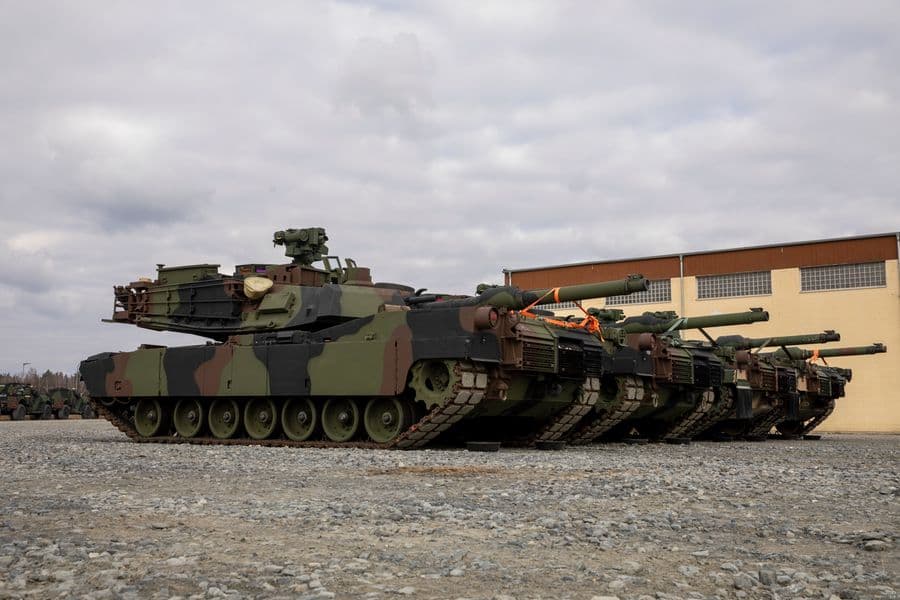
image: Army Prepositioned Stock-2 delivered to Grafenwoehr Training Area, Germany, March 6, 2022. At the direction of the Commander, U.S. European Command, U.S. Army Europe and Africa is drawing APS-2 from Coleman worksite in Mannheim, Germany in preparation to support 1st Armored Brigade Combat Team, 3rd Infantry Division arrival to Germany. (U.S. Army photo by Sgt. Caleb Minor)

In Pursuit of Nuclear Abolition
By Peter Huessy • RealClearDefense
Innovation Alone Won’t Prepare the U.S. for the Future Battlefield
By Joshua Segal • RealClearDefense
The sUAS Tactical Trifecta
By Bryan T. Woody • RealClearDefense
The Revolutionary War: When Strategic Options Share the Same Weakness
By Henry Yep • RealClearDefense
The Houthis Are Testing the Limits of Collective Defense
By Saima Afzal • RealClearDefense

Who Shoots Down the Drone Over the Shipyard?
By John Ferrari & Dillon Prochnicki • RealClearDefense
Northrop Grumman Breaks Out the Big Guns at AUSA
By Daniel Terrill, Defense News
Army Pursuing Diverse Array of New Anti-Air Interceptors
By Trevithick, The WarZoneWho Shoots Down the Drone Over the Shipyard?
By John Ferrari & Dillon Prochnicki, RCD
F-35C Lands for the First Time on a Ford-Class Aircraft Carrier
By The Aviationist