
Russia Showcases Nuclear Capabilities
Last updated 05:29 PM EST • Read time: 7m
Executive Summary:
- On October 22, Russia conducted its annual strategic nuclear forces exercise, coinciding with the North Atlantic Treaty Organization’s (NATO’s) “Steadfast Noon” drills, which Moscow routinely denounces as provocative and threatening.
- The exercise openly rehearsed nuclear launch authorization and retaliatory/counter-retaliatory strike procedures. Unofficially, it simulated responses to Tomahawk or Taurus missile attacks launched from Ukraine, NATO operations in the Baltic or around Kaliningrad, and deployment of NATO forces in Ukraine.
- Russia’s display of the Burevestnik nuclear-powered cruise missile and the Poseidon underwater nuclear drone showcased Russian next-generation nuclear systems aimed at reshaping future arms control talks.
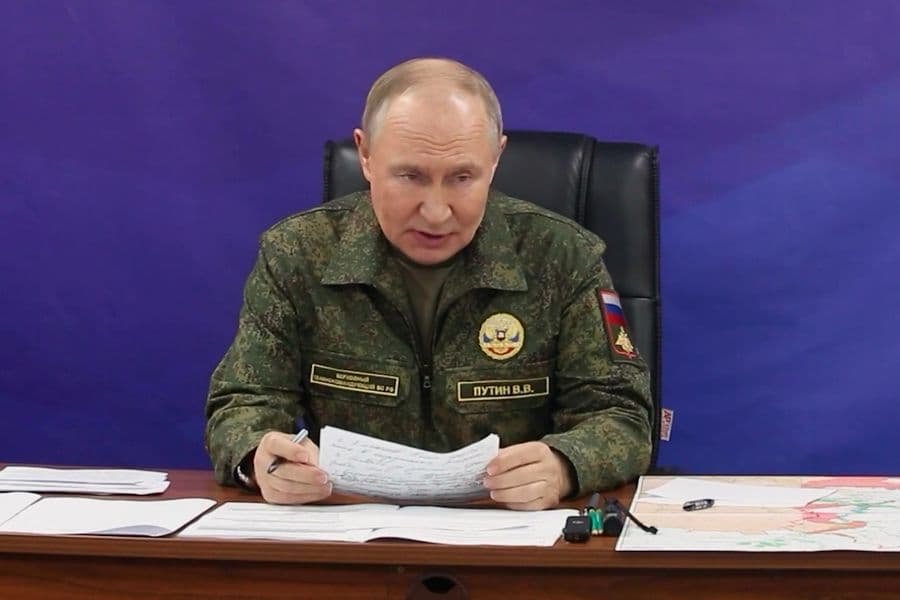
On October 22, under the supervision of Russian President and Supreme Commander-in-Chief Vladimir Putin via video conference, Russia conducted its annual strategic nuclear forces exercise from land, sea, and air. The Plesetsk State Test Cosmodrome launched an RS-24 Yars intercontinental ballistic missile toward the Kura range in Kamchatka, the К-117 Bryansk (Delta-IV) nuclear-powered ballistic missile submarine launched an R-29RM Sineva missile in the Barents Sea, and long-range Tu-95MS bombers launched Kh-102 air-launched cruise missiles. The National Defense Command Center coordinated the exercise, verifying the readiness of command authorities and the operational control of subordinate units (President of Russia, October 22).
According to Chief of the Russian General Staff Valery Gerasimov, the drills tested the authorization procedures for nuclear weapon deployment—a highly complex, multi-step chain of command. The procedure begins when the supreme commander-in-chief issues a coded launch order (e.g., “153”) to the minister of defense, who adds his code (e.g., “153609”) and transmits it to the commanders of the Navy, Aerospace Forces, Ground Forces, and Strategic Rocket Forces (RVSN). Each commander adds their respective codes (e.g., “153609731”) before relaying them to operational units, where automated systems unlock the Permissive Action Links (PALs) and activate the nuclear warheads. The entire process, lasting about 15–20 minutes, is designed to prevent unauthorized use (Argumenty i faky, December 26, 1991; see EDM, February 13).
The call also included Colonel General Sergey Karakayev, commander of the RVSN; Admiral Konstantin Kabantsov, commander of the Northern Fleet; Major General Sergey Kuvaldin, commander of Long-Range Aviation; and Admiral Vladimir Vorobyov, deputy commander-in-chief of the Navy (Telegram/@news_kremlin, October 22).
The exercise’s structure and timing were consistent with previous years, except for 2020–2021, which the Kremlin postponed due to the COVID-19 pandemic (TASS, October 29, 2024). Each year, the Russian strategic nuclear forces exercises coincide with the North Atlantic Treaty Organization (NATO) nuclear deterrence exercise, Steadfast Noon, which began on October 13 in the North Sea region this year. In 2023, Deputy Russian Foreign Minister Sergey Ryabkov remarked that the Steadfast Noon exercises are “becoming increasingly large in scale, their character more confrontational, and in certain aspects, threatening” (TASS, October 13). Deputy Speaker of the Federation Council Konstantin Kosachev described Steadfast Noon as “an extremely dangerous development of the situation, which inevitably provokes a reaction and reciprocal steps” (TASS, October 13).
The Russian drill in 2024 simulated a massive retaliatory strategic nuclear strike (Interfax, October 29, 2024). Former Pacific Fleet Commander Admiral Sergey Avakyants claims that, unlike Western exercises, Russian nuclear drills never simulate a first strike, focusing exclusively on retaliatory or counterattack scenarios (Izvestiya, October 22).
Recent exercises take place under Russia’s updated 2024 nuclear doctrine, “Basic Principles of State Policy on Nuclear Deterrence.” The new framework authorizes nuclear use not only in response to weapons of mass destruction strikes or large-scale conventional critical attacks but also against non-nuclear states acting with or under the support of nuclear powers. Russia also reserves the right to preemptively respond upon receiving “reliable” information about massive aerial attacks within its borders—including not just aircraft and cruise missiles but also drones and hypersonic systems. Any similar moves against Belarus, as a member of the Union State, may also trigger Russia’s nuclear response (see EDM, October 2, November 26, 2024).
According to Igor Korotchenko, editor of the pro-Kremlin National Defense magazine, the recent nuclear missile launches tested full combat readiness using dummy warheads. The exercise validated multiple strike options from full-scale retaliation to selective counterstrikes. Korotchenko highlighted that scenarios included NATO’s possible long-range precision strikes from Tomahawk or Taurus missiles launched from Ukrainian territory, as well as attempts to block Russian access to the Baltic Sea and isolate Kaliningrad. Moscow would interpret NATO troop deployments in Ukraine as direct participation in the war (TASS, October 22).
Retired Colonel Mikhail Khodarenok of the Russian General Staff’s Operations Directorate also warns that Tomahawk deliveries to Kyiv could bring the conflict to the nuclear threshold. According to Khordarenok, possible Russian responses include a massive missile strike on Kyiv’s government district, targeting political-military leadership; the raising of strategic nuclear forces to maximum readiness and conducting demonstrative test launches; and potential high-altitude nuclear detonations over the Black Sea, visible from Odesa or Kyiv, or even near the United Kingdom or Rzeszów in Poland, where the United States might deploy missile assets (Gazeta.ru, October 7).
A day before the October 22 nuclear exercise, Russia reportedly tested the 9M730 Burevestnik (SSC-X-9 Skyfall) nuclear-powered cruise missile. Flying for 15 hours over 14,000 kilometers (8,700 miles), it showcased virtually unlimited range and the ability to circumvent missile and air defense systems (TASS, October 26). Ryabkov confirmed that Moscow formally notified Washington as required by bilateral agreements (Interfax, October 27).
Putin announced successful trials of the Poseidon nuclear-powered unmanned underwater vehicle on October 28, reportedly surpassing the trial-stage Sarmat intercontinental ballistic missile (ICBM) in destructive potential (President of Russia, October 29). According to Dmitry Kornev, editor of MilitaryRussia, the Burevestnik nuclear-powered cruise missile can remain airborne for months, awaiting launch orders, likely while carrying a megaton-class thermonuclear warhead. Its deployment may involve dispersed launcher networks maintaining missiles on constant standby, ready for real-time targeting (Izvestia, October 26).
The Poseidon unmanned underwater vehicle, roughly the size of a small submarine, can patrol covertly for long periods and carry multi-megaton nuclear warheads. Its coastal detonation could cause artificial tsunamis and devastating coastal destruction, earning it the nickname “doomsday weapon.” The recent tests were launched from the BS-329 Belgorod (Project 09852), with serial deployment planned on Khabarovsk-class submarines (Project 09851). The Russian Navy plans to field up to 32 Poseidon systems on four submarines (Izvestia, November 2). The first vessel of such submarine class, launched in Severodvinsk on November 1, was built specifically to carry Poseidon, according to the former chief of the Main Staff of the Russian Navy, Admiral Viktor Kravchenko (RIA Novosti, November 2).
Russian experts argue that integrating Poseidon and Burevestnik into the nuclear triad adds a new dimension of strategic deterrence and will affect future arms control negotiations. They expect that the emergence of such systems could push Washington to resume talks and create updated strategic frameworks—an initiative the United States has so far ignored, despite Putin’s proposal to extend New START for one year after February 2026 as an invitation to broader strategic stability dialogue (Interfax, October 30). Russian experts claim that Poseidon and Burevestnik should encourage the United States to revisit both New START and the Anti-Ballistic Missile Treaty with Russia. Without such steps, they warn, a new multi-party arms race could emerge—this time involving Russia, the United States, the People’s Republic of China, and India (Izvestia, October 26).
The Kremlin is asserting that post-New START stability cannot be rebuilt without accommodating Russian interests through simultaneous nuclear exercises, missile testing, and technological displays. Kirill Dmitriev, Putin’s special envoy and one of the key negotiators with the U.S. administration, asserts that these arms tests also aim to relegate Russia’s war against Ukraine to the periphery of the Kremlin–Washington negotiation agenda (Telegram/kadmitriev, October 26).
Alexander Taranov is an expert on Russian military and nuclear affairs.
This article appeared originally appeared at The Jamestown Foundation's Eurasia Daily Monitor.
Is It Déjà vu All Over Again: The 2012 Report on Global Zero
By Peter Huessy • RealClearDefense
As Private Investment Pours Into Defense, the Clock Is Ticking
By Elaine McCusker • RealClearDefense
The First Test of Peace Lies in Ukraine's Borderlands
By Dennis T. Cosgrove • RealClearDefense
The VFW’s Gambling Addiction Victimizes Veterans
By Jack Yoest • RealClearDefense
Superintelligence Exposes a Gap in the Law of Delegated Authority
By Sue Ghosh Stricklett • RealClearDefense
When Your Navy is too Small, the Bill Comes Due Bigly
By CDR Salamander
Quo Vadis MCU?
By Marine Corps Compass Points
When the Network Goes Dark, Who Controls the Battlefield?
By Jonathan K. Corrado • RealClearDefense
Air Force Should Buy 250 Blended-Wing Tankers, as 2027 Demo Looms
By A&SF Mag.
Long Deployments to Be Navy Standard For Next Couple Years
By Mongilio, USNI News