
Ukraine and the Global South: Putin's Two-Front War Against the West
Last updated 03:18 PM EST • Read time: 5m
*Read Part One.
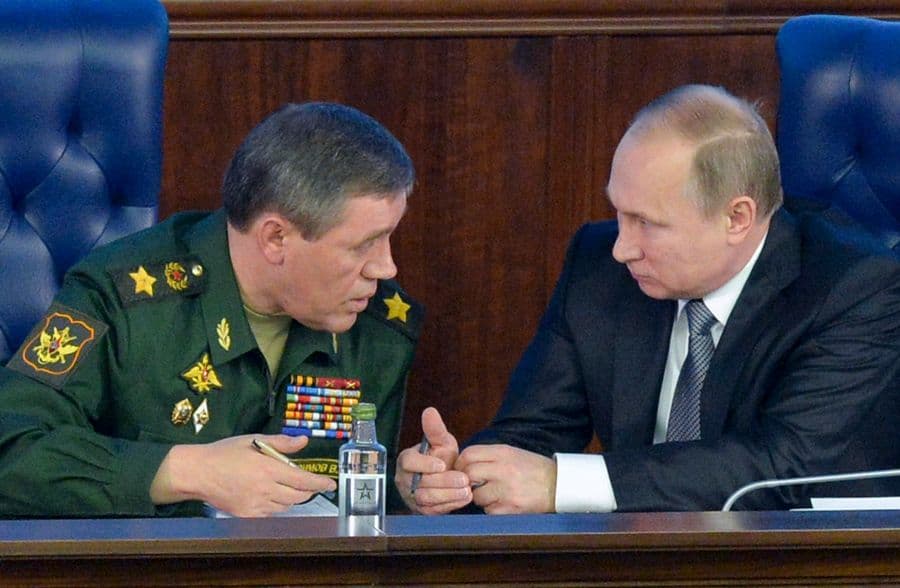
Russian President Vladimir Putin’s speech to the Security Council on October 30 marks a further step toward positioning Russia at the forefront of anti-Western forces more globally (Kremlin.ru, October 30). In the Hamas-Israel war, the Kremlin is taking the side of Hamas and Palestinian irredentism.
Russian strategy in the Global South (not Moscow’s term) is subordinated to a grand strategy that keeps the focus on Europe. The central objective at this stage is to subdue or destroy Ukraine. Should that succeed, Russia could directly threaten the North Atlantic Treaty Organization’s eastern flank from forward positions gained in Ukraine. That threat in turn would advance Russia’s goal to re-negotiate the post-1991 security order in Europe. The Kremlin explicitly linked that goal to its full-scale invasion of Ukraine from the outset.
Russia follows the “indirect approach” fueling conflicts on Europe’s peripheries in the Middle East and Africa. It aims to distract the “collective West” and dissipate its resources from the central theater of conflict, which is Ukraine at this stage. On the second front—as Russia views those peripheries—it operates by enflaming anti-Western sentiments to support Russia in its confrontation with the West.
Putin’s speech to the Security Council laid out this approach with a full collection of slogans and talking points (see Part One). The postulates and rhetoric owe much to the Soviet Union’s perspectives on the “third world.” Putin’s innovations on Soviet themes are nevertheless significant. Moscow no longer transposes the concept of class struggle to the “contradictions” between the post-colonial world and the ex-metropolitan West. The Kremlin caters instead to political and cultural grievances of leadership groups among “the world’s majority”—Moscow’s term to imply the passing of the Western-led order. Unlike its Soviet predecessor, Putin’s Russia shows no ideological preference and no interest in a particular “path of development” of its partners within the “world majority.” Geopolitical expediency is the sole criterion.
Along with those modernized elements, Putin’s Security Council speech largely amounted to a replay of Soviet-era imagery and terminology. The United States as a spider spreading its web on the globe was an image commonly used in Soviet cartoons. References to “lackeys” and their “masters from across the ocean” are vintage Soviet vocabulary. As is the “objective historical process”—that is, the movement toward a multipolar world in which Russia (according to Putin) is “one of the leaders.”
Putin presented an updated version of the Soviet concept of “internationalist duty,” last used to motivate the Red Army to fight in Afghanistan. In Putin’s version, Russian soldiers selflessly fight and die in the “special military operation” in Ukraine for the norms of a just world order and for peoples, such as the Palestinians, to be free (see Part One).
The Security Council meeting was held in the wake of pro-Hamas, anti-Jewish riots by Muslim youth in Russia’s Republic of Dagestan. A crowd waving Palestinian flags and shouting “Allahu Akbar” stormed the Makhachkala airport upon the arrival of a flight from Tel Aviv, trying to identify Jewish passengers. Local law enforcement whisked them to safety and arrested some 60 rioters after several hours of clashes. In the town of Khasavyurt, rioters surrounded a hotel and broke inside searching for presumed Jewish guests (Kavkazskiy Uzel, October 31, November 1). Western, Israeli, and Russian media abroad covered these incidents in detail.
Putin misrepresented the incidents by referencing (twice in his Security Council speech) the Tats, a local ethnic group, as targeted by the rioters (Kremlin.ru, October 30). The misrepresentation apparently sought to deflect attention from the fact that Israeli and Jewish Russian citizens were under threat. The Tats, who live in Dagestan and northern Azerbaijan, are actually Muslims. Their Farsi dialect resembles that of the local community of Mountain Jews, which is why the two communities are sometimes difficult to distinguish from one another. Putin could hardly be unaware of the distinction, having undoubtedly received reports from the scene and mass media before he made his remarks.
The arrested rioters are only being charged with “petty hooliganism” after devastating the airport and fighting police. The “head” (glava) of the Dagestan republic, Sergei Melikov, has offered to clear them of those charges if they join the Russian army in Ukraine. That way they could “wash off the shame” and—as Putin said—help the Palestinian cause (TASS, October 30). Similarly, Chechen republic head Ramzan Kadyrov advised those arrested in Makhachkala: “If you want to settle accounts with the enemy, go to the right place: Ukraine, that is where the real satanists are, the fascists who support the killing of Palestinians” (TASS, October 31).
Russian officials from Putin on down accuse Ukraine of having instigated the riots in Dagestan. The Kremlin does not seem unduly perturbed by the anti-Semitic dimension of the riots, let alone the pro-Hamas message. Russian officials seem mainly concerned that the rioters acted as they did on their own, without guidance or control from the authorities. Moscow will nevertheless continue to exploit such events for its propaganda in pushing a staunch anti-West, anti-Ukrainian agenda.
Vladimir Socor is a Senior Fellow of the Washington-based Jamestown Foundation and its flagship publication, Eurasia Daily Monitor (1995 to date), where he writes analytical articles on a daily basis. An internationally recognized expert on the former Soviet-ruled countries in Eastern Europe, the South Caucasus, and Central Asia, he covers Russian and Western policies, focusing on energy, regional security issues, Russian foreign affairs, secessionist conflicts, and NATO policies and programs.
This article appeared originally at The Jamestown Foundation's Eurasia Daily Monitor.
We Cannot Build Tomorrow's Weapons With Yesterday's Alloys
By Joseph F. Krause • RealClearDefense
Americans Will Sacrifice for Their Country, Not for Politicians
By Jane Li • RealClearDefense
No Need for a New World Order
By Will Thibeau • RealClearDefense
Congress: Don’t Let the NDAA Hand China Our Defense Blueprints
By Richard Newton • RealClearDefense
Washington Cannot Ignore Afghanistan’s Weapons Legacy
By Saima Afzal • RealClearDefense
Marines Deploy Neros Archer Drone in Live Fire Exercise for First Time
By USNI News
Confessions Of An SR-71 Blackbird Pilot
By Howard Altman, The WarZone
Air Force Exploring Creative Ways to Produce More Pilots
By Laura Heckmann, NatDef
"Super F-22' Propels Rator to Fly With F-47 Into 2060s
By Kris Osborn, Warrior Maven
GA-ASI and Saab Test AEW Payload on MQ-9B
By Stefano D'Urso, The Aviationist