
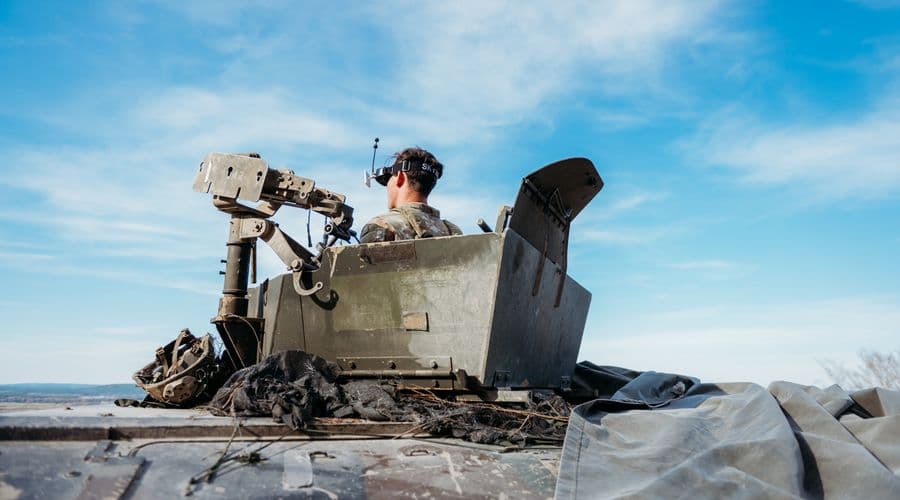
Why Are America's Soldiers Buying Their Own Drones?
Last updated 09:53 PM EDT • Read time: 5m
America’s Soldiers Are Buying Their Own Drones. Why Soldiers Shouldn’t Have to Fund Their Own Transformation.
The third decade of the twenty-first century is halfway done, but the Russia-Ukraine war has ushered in a revolution in modern warfare that will define conflict well past 2100. The emergence of attritable systems—those that can be applied at scale without expectation of recovery—defines this revolution. America’s transformation amidst such change requires both a clear definition of what makes a system attritable and a recognition that the U.S. national security establishment is dangerously behind—so behind that U.S. service members are spending their own money to fill critical capability gaps for their units. Yes, you read that right.
In April, the Army initiated a first-of-its-kind program-of-record for Purpose Built Attritable Systems. Key leaders and acquisition officials understand that time is of the essence and that faster acquisition pathways are critical to delivering technology to the warfighter at the speed of relevance. Interestingly, however, even Army leaders admit there is no formal definition of "attritable." In an era of rapid change and transformation, it is worth offering a definition to orient operators and the industrial base around a critical capability for modern warfare. In our view, an attritable system is one whose loss is deemed an acceptable outcome of its battlefield employment, and for which recovery efforts are neither expected nor required after employment.
Attritable is not merely a price point—it is a mindset. It reflects the absence of any expectation that a system returns from standard use. Defense leaders should not confine the term to a dollar figure, as the significance of price varies based on operational context. A $75,000 unmanned surface vessel may be affordable, while the same amount would be exorbitant for a first-person view (FPV) drone. Attritability, then, is a state of mind—one that accepts loss as the cost of battlefield effectiveness.
Even in an era of great power competition and large strategic defense investments, directed funding for systems that frontline leaders can apply at scale on the tactical and operational levels is necessary for deterrence—and, if needed, for victory. While major defense primes like Lockheed Martin, Raytheon, and now Anduril focus on submarines, exquisite aircraft, and missile defense systems, defense leaders must not lose sight of the centrality of affordable, expendable systems to the mass application of force. Nearly 80% of casualties on both sides of the Russia-Ukraine war reportedly result from this category of low-cost attritable systems.
This reality is not lost on Moscow and Beijing. Russia’s defense industrial base produces around 40,000 attritable FPV drones every month. In December 2024, China placed an order for over 1 million similar systems. The United States is dangerously behind—and it is only by meeting servicemembers where they work that we truly grasp the dire straits of our current capability gap.
Anyone who has studied Steve Blank’s Lean LaunchPad methodology knows the importance of “getting out of the building”—meeting prospective customers, learning about their pain points, and uncovering genuine needs. At Vector, this has been a defining feature of our effort to deliver transformational capabilities at the center of future warfare. Direct engagement with servicemembers remains a core part of our product and training innovation.
Along the way, we have encountered continuous and disturbing, first-hand testimonies of servicemembers personally funding the military’s attritable system gap. One young noncommissioned officer spent $5,000 of his own money to support his unit’s drone adoption—nearly 20% of the unit’s total allocated funds for the same effort. Another teammate recounted how servicemembers spent over $15,000 of their own money outfitting their team with drone technology for operational use. A senior officer responsible for a nearly 10,000-person organization revealed that his unit had enough funding for only three weeks of drone training for just ten servicemembers—over the course of an entire year. Any more allocation of funds towards “attritable systems” and their training would come with a trade off with HMMWV transmissions.
As two former U.S. Army Special Operations leaders and commanders, we know that caring for soldiers is a foundational tenet of leadership. That responsibility also falls on lawmakers charged with outfitting and resourcing the Armed Forces for the wars of the twenty-first century.
Our soldiers see the stakes clearly. They are smart, capable, and adaptive. They are asking for support—drones and associated equipment to train for the next fight. Organizations like the U.S. National Drone Association, founded by soldiers and Marines, demonstrate the extent to which servicemembers are honing their craft in their own free time. This is an opportunity for Congress and the Executive Branch to reinforce this enthusiasm with the resources necessary to transform passion into transcendent battlefield capability.
In a military with a budget exceeding $850 billion, it is unconscionable that servicemembers are forced to make these trade-offs—or worse, pay out of pocket—to prepare for the future of warfare.
This problem is solvable. But it requires urgency, innovation, and leadership.
It’s time to reclaim American tech superiority.
Will Thibeau is a former Army Ranger, an alumnus of Palantir and CDAO, and is Vector’s first employee and Director of Federal Affairs.
Andy Yakulis a former Special Operations Commander, Defense Innovator, and is the CEO and Co-Founder of Vector - the Nation’s First Modern Warfare-as-a-Service company.

Washington Cannot Ignore Afghanistan’s Weapons Legacy
By Saima Afzal • RealClearDefense
Moral Injury at One O'Clock
By Jeff Hood • RealClearDefense
The Mirror-Life Trap: When Deterrence Must Prevent Invention
By Lawrence J. Kaiser • RealClearDefense
The Pentagon’s AI Agents Could Complete the Mission and Still Leak Secrets
By Burak Oktenli • RealClearDefense
A Passage to the Middle East: India as a Mediator and Security Partner
By Irina Tsukerman • RealClearDefense

U.S. Intel Confirms This Is China’s Secret Spaceplane
By Joseph Trevithick, The WarZone
Navy Sees 10-year High For Class A Aviation, Afloat Mishaps
By H. Mongilio, USNI News
U.S. Navy To Install AI Vessel Detection System on Five Destroyers
By The Defense Post
U.S. Navy’s CHAOS Program
By Dylan Malyasov, Defence Blog
Two U.S. Navy Carriers Ready to Operate New MQ-25A Tankers
By Global Defense News