
China's Long March in Space
Last updated 04:36 PM EDT • Read time: 5m
Amidst all of the latest social media fads, political squabbling, and endless other headline-dominating chaff, China – our most potent geopolitical competitor – has continued to march forth on its long-term program of global influence and power-positioning. And while the list of recent Chinese claims, moves, and unanswered provocations would certainly consume more space than this op-ed can offer, their designs for space appear particularly striking and aggressive.
Historically, the “Long March” in China refers to the militarily and culturally important trek by Chinese communists under Mao away from the National Army of the Chinese Nationalist Party over a period of 1934-1935 during the Chinese Civil War. The march was an ordeal of great significance for Mao’s army – it was a grueling retreat, but it ultimately allowed the communists to regroup, resurge and fight another day. In the end, Mao defeated Nationalist forces for control of mainland China in 1948, a turn of events that drives some of our most important – if not our most important – economic, security and foreign policy decisions today.
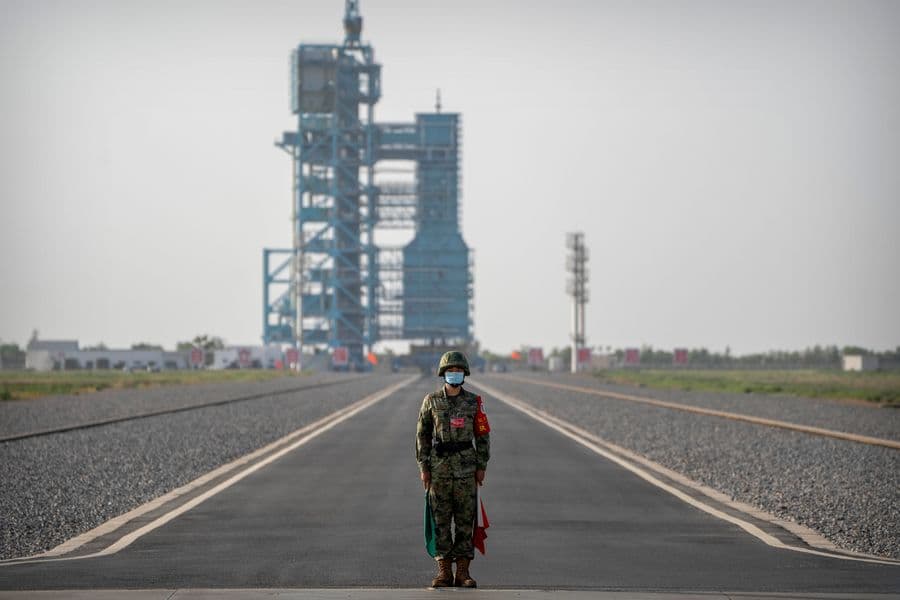
Today, the Long March remains an important propaganda theme and reference point for the Chinese Communist Party, used to exemplify great struggle. It is also happens to be the name of China’s expendable space launch rocket family – which China has relied on for hundreds of space launches for multiple missions for decades. In fact, it was a Long March 2F vehicle that carried the Shenzhou 16 spacecraft and its crew of three Chinese astronauts to the newly erected Tiangong space station just a few days ago on May 30th, 2023. The fact that China has assembled, launched, and established an operational space station – and put a crew of human beings on it – in about two years is a fairly notable accomplishment.
But the Shenzhou 16 mission isn’t the only recent indication of China’s ambitions in space. A day before the Shenzhou 16 launch, China announced their goal of putting a crew of Chinese astronauts on the Moon before 2030. According to new reporting in Space News quoting Lin Xiqiang, the deputy director for China’s Manned Space Agency, “Recently, the moon landing phase of China’s crewed lunar exploration program has started. The main goal is to send Chinese astronauts to land on the moon for the first time by 2030.” As an additional point, given the increasingly blurred lines of separation between civilian and military space in China, the U.S. Space Force should take note of these goals as well. No law is worth anything if there is no way to enforce it, and enforcement means presence.
Given that we’re halfway through 2023, China’s landing of a crewed mission on the Moon before 2030 means that such a mission could happen in only a few short years. Of course, none of this is guaranteed and these timelines may not stick – as they say, “Many a slip between the cup and the lip.” But if China’s relatively quick efforts to deploy an operational space station with relatively few problems, and successfully send a crew of astronauts to that station, are any indication of China’s drive, ambitions and capability, then a Chinese lunar goal may not be out of the question.
In looking at these efforts and accomplishments, one comes away with the clear and flashing notion that China means business – and they are dead-set on achieving their objectives in space for national pride, wider global influence, military capability and economic strength. Despite what other issues China may soon be forced to deal with – like demographic changes and economic health – it is unlikely that China will let up on advancing their space and defense efforts over the coming decade.
At the same time, these developments should also serve as an indicator of the pace and nature of competition in space – it is a dynamic that will require constant encouragement of innovation, a strategic rethinking about our access to key materials and critical supply chains, and firm commitment to shielding our domestic technological and defense industrial base from unfair competition – both domestic and foreign.
As the Congress moves past the debt ceiling episode and targets its focus on both the budget for the coming fiscal year and the National Defense Authorization Act, it will be these types of stunning developments that should drive the decisions and priorities of policymakers in DC. It can be tough to resist getting wrapped up in the day-to-day grind of politics and process and it is easy to lose sight of our strategic imperatives – but China’s long march in space should be clarion call for us to remain laser-focused on our own space and lunar interests over the horizon.
Grant Anderson, P.E. is the President & CEO of Paragon Space Development Corporation, a recognized leader in life support and thermal control in extreme environments. He holds a B.S. in Mechanical Engineering and an M.S. in Aeronautical & Astronautical Engineering from Stanford University.

Beyond Hormuz: What Washington Should Expect from a Frontline Ally
By Daewon Cho • RealClearDefense
Putin, Plague, and the America’s Biodefense Gap
By Ryan Kane • RealClearDefense
Patriot Delays Force a New Air Defense Doctrine on NATO’s Eastern Flank
By Jan K. Varga • RealClearDefense
How the Army Can Turn Plans into Combat Power
By Matt Russell • RealClearDefense
Is It Déjà vu All Over Again: The 2012 Report on Global Zero
By Peter Huessy • RealClearDefense

U.S. Marine Corps Attack Helicopters Set for Major Upgrade
By C. Jones, Defence Blog
How the Iran War Compounded the U.S. Navy’s Maintenance Crisis
By Hartung, NatInt
Fielding Forces for Full Mobilization
By Jon Hoffman, Proceedings
BAE’s New Launcher Lets Warships Deploy and Replenish Missiles at Sea
By NextGenD
Why Is the Navy Spending $19 Billion on ‘Flying Gas Stations’?
By Mark Thompson, RS