
Beyond Hormuz: What Washington Should Expect from a Frontline Ally
Last updated 05:45 AM EST • Read time: 5m
Join the Conversation
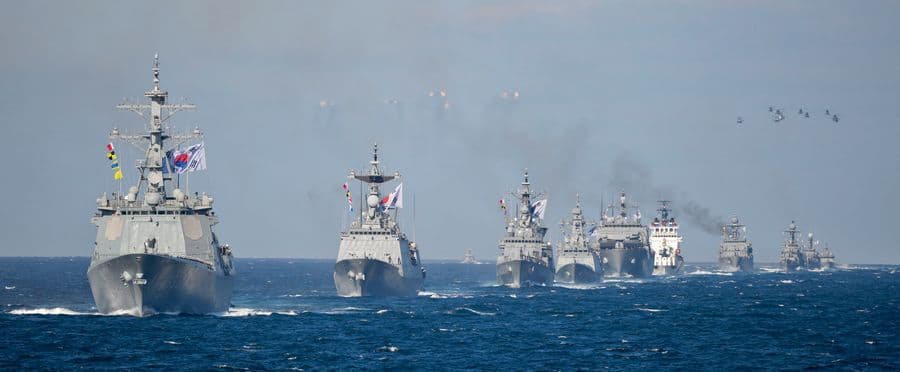
0The debate over whether South Korea should help secure the Strait of Hormuz is, at bottom, a debate about something larger: what should the United States expect from an ally whose most urgent security threat lies elsewhere?
South Korea has a clear interest in keeping international sea lanes open. As a major energy importer, it depends on the uninterrupted flow of oil and other essential goods. But it also faces a nuclear-armed North Korea across one of the world's most heavily militarized borders. Any decision to deploy military assets abroad must reckon with that reality.
The question is not whether South Korea should contribute to international security. It is what Seoul can contribute without compromising the defense responsibilities it cannot afford to neglect.
I come to this dilemma from personal experience. After graduating from the Korea Military Academy, I served as an Army officer, including service at a frontline guard post on the Demilitarized Zone. I later earned master's degrees in economics from Texas A&M University and in political science from New York University.
Those years taught me a simple lesson: a military commitment cannot be judged in isolation — not apart from the threat a country faces, the forces it actually has, or what happens at home when those forces are sent somewhere else.
Washington has legitimate reasons to ask Seoul to do more. The United States maintains security commitments across several regions, and its allies benefit from the international order that American power helps sustain. South Korea, in particular, has a direct economic stake in the security of the Persian Gulf. It cannot expect others to protect the sea lanes its prosperity depends on while refusing to consider what it can contribute in return.
But burden-sharing cannot be reduced to a tally of ships, aircraft, and troops sent to a particular crisis. That is where the discussion often goes wrong.
For South Korea, the opportunity cost of an overseas deployment is unusually high. Deploying a destroyer to the Persian Gulf ties up a naval asset, along with the personnel and logistical support needed to sustain it, that could otherwise serve other operational requirements. The same trade-offs apply to aircraft, surveillance assets, logistics, and personnel. Each commitment must be weighed against the requirements of deterrence and defense on the Korean Peninsula.
North Korea is not a hypothetical contingency. It is an immediate security challenge, armed with nuclear weapons and ballistic missiles and with conventional forces positioned close to South Korea's population centers. Seoul must therefore judge every overseas commitment against the possibility that a crisis at home could demand its full attention.
This does not justify a blanket refusal to take part in maritime security operations. Nor does it mean that every contribution must involve combat forces.
Depending on the circumstances, South Korea could consider maritime surveillance, intelligence-sharing, mine-countermeasure support, logistics, search and rescue, and coordination to protect commercial shipping. Some options would fit a given situation better than others. The aim should be to identify contributions that are operationally useful, match South Korea's capabilities, and avoid unacceptable gaps in its defenses at home.
A responsible ally should be able to explain what it can do, what it cannot do, and why. If Seoul invokes the North Korean threat every time Washington asks for help, a legitimate security concern becomes an all-purpose excuse for inaction.
Washington, for its part, must recognize that allies do not face identical circumstances. A contribution that is reasonable for a country with few immediate military threats may carry very different costs for a frontline state confronting a nuclear-armed adversary.
The United States should also avoid treating every disagreement over an overseas mission as a test of loyalty. An alliance is not strengthened when one partner equates solidarity with automatic compliance. It is strengthened when both sides can discuss competing obligations honestly and reach decisions that serve their shared interests.
South Korea cannot use its security challenges as a blanket exemption from contributing to the wider international order. Its economic success and its security have been closely tied to that order, and it has a responsibility to help sustain it. But Washington should not measure Seoul's contribution solely by whether South Korean warships show up in a particular theater.
South Korea's most consequential contribution to the alliance may often be the least visible one: maintaining a credible defense on the Korean Peninsula. A strong, ready South Korean military deters North Korean aggression, lowers the risk of a major regional conflict, and supports the broader U.S. strategic position in Northeast Asia. Weakening that deterrent for the sake of a symbolic deployment abroad could leave both allies worse off.
For Seoul, that means offering concrete ways to help rather than simply explaining why a deployment would be difficult. For Washington, it means assessing those proposals against South Korea's actual security needs, not measuring every ally against the same standard.
The Strait of Hormuz is one test of the alliance, but not the only one. South Korea must contribute to the international order on which its prosperity depends while maintaining the deterrence that protects its own security. The strongest alliance is not one in which every partner makes the same contribution, but one in which each makes a credible contribution that strengthens their shared security.
Daewon Cho is a former member of the Supreme Council of South Korea's Reform New Party, a graduate of the Korea Military Academy, and holds master's degrees in economics from Texas A&M University and political science from New York University. He is a political commentator and columnist.
Beyond Hormuz: What Washington Should Expect from a Frontline Ally
By Daewon Cho • RealClearDefense
Putin, Plague, and the America’s Biodefense Gap
By Ryan Kane • RealClearDefense
Patriot Delays Force a New Air Defense Doctrine on NATO’s Eastern Flank
By Jan K. Varga • RealClearDefense
How the Army Can Turn Plans into Combat Power
By Matt Russell • RealClearDefense
Is It Déjà vu All Over Again: The 2012 Report on Global Zero
By Peter Huessy • RealClearDefense
U.S. Marine Corps Attack Helicopters Set for Major Upgrade
By C. Jones, Defence Blog
How the Iran War Compounded the U.S. Navy’s Maintenance Crisis
By Hartung, NatInt
Fielding Forces for Full Mobilization
By Jon Hoffman, Proceedings
BAE’s New Launcher Lets Warships Deploy and Replenish Missiles at Sea
By NextGenD
Why Is the Navy Spending $19 Billion on ‘Flying Gas Stations’?
By Mark Thompson, RS