
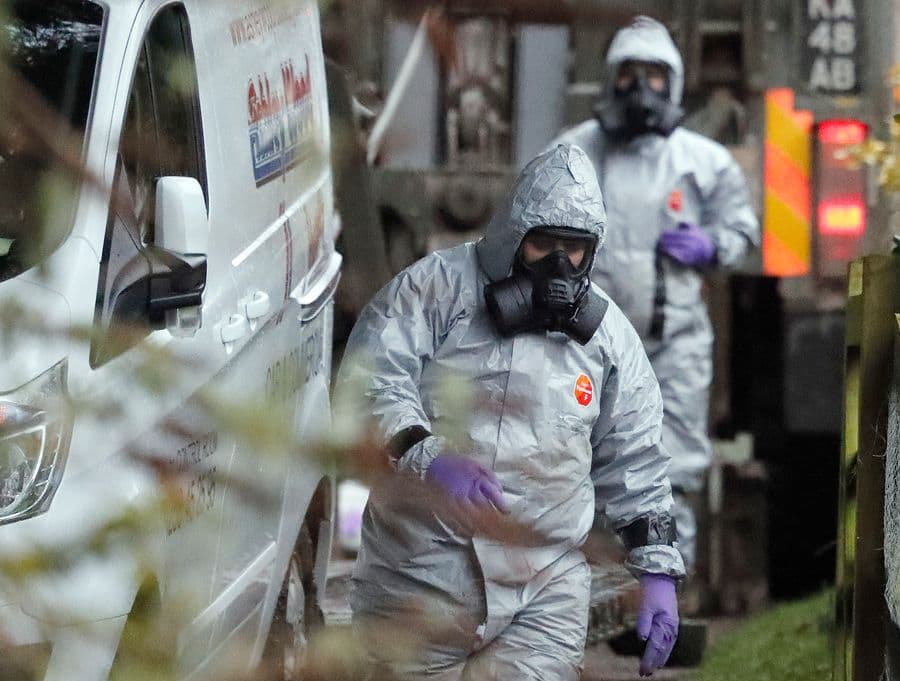
In this March 12, 2018 file photo personnel in protective gear work on a van in Winterslow, England, as investigations continue into the nerve-agent poisoning of Russian ex-spy Sergei Skripal and his daughter Yulia, in Salisbury, England. British officials said the attack on the Skripals received approval "at a senior level of the Russian state" and announced charges in absentia against two Russian agents. The disappearance of Saudi Journalist Jamal Khashoggi, during a visit to his country’s consulate in Istanbul on Oct. 2, 2018, raises a dark question for anyone who dares criticize governments or speak out against those in power: Will the world have their back? (AP Photo/Frank Augstein, File)
Putin, Plague, and the America’s Biodefense Gap
Last updated 05:45 AM EST • Read time: 6m
Join the Conversation
0Biological weapons are back in Russia. Congress must pay attention, correct America’s biological preparedness shortcomings, and act to stave off this threat to the nation.
This week’s plague outbreak, a disease that killed millions in centuries past, is not merely a historical curiosity nor a naturally occurring phenomena. Russia’s outbreak, originating at the Irkutsk Anti-Plague Institute of Siberia, stems almost entirely from their research into offensive biological weapons. This same Russian facility today also works to research and weaponize anthrax, brucellosis, cholera, and other deadly agents that pose material threats to the United States.
As expected, Russia’s cooperation thus far on the plague leaks has been minimal, as they continue to obfuscate the impacts of the outbreak. Russians are quite adept at obstruction of biological events: in 1979, aerosolized anthrax accidentally leaked from Sverdlovsk. While Russian reports claimed only 68 fatalities occurred, American and European reports believe there may have been well over 1,000 fatalities.
Since the 1979 anthrax release, Washington D.C. has watched as Russia continues to develop and utilize biological and chemical weapons. In 2018, Putin targeted former Russian double agent Sergei Skripal with Novichok nerve agents. Russia continues to enhance the development of Iran’s anthrax bioweapons program. Russia also served as the long-time enabler of Syria’s chemical weapons program. In 2024, Russia launched “major expansions” at secretive biological weapons facilities. In the very same year, Vladmir Putin used these biological weapons to poison Russian opposition leader Alexei Navalny.
After many Russian biothreats and attacks later, Washington D.C. still continues to watch and placate these efforts. Biological weapons do not respect boundaries nor politics, yet Congress after Congress, and administration after administration, continues to neglect America’s biological preparedness in the face of Russian, Iranian, Chinese, and North Korean threats.
Thankfully, there is a solution: these threats may be deterred and their consequences mitigated through meaningful investments in the U.S. Strategic National Stockpile (SNS).
Preparedness starts at the nation’s medical formulary, the SNS, which serves as an insurance policy for a biological attack. Contents of the SNS, such as anthrax, plague, and smallpox countermeasures, generally lack commercial markets and rely solely on government procurement for their sustainment. The day which these capabilities establish a commercial market becomes our nation’s worst-day scenario. While one may hope that Congress has acted responsibly and fully funded the SNS to meet its full requirements, it would surprise few that Congress has repeatedly failed on this front.
Year after year, Congress has fallen short, funding less than 50% of the annual budget needs of the SNS. Accusations of SNS mismanagement are seemingly routine. The previous administration even attempted to eliminate stockpiling of anthrax countermeasures, directing those funds instead to pandemic priorities outside the core bioterrorism authorization of the SNS. Despite the Trump Administration’s recent pledge to reverse the Biden anthrax preparedness cut in their recently released Multi-Year Budget, anthrax countermeasure stockpiles remain at a record-low in the SNS. Stockpile shortfalls across threat portfolios, such as plague, continue to persist. Meanwhile, the industrial base continues to contract and preparedness worsens. While a strong SNS remains a key deterrent to a biological attack by neutralizing the impact of a biothreat, a weak SNS only provokes a biological disaster.
Congress has also repeatedly failed to re-authorize critical biodefense legislation purpose-built to protect Americans: the Pandemic and All Hazards Preparedness Act (PAHPA). The most recent iteration of PAHPA included much-needed guardrails to protect the biodefense industrial base and enhance the procurement authorities of the SNS. Congress failure in 2024 to re-authorize PAHPA means that procurement challenges at the SNS continue to persist, while key provisions that would have resolved these challenges remain stalled.
To be clear: both the White House and Congress have made some progress in bolstering America’s biological defense. President Trump made two strong personnel choices in nominating Dr. Bob Kadlec, the nation’s most qualified individual on biodefense issues, to a key post at the Pentagon. President Trump also nominated Sean Kaufman, whose biodefense career included service at the CDC during the 2001 anthrax attacks, to serve as the Assistant Secretary for Preparedness and Response. From his U.S. Senate confirmation hearings, Mr. Kaufman appears very reasonable and competent in addressing these critical biosecurity challenges.
While Congress as a whole has broadly neglected our biological defenses, some in Congress continue to advocate for a stronger posture. This includes Reps. Don Davis and Jen Kiggans, who are leading the Protecting American Families and Servicemembers from Anthrax Act. Their bipartisan bill, which strengthens America’s anthrax defense following the Biden cuts, has support from 20 Members of Congress. Congress adopted a version of this bill, incorporated into the reports of the National Defense Authorization Act (NDAA) for both FY26 and FY27. Key Congressional appropriators – including Reps. Tom Cole, Rosa DeLauro, and Andy Harris – continue to advocate for enhanced SNS funding in a rare act of bipartisanship. Congress also included in its FY26 LHHS Appropriations report a directive to develop a plan to mitigate shortfalls of countermeasures in the SNS, for such threats including plague, anthrax, and smallpox. In the 2021 NDAA, Congress directed the U.S. Government to develop and advance plague countermeasures.
Unfortunately, many of these reports have yet to be fully implemented, with funding gaps serving as a key limitation.
While the nation’s biodefense shortfalls persist, biological weapons programs of our adversaries grow – and not by coincidence. Our adversaries watch Washington D.C. very closely and respond in-kind to vulnerabilities. Across bipartisan lines, key national security and public health continue to plead for biosecurity reforms, such as Amb. Robert O’Brien, who formerly served as President Trump’s National Security Advisor. Others, including former SNS Director Greg Burel, make the same pitch. Yet Congress continues to rest on their laurels, gambling with America’s health security and national defense.
To counter Russia’s biological threats, our leadership in Washington D.C. must act proactively. Congress must fully fund the SNS and re-authorize PAHPA, enhancing biological deterrence while shoring up preparedness and response capabilities. The administration must prioritize long-term engagement with the industrial base. The Department of Homeland Security should invest in the modernization and improvement of its Biowatch biosurveillance program, which has been criticized as one of the nation’s most-failed programs. We must further expand domestic production of medical countermeasures and ensure the long-term resilience of the supply chain.
Had Congress acted years ago and taken these steps to enhance preparedness, perhaps Russia’s plague outbreak may not have caused a five-alarm fire.
As the world continues to watch Russia’s plague outbreak unfold, recent reports indicate that Putin has directed his generals to abandon the rules of war against Ukraine, with some concerned that biological or nuclear weapons may be coming. Is plague, anthrax, or smallpox next?
It should not take Putin unleashing a bioweapon in Ukraine – or even here at home – to motivate Congress to act. The time to prepare for a biological war is before the first victim, not after the body count forces our hand.
Ryan Kane is the Chairman of the American Biodefense Action Coalition.

Beyond Hormuz: What Washington Should Expect from a Frontline Ally
By Daewon Cho • RealClearDefense
Putin, Plague, and the America’s Biodefense Gap
By Ryan Kane • RealClearDefense
Patriot Delays Force a New Air Defense Doctrine on NATO’s Eastern Flank
By Jan K. Varga • RealClearDefense
How the Army Can Turn Plans into Combat Power
By Matt Russell • RealClearDefense
Is It Déjà vu All Over Again: The 2012 Report on Global Zero
By Peter Huessy • RealClearDefense

U.S. Marine Corps Attack Helicopters Set for Major Upgrade
By C. Jones, Defence Blog
How the Iran War Compounded the U.S. Navy’s Maintenance Crisis
By Hartung, NatInt
Fielding Forces for Full Mobilization
By Jon Hoffman, Proceedings
BAE’s New Launcher Lets Warships Deploy and Replenish Missiles at Sea
By NextGenD
Why Is the Navy Spending $19 Billion on ‘Flying Gas Stations’?
By Mark Thompson, RS