
Cislunar Space Competition With China
Last updated 06:50 AM EDT • Read time: 7m
Cislunar Space Competition With China: Urgent Action Needed to Secure the Ultimate High Ground
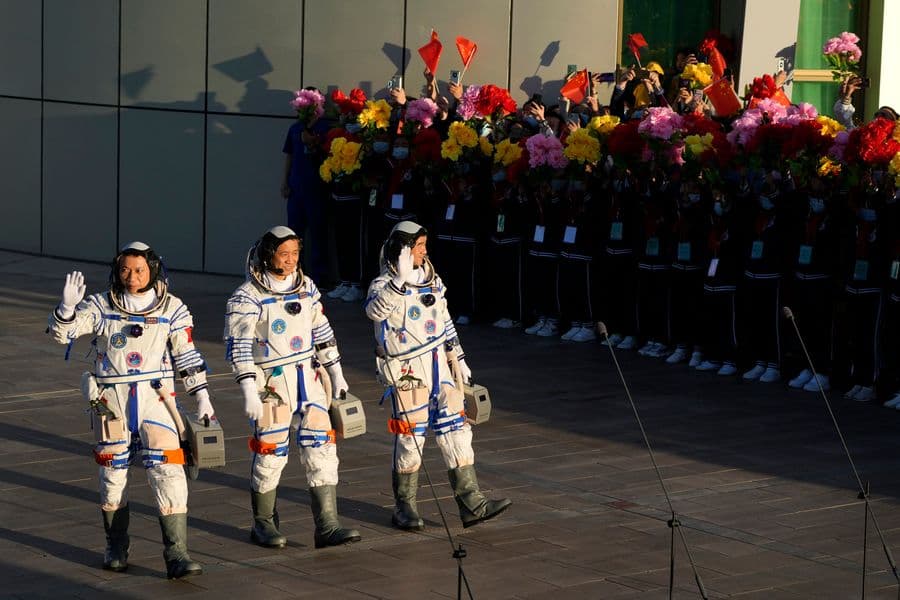
Like previous rivalries between nation-states throughout history, the U.S. and PRC are competing for political prestige, international influence, scientific knowledge, technological advancement, economic prosperity, and military power. The PRC sees itself in a new space race with America that it intends to win. The Sino-American rivalry to influence or control the physical and human geography of the world now extends from Earth to cislunar space – the line between the Earth and the Moon or the Moon’s orbit – and is a direct outgrowth of the Chinese Communist Party’s (CCP) aim to reestablish China as the world’s dominant power. China considers space a “critical domain in international strategic competition.”
China is conducting operations in cislunar space and has even more ambitious future space plans. Lagrange points, lunar transfer orbits, lunar orbits, and the Moon’s surface are “strategic key points” and “strategic thoroughfares” in cislunar space from which China could exert influence in or control over the Earth- Moon system.
China’s December 2020 Chang’e-5 mission to the near side of the moon returned samples of Helium-3. (Helium-3 is a non- radioactive isotope extremely valuable in medical devices, fusion reactors, and as a coolant for quantum computing.) On May 3, 2024, China landed Chang’e-6 in the South Pole-Aitken Basin on the far side of the Moon. These activities are intended to pave the way for future Chinese human presence on the Lunar surface and future missions to Mars. China’s cislunar space operations are a means to gain access to the natural resources on the Moon and eventually other celestial bodies in the solar system and are important precursors to developing a permanent Chinese base for manned and unmanned operations on the lunar surface. China is moving out expeditiously to put in place the infrastructure necessary for trips to and from the Lunar surface to support PRC operations in space. It is worth emphasizing that China’s space program is run by the People’s Liberation Army (PLA).
The stratagems the CCP employs with respect to its space ambitions are consistent with how it pursues terrestrial objectives. Besides blandishment, inducement, and deception, the CCP uses coercion to erode established norms, undermine the rules-based international order, seize territory, and change international boundaries. China’s efforts to exert influence or control over cislunar space will employ similar means and methods. This includes asserting claims of sovereignty, waging political, economic, and legal warfare, conducting grey zone operations, and developing advanced military and intelligence capabilities to coerce the U.S. and other nations to accede to the PRC’s claims.
While some may discount China’s cislunar space aspirations because the United States has already gone to the Moon, they are at risk of underestimating the impact. If the world perceives that the PRC is winning the competition with the United States over cislunar space, it would be a historic CCP accomplishment that diminishes America’s political and economic prestige, international standing, and global influence.
The PRC likely will set precedents through cislunar space operations to establish a new, advantageous basis for customary international law. Indeed, China will likely employ political and legal warfare (“lawfare”) tactics to justify multiple vectors of coercion, including the threat or use of armed force, to establish autocratic norms of behavior, undercut and change existing rules, claim territory, and in effect create its desired boundaries on Earth and in cislunar space. The CCP’s pursuit of a dominant position in cislunar space would strengthen the economic element of its national power and weaken the United States and its allies. The PRC may establish an Exclusive Economic Zone (EEZ) in cislunar space, declare a Space Defense Identification Zone (SDIZ) and “keep out” zones to protect it, conduct in-situ resource utilization to support operations on the lunar surface, and extract valuable resources such as rare Earth materials and water on the Moon to increase its international competitiveness, wealth, and military power. Indeed, the CCP could move to monopolize the market for rare minerals on the Moon as well as the use of lunar water as an energy source. If PLA forces were in a commanding position atop the Earth- Moon system’s gravity wells, this could enhance their ability to deny the U.S. freedom of action to use space systems as a force multiplier to enhance the combat effectiveness of its operational forces in other domains.
The U.S. Government has yet to identify cislunar space as a vital national interest, take the steps necessary to protect and promote America’s interests in cislunar space, and counter China’s strategy for dominating cislunar space. Hence, urgent action is needed to ensure the U.S. can compete effectively in the cislunar competition and secure the ultimate high ground.
To advance U.S. political, economic, technological and security interests in cislunar space, the next President should:
- Declare that advancing U.S. interests in cislunar space is a top national priority and direct the National Space Council to prepare an integrated National Strategy and Action Plan for cislunar Space that affirms U.S. vital interests and outlines the steps that relevant Federal departments and agencies must take to better position the U.S. to compete with China in cislunar space, including by promoting and enabling U.S. commercial cislunar space activities.
- Direct development of an integrated Government-wide strategy to better position the U.S. for the increasing competition between the U.S. and China in cislunar space. This includes, among other things, efforts to improve
U.S. space domain awareness in cislunar space and to facilitate U.S. commercial sector leadership in space launch, exploration, and mining operations.**
- Direct the Director of the Office of Management and Budget to provide significant additional funding, beginning in Fiscal Year 2025, to relevant departments and agencies for cislunar space programs and activities.
- Direct relevant departments and agencies to reduce or eliminate regulatory and other barriers to U.S. commercial activities in cislunar space and to promulgate measures that incentivize and bolster U.S. competitiveness in cislunar space.
- Direct the Secretary of Defense (SecDef) to develop plans and programs to protect and defend U.S. interests in cislunar space. Also, direct the SecDef, in collaboration with other relevant department and agency heads, to rapidly develop and deploy a cislunar Space Domain Awareness capability that effectively leverages U.S. commercial SDA offerings.
- Direct the Director of National Intelligence to make China’s plans for and activities in cislunar space a top priority for intelligence collection and analysis and to increase production of classified and unclassified analytic products on this topic.
- Direct the Secretary of State to enhance and expand U.S. diplomatic efforts aimed at advancing U.S. interests in cislunar space and countering China’s use of lawfare and other tools that undermine U.S. interests and international principles and norms.
- Direct the Administrator of NASA to expand and accelerate efforts associated with the Artemis Accords.
- Work with the bipartisan leadership in Congress to pass legislation to promote U.S. commercial competitiveness in cislunar space.
The outcome of the U.S.-China competition in cislunar space will have profound implications for U.S. political, economic, technological, and security interests. A bold vision together with sustained leadership is needed to protect and advance U.S. national interests in this increasingly important region of space.
James Frelk serves as Vice Chair of the Moorman Center for Space Studies, the independent think tank within the National Security Space Association. Chris Williams serves as Chair of the Moorman Center.
This report is a part of the “Presidential Transition Issue Paper Series”. For more information on this Series and other NSSA Moorman Center activities, please visit us at www.nssaspace.org.
* This paper draws upon Marc Berkowitz and Chris Williams, “Strategic Implications of China’s Cislunar Space Activities”, https://nssaspace.org/wp-content/uploads/2023/08/Strategic-Implications-of-Chinas-Cislunar-Space-Activities-8.21-final. pdf
** See “Strategic Implications of China’s Cislunar Space Activities”
https://nssaspace.org/wp-content/uploads/2023/08/Strategic-Implications-of-Chinas-Cislunar-Space-Activities-8.21-final. pdf
This report is a part of the “Presidential Transition Issue Paper Series”. For more information on this Series and other NSSA Moorman Center activities, please visit us at www.nssaspace.org.

The Services Do Not Need a Four-Star Autonomous Warfare Command
By Steven Wills • RealClearDefense
Honor Them While There Is Still Time
By Jeffrey Rosales • RealClearDefense
From Siberia to Fairford: How Operation Spider’s Web Has Changed the Rules of Airpower
By Frank A. Rose • RealClearDefense
Faster Simulations, Better Defense Decisions
By Rut Lineswala • RealClearDefense
Will HASC Have an Oversight Subcommittee in the Next Congress?
By Christopher J. Bright • RealClearDefense

Hegseth Barred Trans Troops. Military Boards Are Rejecting Those Orders.
By NYT
Closing the Sea: Lessons from Ancient Mediterranean Blockades
By DeCasien, CIMSECFrom Siberia to Fairford: How Operation Spider’s Web Has Changed the Rules of Airpower
By Frank A. Rose • RealClearDefenseFaster Simulations, Better Defense Decisions
By Rut Lineswala • RealClearDefense
Bombers Could Have a Major Air-to-Air Combat Role
By Joseph Trevithick, The WarZone