
Trust the Signal, Doubt the Position
Published Aug. 20, 2026 • Read time: 5m
Join the Conversation
0The Pentagon Can Authenticate the Signal and Still Trust the Wrong Position
Recent investments in assured positioning, navigation, and timing are pushing resilient navigation forward. The next procurement requirement should govern what weapons and autonomous systems do when a trusted receiver can no longer justify confidence in its own solution.
The Pentagon is spending real money on the problem of knowing where forces and weapons are when an adversary is trying to make that answer unreliable. On July 14, its latest APFIT awards included $43 million for an Assured Position, Navigation, and Timing device at scale and $11.24 million for advanced navigation for unmanned aircraft and launched effects. Three days later, the Air Force and Space Force moved ahead with next-generation Maritime and Aviation Receiver Card agreements intended to give weapons-system integrators more resilient PNT in contested environments.
Those investments are aimed at the right battlefield problem. The next question belongs in the requirements documents: when a receiver is genuine and the signal source can be authenticated, what exactly must the platform do when the navigation solution itself becomes doubtful?
That distinction matters because authentication establishes provenance. Navigation integrity governs whether the position, velocity, or timing solution in use right now remains fit for action. A system can succeed at the first task while confidence in the second is already degrading.
A useful civil-navigation example is Galileo. Its Open Service Navigation Message Authentication (OSNMA) service reached its first operational anniversary in July. OSNMA lets a receiver verify that navigation information came from Galileo and was not altered in transit. The service is an important advance, and its own roadmap points toward further protection, including future ranging-signal authentication. At the same time, Europe continues to confront increasingly serious GNSS interference. The European Union Aviation Safety Agency updated its GNSS interference bulletin on July 3 after reviewing recent jamming and spoofing events.
The lesson for defense acquisition is straightforward. Verification happens at moments. Navigation happens continuously. Between cryptographic checks, a receiver keeps computing. Autopilots keep flying. Timing systems keep synchronizing. Weapons and autonomous platforms keep consuming outputs. A successful authentication event cannot reach backward and undo an operational decision made during an interval when the solution had already become unreliable.
That is where a procurement checkbox becomes too small for the assurance problem. A specification that says only “supports authentication” describes a capability. It says very little about behavior under pressure.
A serious requirement should answer harder questions. How old is the last successful authentication? What independent evidence is checking the current solution in the meantime? Does the downstream mission system receive an explicit integrity state and uncertainty estimate, or only a position that looks as confident as it did ten minutes earlier? What happens when the evidence supporting that solution falls below a defined threshold?
Three changes would make assured PNT requirements more operationally useful.
First, require a continuous integrity state that travels with the navigation output. Downstream systems need more than an authenticated or unauthenticated flag. They need the age and status of the last successful verification, the current integrity assessment, an expression of uncertainty, and a reason code when confidence has been downgraded. That information has to propagate all the way to whatever is making the decision.
Second, specify the behavior required when confidence runs out. Depending on the mission, a platform may shift to an alternate source, enter a declared degraded mode, constrain autonomous action, request operator confirmation, or abstain from providing a solution for a class of decisions. The critical point is that downstream software cannot quietly preserve the last good value or substitute a nominal default and continue acting as though nothing changed.
Third, test the interval rather than only the authentication event. Acceptance testing should measure how quickly a degraded solution is recognized, how the system behaves during false alarms, whether declared degraded modes actually engage, and whether consuming systems honor an invalid or uncertain navigation state. That is closer to the battlefield question than a demonstration that a receiver can successfully validate cryptographic material under nominal conditions.
The Pentagon is already moving toward more resilient military GPS equipment. The Air Force Life Cycle Management Center recently centralized responsibility for major military GPS user-equipment modernization efforts, while the MAVRC work is explicitly intended for contested PNT environments. That creates an opportunity to define resilience end to end, from signal provenance through the behavior of the weapon, aircraft, ship, or autonomous system consuming the solution.
Someone also has to own that end-to-end requirement. Constellation operators, receiver manufacturers, platform integrators, software teams, program offices, and mission owners each hold one piece of the assurance chain. A requirement that belongs to everyone in general belongs to no one in practice.
Cryptographic authentication deserves its place in modern navigation. Its value increases when procurement language is equally precise about what authentication can establish and what the rest of the architecture still has to determine. The next generation of assured PNT should tell a commander more than whether the signal came from a trusted source. It should tell the system when the answer built from that signal has stopped earning trust.
Burak Oktenli is an independent researcher based in Washington, D.C. He holds a bachelor's degree in computer science and engineering from the University of South Florida and an MBA and is completing a Master of Professional Studies in Applied Intelligence at Georgetown University. His research focuses on authority, autonomy, assurance, and dependency in AI-enabled systems.
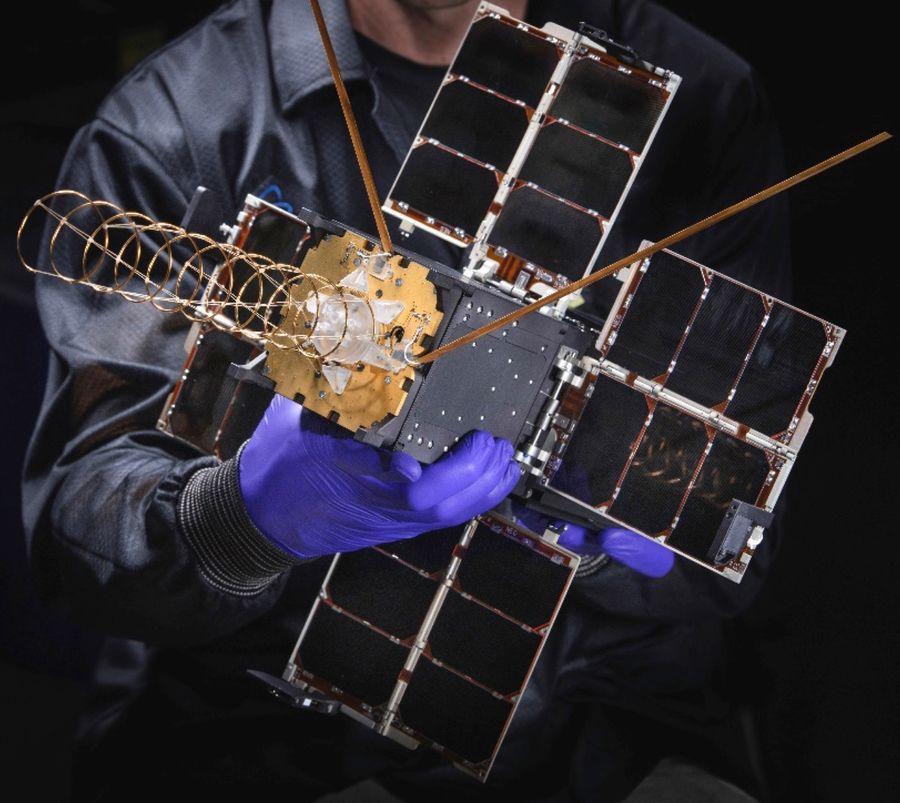
image: Gunsmoke-J, a U.S. Army Space and Missile Defense Command and Assured Position Navigation and Timing/Space Cross Functional Team joint capability technology demonstration satellite, launches into orbit, March 22. Gunsmoke-J’s experiments will show how its sensors can provide critical data and information key in multi-domain operations. (U.S. Army photo)

Operation Epic Fury and the Illusion of Victory
By Stephen D. Cook • RealClearDefense
Previewing The Shenzen Summit: A Critical View
By Stephen Blank • RealClearDefense
How to Win Without Military Victory
By Kevin Eyer • RealClearDefense
We Keep Funding ‘Shared Infrastructure.’ Nobody Has Defined It.
By Frederick Gale • RealClearDefense
Congress Must Reauthorize Section 702 of the Foreign Intelligence Surveillance Act
By Bryce G. Poole • RealClearDefense

Five Takeaways From Navy Nominee’s Rocky Hearing
By Seligman & Weisgerber, WSJ
U.S. Air Force Taps Anduril for Containerized Launcher
By Global Defense News
Time To Say Goodbye to the NMESIS and NSM
By Marine Corps Compass Points
HII and U.S. Navy Break Ground on Shipyard Complex
By George Allison, UKDJ
Rare U.S. Air Force Spy Plane Spotted Over the Black Sea
By D. Malyasov, Defence Blog