
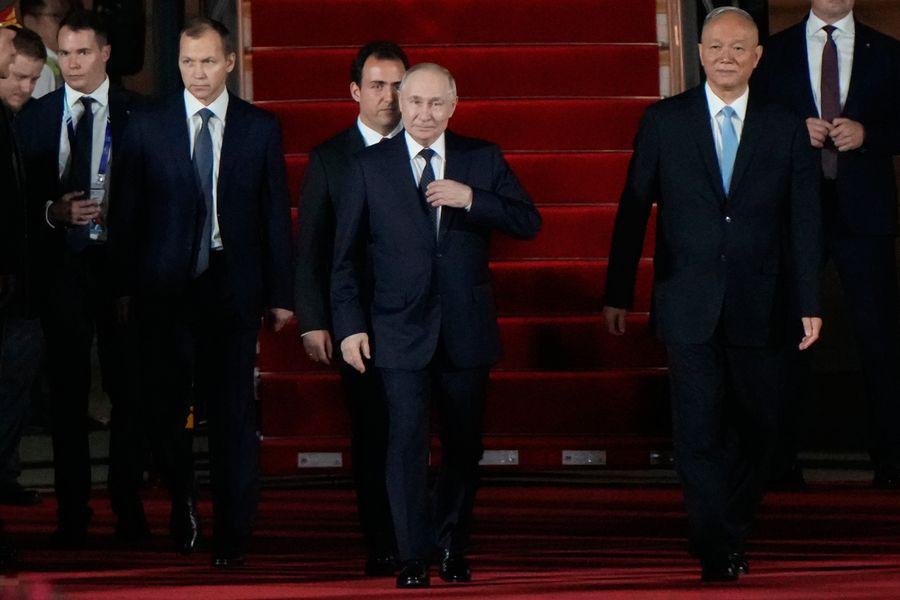
Russian President Vladimir Putin arrives at Shenzhen Baoan International Airport ahead of the Asia-Pacific Economic Cooperation (APEC) China 2026 summit in Shenzhen, southern China's Guangdong province, Wednesday, Nov. 18, 2026. (AP Photo/Anupam Nath, Pool)
Previewing The Shenzen Summit: A Critical View
Published Nov. 18, 2026 • Read time: 5m

Join the Conversation
0The Shenzen summit comprising the U.S., China, and Russia will meet on the sidelines of the annual APEC (Asia-Pacific Economic Community) conference on November 19-20. Normally a successful summit requires intense and prolonged diplomatic preparation, a procedure opposed to President Trump’s practice which dispenses with those requirements and is driven as much by his vanity, transactional approach, and emphasis on style over substance. Past summits therefore suggest that we should not expect too much from Shenzen.
Trump’s 2025 Anchorage summit with Vladimir Putin, despite its hoopla, led nowhere and even disbanded without a communique. Typically, Russian spokesmen subsequently repeatedly invoked “the spirit of Anchorage” that allegedly involved relief from sanctions and a settlement of Russia’s aggression against Ukraine over Kyiv’s head. Likewise, Trump’s summits with Xi Jinping were full of pomp but only enabled China to present itself as America’s equal. This gratified Beijing given its visible anxieties over its status as a great power, but gave Washington nothing. Meanwhile, China has resumed its encroachments on Taiwan, the Philippines, and Japan without noticeable American pushback. For example, Trump is still withholding military aid to Taiwan.
More recently a widespread apprehension has engulfed Europe that Trump will sell out vital Ukrainian and European interests at Shenzen and the Abu Dhabi “technical talks” with Russia and Ukraine that took place on November 11-12. Before those talks European governments and the EU insisted on their presence there despite Russia’s objections to a European presence there. Yet Moscow prevailed and Europe was marginalized. Also, before those talks Trump announced that Ukraine’s borders would be revised as Russia demands and his emissary Jared Kushner outlined several principles of a pan-European solution employing Russian terminology and demanding security guarantees against fictitious NATO threats. Acceding to these demands gives Russia a veto power over Europe’s security future and NATO, vitiating eighty years of NATO policy. Yet the Administration supports this move. Furthermore, on October 9 Trump decreed a break in sanctions allowing Russia to sell diesel fuel abroad. i.e., one day after Secretary of State Rubio said a negotiated peace was unattainable, Trump blindsided him and his negotiators making unilateral concessions to Putin to avoid being blamed for an impending electoral defeat. Trump’s envoys then reportedly told the Ukrainians that this deal was supposed to soften Putin up since he refused to negotiate. Therefore, he had to be shown the potential benefits of negotiating! Predictably European negotiators derided this ignorant excuse and example of a broken policy process.
According to Trump’s deal Russia would supposedly immediately supply three million tons of diesel fuel, 500,000 tons in November and a million tons “immediately thereafter” and release a further three million tons “within a short time” depending on its refineries’ condition. Predictably Russia failed to meet those terms. Moreover, the vagueness of the terms which also may violate federal statutes furnished another example of the amateurishness of Trump’s foreign policies.
Neither does Trump’s incompetent diplomacy and strategic malpractice vis-à-vis Russia end here. He has invited Russia to the G-20 meetings at his hotel resort in Miami in December 2026. Trump then reacted to Zelensky’s critique of his executive order on sanctions by throwing more tantrums against him. And then Trump invited Putin and Xi Jinping to a summit on the side of the upcoming APEC meeting in China. As part of this process and in direct contravention of U.S. and European legislation, U.S. negotiators have discussed major business deals with. Russia to include gas sales to Europe, joint ventures with U.S. oil majors, reopening Russian airspace for overflights and travel for U.S. airlines, and joint ventures to produce titanium. Evidently they also discussed lifting sanctions upon Russia’s Direct Investment Fund that is a vehicle for projecting Russia’s global influence.
Consequently, it is no surprise that the same anxiety displayed before the Abu Dhabi meeting appeared in conjunction with the Shenzen summit. Indeed, there are good reasons for these apprehensions that this summit will be a second Yalta or Munich where Europe and/or Asia’s future will be decided in their absence. There is, as of this writing, no agenda for this summit and likewise no sign of the preparation required for a summit to lead to productive and mutually beneficial outcomes. Thus there already are clashes about the format of this summit. While there is some talk of this summit being about arms control; success in this field requires extensive preparation and negotiations by subordinates and experts leading to a substantive treaty and vigorous enforcement by mutual verification and inspection. China has hitherto refused to discuss arms control while Russia has broken almost every arms control treaty it has signed so one summit will hardly generate meaningful progress here.
Finally, while Europe and Ukraine’s refusal to surrender to aggression places a brake upon this latest example of the Administration’s strategic malpractice; another factor must be taken into account. Russia’s expanding economic dependence on China, without which it could not prosecute this war, is according to many analysts, leeching away its sovereignty. China clearly wants the war to continue for otherwise Washington, and the West’s full attention would focus on it as Foreign Minister Wang Yi candidly told European officials. Thus, Russia’s great power standing increasingly depends on Chinese sufferance so it will not diverge from China. Therefore, a three-way summit will likely be two against an unprepared one who does not fully grasp the issues at stake.
This is no way to run a railroad let alone world politics. So once more, Trump, mainly due to his own shortcomings, will still likely be denied a Nobel peace prize. Unfortunately, since he will not accept responsibility for holding the power and bearing the responsibility once again, our allies will be blamed for his failure and pay the price of it.
Stephen Blank is a senior fellow at Foreign Policy Research Institute (FPRI).
Operation Epic Fury and the Illusion of Victory
By Stephen D. Cook • RealClearDefense
Previewing The Shenzen Summit: A Critical View
By Stephen Blank • RealClearDefense
How to Win Without Military Victory
By Kevin Eyer • RealClearDefense
We Keep Funding ‘Shared Infrastructure.’ Nobody Has Defined It.
By Frederick Gale • RealClearDefense
Congress Must Reauthorize Section 702 of the Foreign Intelligence Surveillance Act
By Bryce G. Poole • RealClearDefense
Five Takeaways From Navy Nominee’s Rocky Hearing
By Seligman & Weisgerber, WSJ
U.S. Air Force Taps Anduril for Containerized Launcher
By Global Defense News
Time To Say Goodbye to the NMESIS and NSM
By Marine Corps Compass Points
HII and U.S. Navy Break Ground on Shipyard Complex
By George Allison, UKDJ
Rare U.S. Air Force Spy Plane Spotted Over the Black Sea
By D. Malyasov, Defence Blog